
How to Aerate a Pond Without Electricity
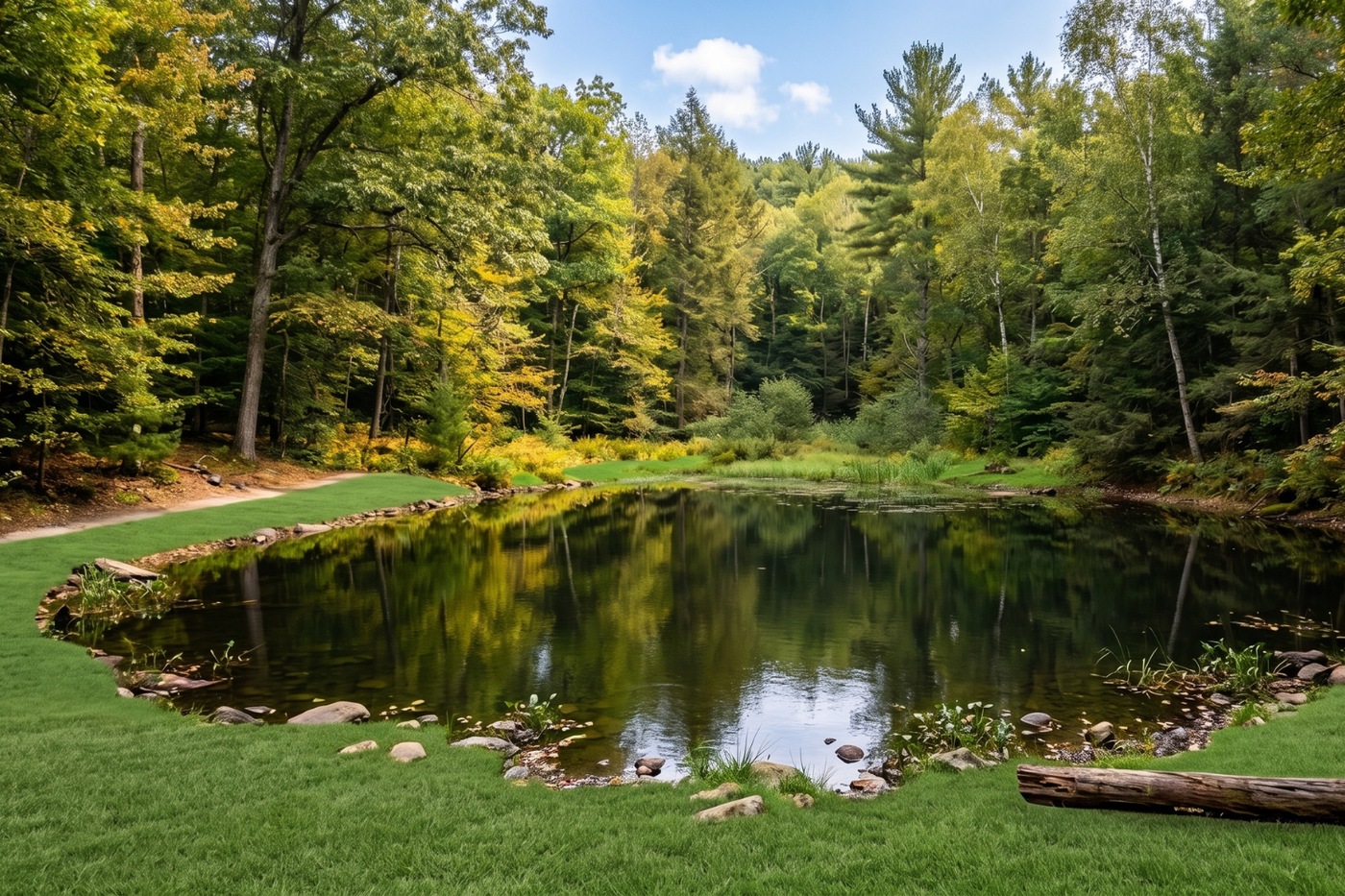

If your pond sits too far from a power line to plug anything in, you still have real aeration options – windmill systems, solar systems, and the pond’s own natural processes each have a role to play. Understanding how to aerate a pond naturally starts with separating natural oxygen production from off-grid mechanical aeration that runs on wind or sunlight. Plants add oxygen through daylight photosynthesis, while flowing or agitated water increases gas exchange where the surface meets the air.
Manual agitation provides limited surface movement for small ponds or immediate emergencies, rather than dependable circulation throughout a large water body. Windmill systems mechanically compress air, while solar systems use electricity produced by photovoltaic panels to power a connected compressor.
Solar fountains create surface agitation, although their output changes with available sunlight unless battery storage supports extended operation. Your pond’s depth, shape, and oxygen demand determine whether passive movement, surface agitation, or bottom diffusion fits the site – and getting that match right is the difference between a pond that stays healthy through summer and one where fish struggle on hot, still nights.
Why Off-Grid Aeration Matters
Off-grid pond aeration provides another operating option when utility electricity can’t reach the pond without extensive trenching, wiring, or service extensions. Grid outages can also interrupt circulation when the system depends entirely on an electrical supply located beyond the pond site. Windmill and solar systems avoid that grid connection, although their operation remains dependent on available wind, sunlight, or stored battery capacity.
Warm weather can increase aeration requirements because warm water holds less dissolved oxygen, while biological activity can increase oxygen demand. Deeper pond layers may also receive limited sunlight, allowing dissolved oxygen concentrations to decline below the illuminated surface water—which is why fish in deeper ponds often crowd the surface on hot summer mornings, even when the top of the pond looks fine.
Before you choose a system

Selecting suitable off-grid equipment requires site measurements and operating information that account for seasonal conditions rather than one favorable observation period.
- Pond dimensions: Record the surface area and maximum depth required for compressor, diffuser, and circulation calculations.
- Fish requirements: Determine whether fish are present and whether overnight respiration is needed for extended operation.
- Solar exposure: Confirm whether the proposed panel location receives dependable sunlight across different seasons and weather conditions.
- Wind exposure: Verify that the site typically receives at least 6–8 hours of usable wind each day.
- Calm periods: Identify recurring overnight and summer periods when limited wind could interrupt compressor operation.
- Pond shape: Identify narrow arms, coves, or separated basins that may interrupt circulation between pond areas.
- Airline distance: Measure the complete route between the compressor and every proposed diffuser location.
Natural Water Movement and Aquatic Plants
Natural pond processes can contribute oxygen or water movement, although their output changes with sunlight, inflow, and surrounding environmental conditions. Aquatic plants add oxygen during daylight photosynthesis, while streams and cascades create turbulence that supports gas exchange where moving water contacts the atmosphere. Manual agitation serves a narrower purpose because repeated physical effort cannot provide dependable full-depth circulation throughout a managed pond.
Aquatic plant oxygen cycles
Aquatic plants and algae add oxygen to the surrounding water when sufficient daylight supports photosynthesis within the illuminated portion of the pond. Those organisms continue respiring after sunset, which consumes dissolved oxygen when photosynthetic oxygen production has stopped for the night. Submerged plants normally produce more oxygen than they consume during daylight, while nighttime respiration reverses that contribution.
Plant growth can’t maintain a controlled operating schedule or lift low-oxygen bottom water toward the air-water interface. Turbidity can further reduce oxygen production by limiting the amount of sunlight reaching plants below the upper water layer.
Gravity-fed streams and cascades
Gravity-fed streams and cascades expose moving water to the atmosphere before creating turbulence where the flow enters the receiving pond. Continuous inflow can support localized oxygenation as long as enough water passes through a meaningful elevation change during the required operating period.
Seasonal inflow provides support only while the source continues supplying water through the feature. A shallow drop with limited flow may improve oxygenation only near the inflow while leaving distant coves and deeper water largely unmixed.
Manual agitation for temporary support
Manual agitation can disturb the surface of a small pond when an immediate oxygen concern requires temporary action before suitable equipment becomes available. Water should be lifted from near the surface and returned through a spray or splash without disturbing low-oxygen bottom water. Buckets and paddles provide limited benefit because repeated manual movement can’t circulate the complete water column throughout a large pond.
A homemade pond aerator without electricity shouldn’t be assumed to provide reliable pond-wide circulation—before depending on one, verify its airflow, operating pressure, and runtime, and confirm the dissolved-oxygen response under actual pond conditions.
Windmill Diffused Aeration
Windmill-diffused aeration converts blade rotation into mechanical compressor movement that sends air through tubing to one or more submerged diffusers. Rising bubbles carry surrounding water upward toward the surface, where circulated water contacts the atmosphere and releases accumulated gases.
A practical windmill site should receive roughly 6–8 hours of usable wind daily across the operating season, because calm stretches mean no air delivery—and a stocked pond can’t pause its oxygen demand while it waits for the blades to turn.
Available airflow changes with blade speed, making seasonal wind patterns and extended calm periods part of the site assessment. Windmills also contain moving mechanical components that require periodic inspection and maintenance according to the manufacturer’s service instructions.
Several connected conditions determine whether a windmill can deliver suitable airflow at the selected diffuser locations:
- Daily wind duration: Confirm approximately 6–8 hours of usable wind during typical operating conditions.
- Seasonal wind: Compare summer, winter, and overnight conditions instead of relying on one daytime observation.
- Air delivery: Changing blade speed produces changing compressor output rather than a constant airflow rate.
- Diffuser pressure: The compressor must overcome water pressure at the installed depth before air reaches the membrane.
- Airline resistance: Longer routes, undersized tubing, and restrictive fittings can reduce the pressure available at each diffuser.
- Mechanical maintenance: Inspect blades, linkages, bearings, and compressor components at the manufacturer’s recommended intervals.
- System construction: A homemade windmill pond aerator requires verified output, secure tower engineering, and pressure-rated connections.
A second tower can increase total airflow or circulation coverage when each compressor can independently overcome its connected system pressure. That being said, adding a tower doesn’t correct an individual compressor’s inability to overcome diffuser depth and airline friction—each unit must be sized for its own route.
Solar Diffused Aeration
Solar-diffused aeration uses electricity generated by photovoltaic panels to operate a compressor connected to one or more submerged diffusers. Each rising bubble plume lifts surrounding water through the water column, supporting bottom-up circulation from the selected diffuser depth. Available sunlight, panel capacity, and compressor performance determine whether the system can maintain the airflow required by the pond.
Diffuser depth increases backpressure, so the selected compressor must deliver its required airflow at the actual installation depth—a compressor that meets its rating at the surface can fall short at the diffuser, leaving the deepest water under-circulated. Panel wattage alone can’t show whether the complete system will provide suitable pressure, runtime, or circulation coverage.
Direct-drive and battery-backed configurations differ in their operating schedules, weather response, and ongoing service requirements:
| Operating factor | Direct-drive system | Battery-backup system |
|---|---|---|
| Energy path | Panels power the compressor directly | Panels charge batteries that support compressor operation |
| Operating period | Adequate daylight and solar input | Available sunlight plus stored battery capacity |
| Weather response | Output may decline during clouds or shade | Stored energy may support operation during reduced sunlight |
| Added equipment | Panels, controls, and compressor | Panels, controls, batteries, and compressor |
| Service planning | Panel and compressor maintenance | Panel, compressor, and battery maintenance |
Direct-drive systems
Direct-drive systems operate when their panels receive enough sunlight to supply the compressor within its specified electrical and pressure requirements. Their output may slow or stop during heavy cloud cover, recurring site shading, or periods without productive daylight.
Daytime solar pond aeration systems operate without battery storage and therefore follow the available solar window. Manufacturer performance data should confirm airflow at the required pressure because electrical ratings alone don’t establish output at diffuser depth.
Battery-backup systems
Battery-backup systems store solar energy during productive daylight hours and use that reserve when panel output no longer supports direct compressor operation. For stocked ponds or any water body with real oxygen demand, battery backup is the safer choice: dissolved oxygen falls to its lowest point in the pre-dawn hours, exactly when a direct-drive system has been idle the longest, so stored energy is what keeps oxygen moving through the night.
The battery bank must receive enough daytime energy to replace the charge consumed during extended operation. Panel orientation, seasonal sunlight, and cloud cover affect available charging energy, while batteries require scheduled inspection and eventual replacement. Pond Haven’s solar pond aerators include both direct-drive and battery-backup configurations, sized by acreage and depth.
Decorative Solar Fountains for Shallow Ponds

Solar fountains lift water above the pond surface and return it through spray, increasing localized air-water contact within the display area. A solar fountain is primarily a water feature: it aerates only the top few feet of water around its display, so treat the visual effect as the main benefit and the oxygen contribution as a bonus. Direct-drive models change speed or stop when available sunlight falls below their operating threshold, while battery storage can support a longer schedule.
A solar fountain for pond aeration should be evaluated according to the depth and surface area reached by its returning spray—the best floating solar pond fountain is the model whose operating depth, sunlight requirements, and circulation coverage match the site, not the one with the tallest display. Compare solar pond fountains by operating depth and coverage before deciding.
Several operating factors determine whether the selected fountain can move water through the area requiring additional surface agitation:
- Shallow water: A solar fountain for a pond can agitate a useful area when returning spray covers the intended zone.
- Deep water: Lower layers may remain unmixed because a surface fountain can’t reproduce the bottom-up circulation of a submerged diffuser placed near the pond’s deepest practical point.
- Irregular layouts: Narrow coves or separated basins may receive little movement beyond the immediate display area.
- Operating schedule: Direct-drive units may slow or stop during cloud cover and after available daylight ends.
- Display selection: Spray height affects appearance, while flow rate and coverage determine the area receiving agitation.
Solar Aerating Fountains
Not every solar fountain is a display piece. A solar aerating fountain is built the other way around: it runs a propeller rather than an impeller-and-nozzle assembly, moving a high volume of water at low height so that oxygen transfer is the primary job and the spray is simply the visible result of it.
A decorative solar fountain pushes a smaller flow through a nozzle for pattern and height. An aerating fountain throws a wide sheet of water into the air, and that air-water contact is what loads oxygen into the pond—so the flow rate matters far more than how tall the display is.
The Scott Aerator DA-20 Solar Pond Aerator Fountain shows how that plays out. The 1/2 horsepower (HP) model moves 200 gallons per minute (GPM) on two solar panels, while the 3/4 HP model moves 300 GPM on four panels. Those flow figures are the aeration spec: at 300 GPM, the pond's upper layer cycles through the air many more times each hour, which is what holds dissolved oxygen up through a hot, still afternoon.
The trade-off is a spray that sits low and wide: 4–5 feet high and up to 20 feet across, rather than tall, with no menu of decorative patterns to choose from. Minimum operating depth is 36 inches for the 1/2 HP unit and 44 inches for the 3/4 HP unit, which is why these fit the shallow ponds where a bottom diffuser has little depth to work with. Pond Haven's solar aerating fountains run from 1/2 HP up to 1 HP.
The DA-20 Solar is a direct-drive unit: its controller throttles flow as sunlight changes, and the fountain stops once the panels go dark, so check whether any model you're considering offers battery backup before relying on it overnight.
Choosing between a decorative solar fountain, a solar aerating fountain, and a solar diffused system comes down to four questions:
- Depth: Under roughly 6 feet, a solar aerating fountain can influence most of the water column; beyond 6–8 feet, only a diffuser on the bottom lifts water from the deepest layer.
- Priority: If the display is the point, a decorative solar fountain wins on pattern choice; if oxygen is the point, the aerating fountain's higher flow does the real work.
- Sizing: Follow the fountain baseline of roughly 1 HP per surface acre, and treat it as a floor when fish health is the goal. An undersized aerating fountain still looks fine but won't hold oxygen where it counts.
- Runtime: A direct-drive unit stops overnight, so a stocked pond with heavy nighttime oxygen demand needs either battery backup or a diffused aerator running alongside it.
Sizing Aeration for Larger Ponds
Determining how to aerate a pond naturally becomes more complicated as circulation area, operating depth, and biological oxygen demand increase. Larger ponds often require multiple circulation points because one bubble plume or fountain may not influence narrow arms, coves, or separated basins. Equipment selection must connect pond measurements with verified airflow, operating pressure, and expected runtime.
The following conditions affect how many circulation points the pond requires and whether the selected energy source can support them:
- Surface area: Establishes how much pond area the diffuser or fountain layout must serve.
- Maximum depth: Greater depth can increase lift potential, but it also raises backpressure and may exceed compressor capability.
- Pond shape: Narrow arms or separated basins may require several circulation points despite a modest total surface area.
- Fish presence: Stocked ponds may require dependable operation because fish continue consuming oxygen after sunset.
- Seasonal conditions: Warm water, nighttime respiration, and reduced photosynthesis can increase oxygen concerns during summer.
- Operating time: Wind availability, solar production, and stored energy determine how long the aerator can run.
Adding diffusers divides the available airflow among the connected outlets. When the compressor is undersized, airflow at each diffuser can fall below the amount required for useful bubble release. Properly sized compressors and manifolds can support multiple diffusers when the system maintains sufficient airflow at the required operating pressure.
Long airline routes can create additional resistance, making tubing diameter and compressor capacity part of the same sizing decision. Diffuser placement must also account for basin shape because one circulation plume may not reach narrow arms or separated pond areas.
Off-Grid Aerator Installation and Maintenance
Correct installation protects the airflow that a windmill or solar system must deliver through the airline to every connected diffuser. Tower placement, solar exposure, tubing selection, and diffuser positioning can each affect pressure delivery and circulation coverage. Maintenance requirements differ between energy sources, although every configuration depends on secure equipment and an unobstructed air path.
Windmill system requirements
Windmill towers require an open location where surrounding trees and structures do not create recurring turbulence across the rotating blades. Positioning the tower for consistent, unobstructed wind exposure matters more than shoreline proximity because airlines can connect the compressor to the pond. The site should also provide roughly 6–8 hours of usable daily wind under typical seasonal conditions.
Inspection schedules should address the components responsible for tower stability, mechanical movement, and pressure delivery:
- Tower assembly: Check anchors, bolts, and cross-braces for movement that could change the tower’s alignment.
- Blade assembly: Inspect blades and related hardware for damage that could restrict balanced rotation.
- Mechanical linkage: Service moving components that transfer blade movement to the compressor according to product instructions.
- Compressor assembly: Inspect diaphragms and airline connections because wear or leakage can reduce delivered airflow.
- Backflow protection: Install check valves and other safeguards in the locations specified by the system manufacturer.
Solar system requirements
Solar panels require an orientation that supports productive exposure throughout the expected operating season rather than during one observation period. Recurring shade from trees or structures can shorten compressor runtime even when every electrical and mechanical component remains functional. Secure mounting maintains the selected angle when wind, soil movement, or routine maintenance places force on the equipment.
Scheduled maintenance should address the components that collect, control, and store energy for compressor operation:
- Panel surface: Remove dust and organic residue using an approved method that will not damage the panel.
- Mounting hardware: Inspect fasteners and supports that maintain the specified panel angle and orientation.
- Electrical connections: Check accessible cables and connections according to the manufacturer’s inspection schedule.
- Storage components: Inspect battery terminals and related connections when the system includes battery backup.
- Compressor enclosure: Keep approved intake and cooling openings unobstructed to maintain ventilation during operation.
Airline, diffuser, and gradual-start procedures
Airline installation must protect pressure delivery throughout the complete route between the compressor and each submerged diffuser. Weighted tubing keeps the underwater route against the pond bottom, while protected shoreline transitions reduce exposure to equipment, animals, and foot traffic.
The installation layout should address the components and locations that influence air delivery below the surface:
- Submerged airline: Use weighted tubing so the route remains on the bottom instead of floating into operating areas.
- Shoreline transition: Protect exposed airline where foot traffic, equipment, or animals could damage the tubing.
- Connections and placement: Secure fittings and position each diffuser according to the approved layout for the basin shape.
- Diffuser base: Keep the membrane above soft sediment that could obstruct openings and restrict bubble release.
- System safeguards: Install check valves and related components where the manufacturer specifies their placement.
An established stratified pond requires controlled mixing when a diffused system first begins circulating low-oxygen water from deeper layers. Begin with 30 minutes daily, then double the operating time each day until continuous operation begins on day seven.
This gradual startup controls the rate at which low-oxygen bottom water enters the upper water column—turning a stratified pond over too quickly can pull enough oxygen-poor water upward at once to stress or even kill fish.
Choose an Off-Grid Aeration System
Pond Haven can compare pond dimensions, diffuser placement, and seasonal wind or sunlight conditions before recommending an off-grid aeration system.
For wind-powered sites, the Deluxe Windmill Pond Aerator from Outdoor Water Solutions runs entirely without grid electricity and uses submerged diffusers for bottom-up circulation, with 20-foot and 24-foot tower options, airflow up to 4.5 cubic feet per minute, and pond coverage up to 2.5 acres. Site suitability still depends on roughly 6–8 hours of usable wind per day, so compare the full range of windmill pond aerators and solar pond aerators against your pond’s depth and layout.
Share your pond’s measurements and power situation with Pond Haven for personal guidance on the off-grid system that fits your site.
FAQs on How To Aerate Ponds Without Electricity
Do windmill and solar aerators work in winter?
Yes, wind is often stronger and more consistent in winter than in summer, so windmill systems frequently perform at their best in cold months. Running a diffuser through winter keeps an area of ice open, which lets trapped gases escape and helps prevent winter fish kills. Many manufacturers recommend moving the diffuser to a shallower shelf for winter so the system doesn’t chill the deeper water where fish overwinter—check the manual for your specific system before the first freeze.
Can you combine a windmill and a solar aerator on the same pond?
Yes, and the pairing can cover each system’s weak spot: overcast days are often windy, while calm days are often sunny. Each system needs its own properly sized airline and diffuser, or a combination unit designed to accept both power sources. Larger or irregular ponds benefit most, since the second system can serve a cove or arm the first plume doesn’t reach.
How long does off-grid aeration take to improve water quality?
Dissolved oxygen typically improves within days of the system reaching its full operating schedule, after the gradual startup period. Visible changes – clearer water, less surface scum, reduced odor – usually take several weeks, while meaningful muck reduction at the bottom is a season-long process that depends on how much organic material has accumulated. Keeping a simple log of water clarity and odor gives you a baseline to judge progress against.
Will a solar fountain keep fish alive on its own?
In a small, shallow, lightly stocked pond, a solar fountain with battery backup may provide enough surface aeration to support fish. For a stocked pond with real oxygen demand, it shouldn’t be the only system: a fountain only agitates the top few feet, and a direct-drive model stops exactly when fish need oxygen most—overnight. Treat a decorative solar fountain as a display feature and step up to a solar aerating fountain or a diffused aerator when fish health is the priority.
How much do off-grid aerators cost to run?
Ongoing energy costs are effectively zero—wind and sunlight are free—which is the main operating advantage over an electric compressor running around the clock. The trade-off sits upfront: off-grid systems cost more to purchase than comparable electric units, and batteries add a periodic replacement cost. The comparison usually favors off-grid once you factor in what trenching and wiring to a remote pond would cost, which is exactly the situation these systems are designed for.
Back to Top: How To Aerate Ponds Without Electricity: A Complete Guide