

Solar Pond Fountains
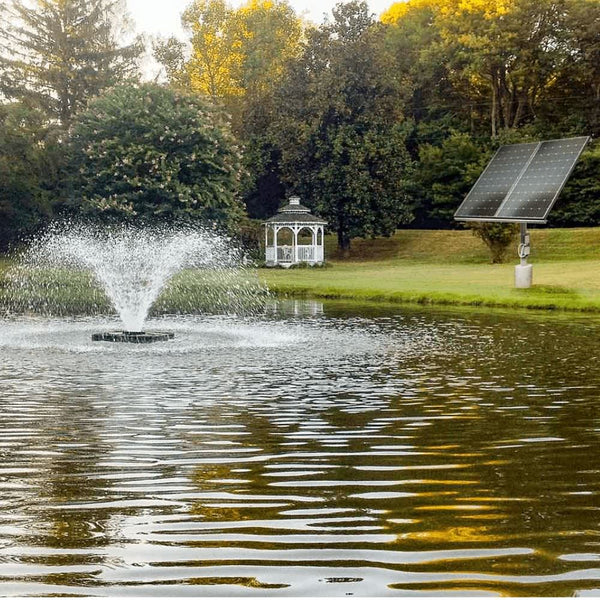
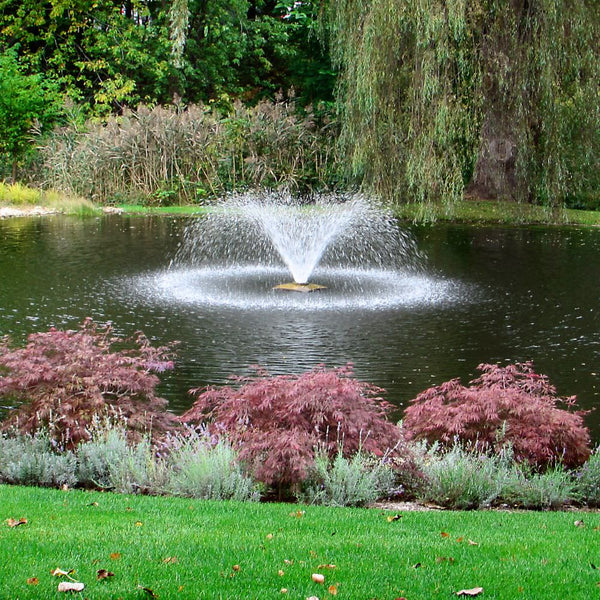
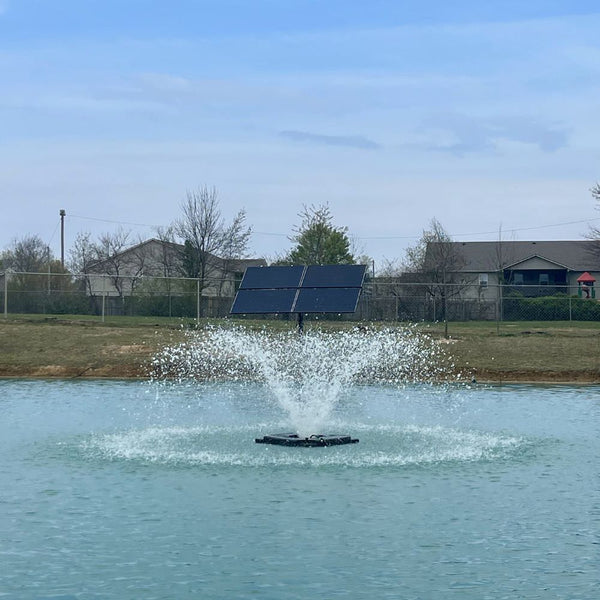
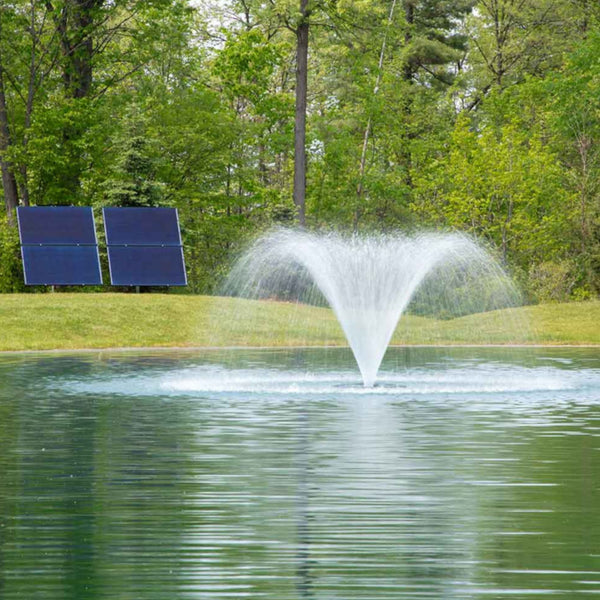
Solar pond fountains provide spray and surface aeration on a pond without power at the water's edge. The units here are the large-pond tier, built to skip the trenching and the electric bill a wired fountain would need. They suit a pond up to about an acre, and they run on daylight, so the spray rises and falls with the sun through the day.
Filters
Filters


Panel placement
The decision is where the panels go
Frequently Asked Questions
What is the difference between a solar pond fountain and a solar pond aerator?
The difference between a solar pond fountain and a solar pond aerator is that a fountain throws a visible spray while it aerates, and an aerator moves oxygen into the water with no display. A solar aerator is usually a bottom-diffused system: a shore-mounted compressor pushes air through weighted tubing to a diffuser on the pond floor. Every unit on this page is an aerating fountain, so it does both jobs at once.
Do these solar pond fountains actually oxygenate a pond?
These solar fountains oxygenate a pond by pulling water up and breaking it across the surface, where it picks up dissolved oxygen, the oxygen fish and bacteria actually breathe, before falling back. Within the unit's rated size and depth, that surface exchange raises oxygen and keeps the top layer moving through warm weather, when ponds need it most. How much a given pond needs depends on its size, depth, and fish load, so a unit matched to the pond matters more than raw spray height.
What size pond can one of these solar fountains handle?
These solar fountains are rated for roughly three-quarters to one acre. The Outdoor Water Solutions Palatial covers up to an acre. The Aerify covers up to three-quarters of an acre. For larger water, run multiple units or step up to a commercial pond fountain.
How deep does my pond need to be for one of these units?
Your pond needs to be at least 24 to 44 inches deep where the fountain sits, depending on the model, to keep the motor covered. The Outdoor Water Solutions units run in as little as 24 inches. The Scott Aerator DA-20 needs 36 inches for the 1/2 HP and 44 inches for the 3/4 HP. Deeper is fine, and the Airmax aerates down to 6-8 feet.
Do these solar fountains run at night?
These solar fountains run during daylight only, because none of them carry a battery. As the sun changes, the spray rises and falls with it. The Scott Aerator uses a Photon Drive inverter to hold output steadier, while the Outdoor Water Solutions and Airmax units are direct-drive. For a fountain that runs after dark, the electric models in the pond fountains collection run on an outlet around the clock.
How long do the solar panels last?
The solar panels on these fountains generally outlast their warranty, so the array is rarely what ends a fountain's service life. Those warranties run 15 to 25 years: Airmax covers its panels for 25 years, Outdoor Water Solutions for 15 years, and Scott Aerator folds panel coverage into its 5-year motor warranty. The motor and controller carry shorter terms, 2 to 5 years, since the moving parts see more wear than the panels.
How much does a solar pond fountain cost?
A solar pond fountain's price is determined by its motor size, flow rate, and the number of solar panels, so higher-flow units cost more. Pricing starts with the Scott Aerator DA-20 and climbs to the Airmax SolarSeries, with the two Outdoor Water Solutions units in between. Each product page lists its current figure. All of them cost more than a wired fountain of the same spray, because the solar array and controller stand in for the electric hookup, which is the trade for skipping a power line to a remote pond.
How are these solar fountains installed?
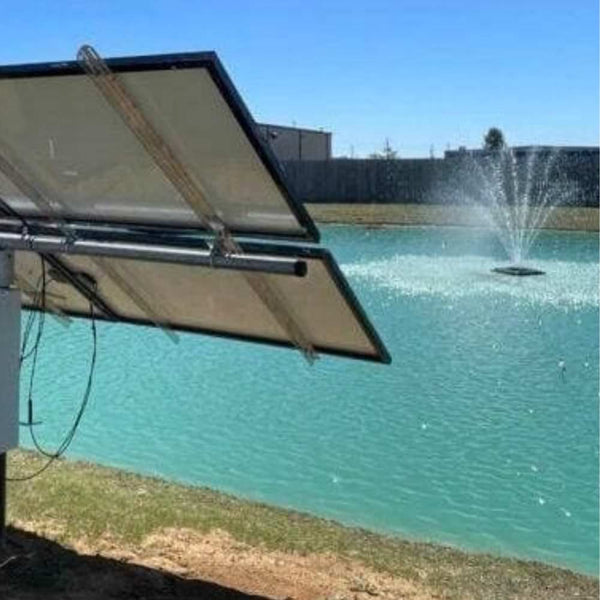
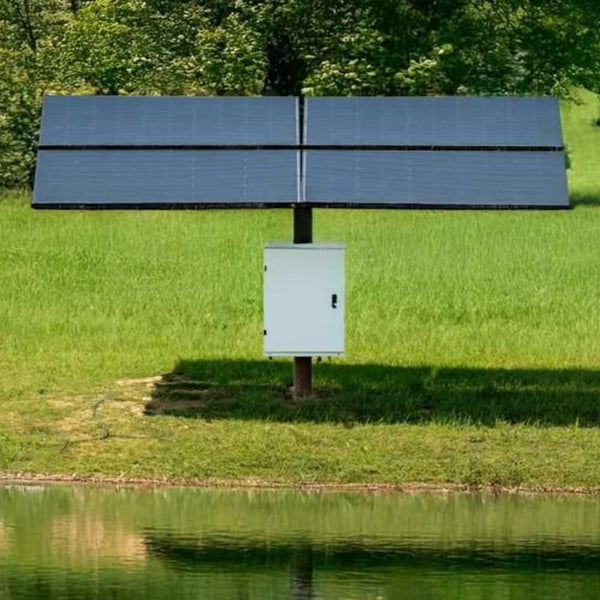
These solar fountains are installed by floating the fountain in the pond and mounting the solar panels onshore where they get full sun. The Scott Aerator DA-20 ships as a complete kit with panels, frames, inverter, and wiring, and requires no special tools or an electrician. Its frame is anchored with two 30-pound weights or concrete blocks, which are not included. There is no outlet, GFCI, or breaker wiring anywhere in the job, so the real decision is where to put the panels.
Can one of these fountains replace a bottom-diffuser aerator in a deep pond?
In a deep pond, one of these fountains cannot fully replace a bottom-diffuser aerator. A surface fountain circulates the top few feet, but below about 6 to 8 feet, the lower water tends to remain separated from the surface, and a bottom diffuser is installed to break up that layering near the pond floor. In deeper ponds, many owners run a fountain for display and surface oxygenation, and add a bottom-diffused system to turn over the entire column.
Need expert help finding the right setup?
Contact Pond Haven Support