
Types of Pond Aeration Systems
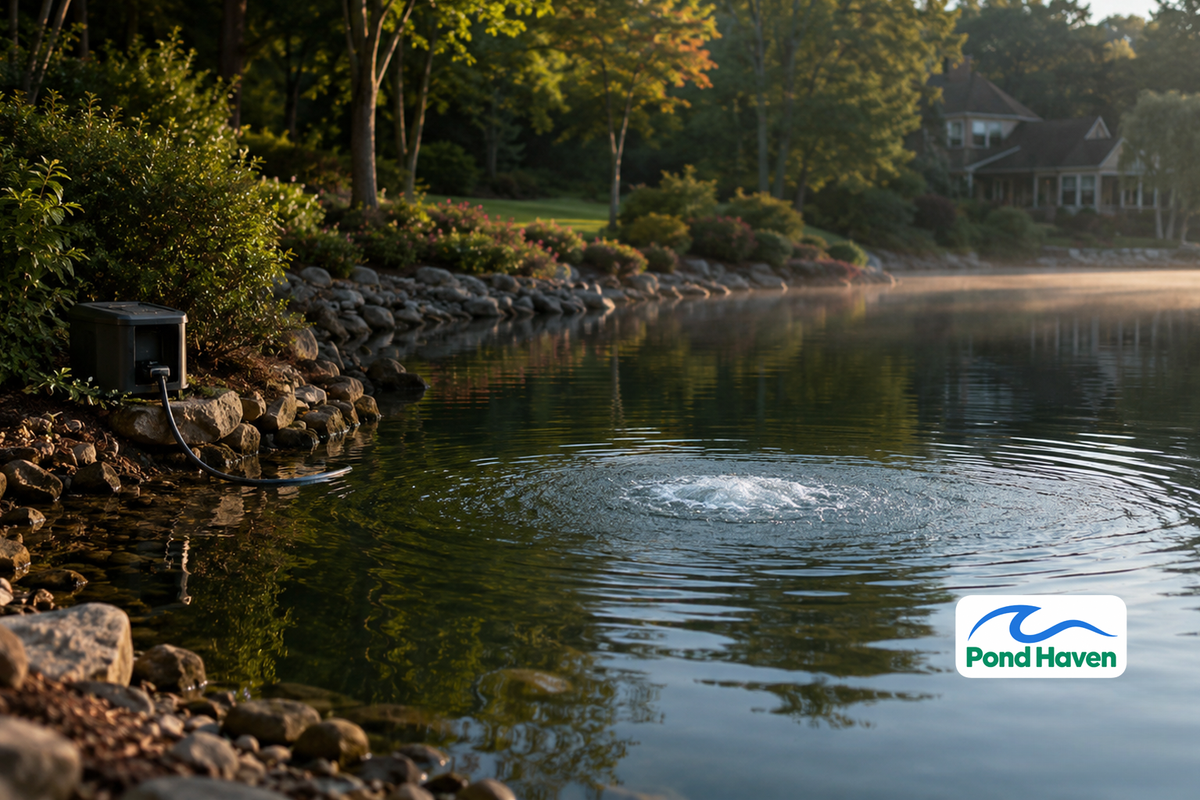

Aeration is the single most important investment you can make for your pond's health. It keeps fish alive, prevents algae blooms, and breaks down muck on the bottom. But with surface aerators, sub-surface diffused systems, paddlewheels, solar units, and windmills on the market, how do you choose?
The answer starts with one number: your pond's depth.
Here's the rule that guides every aeration decision: surface aeration works for ponds 6 feet deep or less. Anything deeper requires sub-surface diffused aeration. This guide walks you through every system type, what they cost, how to size them, and a step-by-step framework for choosing the right one.
- Depth comes first. Ponds over 6 feet deep need sub-surface diffused aeration; surface aerators only mix the top 4-6 feet.
- Diffused systems are the most energy-efficient option, costing 2-3 times less to operate than surface aerators.
- Solar aeration only works for fish ponds with battery backup. Without it, your aerator shuts off at night when oxygen levels drop lowest.
- Windmill aeration is now positioned as supplemental, not primary, because wind is too unpredictable for consistent oxygen delivery.
- Budget $800-$2,500 for an electric diffused system, or $1,500-$4,000 for a battery-backed solar setup.
Pond Aeration Fundamentals
Dissolved oxygen (DO) is the most critical water quality parameter in pond management. Fish, beneficial bacteria, and aquatic plants all need it to survive.
Most warm-water fish species need DO above 5 mg/L for optimal health. Cold-water species like trout require 7-8 mg/L. When levels drop below 3 mg/L, fish experience physiological stress. Below that, they die.
Here's the problem: warm water holds less oxygen than cold water. At 50°F, water saturates at 11.3 mg/L of oxygen. At 85°F, that drops to just 7.6 mg/L. Summer is exactly when fish metabolic rates spike and oxygen demand increases. That combination is why summer fish kills happen.
Ponds also stratify naturally. In warm weather, the water column separates into three layers:
- Epilimnion — the warm, oxygenated surface layer
- Metalimnion (thermocline) — a transition zone where temperature drops rapidly
- Hypolimnion — the cold, oxygen-depleted bottom layer
The bottom layer goes anaerobic. Without oxygen, bacteria produce hydrogen sulfide (rotten egg gas), methane, and ammonia. When a storm or sudden weather change mixes these layers, the toxic water reaches the surface and can kill fish in under 12 hours.
Aeration solves both problems. It circulates the entire water column, breaks the thermocline, and lets toxic gases escape. It also promotes aerobic bacteria at the pond bottom, which consume organic muck far more efficiently than anaerobic bacteria.
The 6-Foot Rule: Your First Decision
The 6-foot rule is the cornerstone of aeration selection.
Surface aerators and fountains are effective for gas exchange in the top 2-4 feet of water. They lose efficiency beyond 6 feet. For any pond deeper than that, sub-surface diffused aeration is the industry standard.
Why does depth matter so much? Surface aerators pull water from the top 1-2 feet and spray it into the air. The oxygen transfer happens at the surface. Below 6 feet, the water column stays stratified, and the bottom layer remains oxygen-depleted regardless of how much surface splashing you create.
Ponds under 6 feet deep rarely stratify persistently. The 6-10 foot range is transitional and can stratify during calm, hot periods. Ponds over 10 feet deep are highly prone to stable stratification.
Measure your pond's depth before buying anything. Take multiple readings across the pond, not just at the deepest point. A pond that averages 4 feet but has an 8-foot hole near the dam still needs sub-surface aeration for that deep basin.

Types of Pond Aeration Systems
Sub-Surface Diffused Aeration
Sub-surface diffused aeration works by pushing air from an on-shore compressor through weighted tubing to diffusers sitting on the pond floor. The rising bubbles create an "airlift" effect that pulls oxygen-depleted water from the bottom to the surface, continuously circulating the entire water column.
This is the most efficient aeration method for deep water. Oxygen transfer efficiency (OTE) increases with depth: roughly 1.6% per foot. At 10 feet, that's about 16% of introduced oxygen dissolving. At 15 feet, over 20%. At 20 feet, 30-40%.
Diffuser type matters. Fine bubble disc diffusers produce bubbles 1-3 mm in diameter and offer the highest oxygen transfer. Standard sizes are 9-inch or 12-inch plates. Coarse bubble diffusers work better in high-sediment water and clog less, but transfer oxygen less efficiently. Tube diffusers suit narrow spaces or "curtain" patterns.
Advantages
- Highest oxygen transfer efficiency in deep water
- Moves the entire water column, not just the surface
- Costs 2-3 times less to operate than surface systems
- Electrical components stay on shore, away from water
- Promotes aerobic bacteria for muck reduction
- Invisible once installed, preserving the natural look
Disadvantages
- More complex installation with tubing, manifolds, and check valves
- No visual appeal or fountain effect
- Requires a properly sized compressor
- Diffusers can clog if airflow drops below minimum
Surface Aerators and Fountains
Surface aerators and fountains pull water from the top 1-2 feet and spray it into the air. The small droplets create a large surface area for oxygen transfer. They provide immediate surface oxygenation and visual appeal.
These systems work well for shallow ponds under 6 feet deep, decorative features, and HOA stormwater ponds. They are not a solution for deep ponds.
Surface aeration has a fixed OTE of just 1.6-3.2% because it only interacts with the top layer. Operating costs run 2-3 times higher than diffused systems because moving water takes more energy than moving air.
Aesthetic fountains and functional surface aerators are different products. A decorative fountain moves water for looks. A high-flow surface aerator like the Kasco Marine 2400AF (1/2 HP, rated for ponds up to 0.5 acres) moves water for oxygen transfer. Know which one you're buying.
Advantages
- Visual appeal, especially with nighttime lighting
- Simple installation, no tubing or manifolds
- Immediate surface oxygen transfer
- Good for shallow ponds where diffusers are overkill
Disadvantages
- Ineffective below 6 feet; does not break stratification
- Operating costs 2-3 times higher than diffused systems
- Submerged electrical cables create wildlife and anchor hazards
- Pumps prone to clogging from vegetation
- No muck reduction at the pond bottom
Paddlewheel Aerators
Paddlewheel aerators use rotating paddles to splash water into the air and create directional current. They are a standard tool in commercial aquaculture.
Performance is measured in Standard Aeration Efficiency (SAE). Efficient designs can achieve 2.0 kg O₂/kW/hour or higher. Standard paddle speed is 80-90 rpm with optimal submergence of 8-12 cm.
Paddlewheels are most efficient in water under 2 meters (about 6.5 feet) deep. They are the highest energy consumer of all aeration types. In intensive aquaculture operations, aeration often runs for many hours per day at significant power levels.
For a backyard pond, a paddlewheel is overkill. These are production tools for catfish, shrimp, and tilapia operations on 1+ acre ponds.
Advantages
- High-volume horizontal circulation for large ponds
- Proven technology in commercial aquaculture
- Effective surface oxygen transfer
- Can combine with diffusers for hybrid systems
Disadvantages
- Highest energy consumption of all system types
- Inefficient in water deeper than 6.5 feet
- Mechanical complexity: gearboxes, bearings, moving parts
- Noisy and visually intrusive for residential settings
Compressor Types for Diffused Systems
If you need sub-surface aeration, your compressor choice depends on depth and airflow requirements.
Diaphragm (linear) air pumps use electromagnetic oscillation to flex a rubber diaphragm. They deliver 0.5-3.5 CFM at depths up to 4-6 feet, run at just 35-45 dB, and consume only 20-80 watts. Diaphragm kits need replacement every 18-24 months. These suit small koi ponds and water gardens under 4 feet deep. Expect to pay $80-$400.
Rocking piston compressors use a positive displacement piston with PTFE cup seals. They deliver 1.5-5+ CFM at depths of 8-20+ feet, run at 55-65 dB, and consume 150-500+ watts. Piston and valve kits need replacement every 12-18 months. These are the workhorses for most backyard ponds. Expect to pay $500-$1,500 for a quality unit.
Rotary vane compressors use rotating carbon vanes to create airflow. They deliver medium pressure between 5-15 PSI, with larger units reaching 22 PSI. A 1/4 HP unit produces 3.6-4.0 CFM; a 1 HP unit produces 11.8 CFM. Carbon vanes last 12-24 months and cost less than $100 to replace. With regular vane changes, these systems last decades. They suit large ponds and multiple diffuser stations.
| Compressor Type | Max Depth | Airflow (CFM) | Noise (dB) | Power (Watts) | Maintenance Interval |
|---|---|---|---|---|---|
| Diaphragm | 4-6 ft | 0.5-3.5 | 35-45 | 20-80 | 18-24 months |
| Rocking Piston | 8-20+ ft | 1.5-5+ | 55-65 | 150-500+ | 12-18 months |
| Rotary Vane | 8-20 ft | 3.6-100 | 60-75 | 300-3,700+ | 12-24 months |
Solar-Powered Aeration
Solar aeration systems combine solar panels, a charge controller, a battery pack, and a motor-driven compressor. They eliminate the need for trenching electrical lines, which can cost $2,000 or more to a remote pond.
But solar has real limitations. Direct-drive systems pump only during peak sunlight. That means no aeration at night or early morning, exactly when dissolved oxygen levels hit their lowest point. For fish ponds, this is a dealbreaker.
Battery-backup systems provide 24/7 aeration and are the only solar option recommended for fish-bearing ponds. Expect to replace batteries every 3-5 years at $200-$600 per set.
Solar systems cost 2-2.5 times more than equivalent electric systems. A complete solar diffused setup runs $1,500-$4,000 upfront versus $800-$1,500 for electric. Solar motors typically fail every 1-2 years and cost $750-$1,500 to replace.
Over a 20-year lifecycle, a direct-drive solar system costs significantly more than an electric system over the same period, unless you factor in the cost of running electrical lines.
Windmill Aeration
Windmill aerators use wind to drive a piston or diaphragm compressor that pushes air to a bottom diffuser. They are a well-known option for remote ponds.
Modern windmills operate in winds as low as 3-5 mph and perform up to 15 PSI (about 30 feet of water). A typical residential unit delivers 3.0-4.5 CFM at 10-15 mph wind.
Here's the current industry position: windmill aeration is supplemental, not primary. Wind is unpredictable. Your pond needs consistent oxygen delivery, especially during hot, calm summer weather when wind dies down and oxygen demand peaks. A windmill that stops turning when the breeze stops leaves your fish vulnerable.
Windmills make sense for remote ponds with no electricity, as a backup, or as a daytime supplement alongside a solar or electric system. They cost $1,200-$3,000 complete, with annual operating costs around $150 for maintenance.
Over 20 years, a windmill system costs $3,000-$6,000 total and delivers air at a very low operating cost when wind resources are adequate.
How to Size Your Aeration System
Airflow Requirements (CFM)
For diffused systems, the baseline is 1-1.5 CFM per surface acre. A more precise rule uses pond volume:
- Lightly stocked ponds: 1 CFM per 1,000 gallons
- Heavily stocked or high organic load: 1.5-2 CFM per 1,000 gallons
Calculate your pond volume by multiplying surface acres by average depth. A 1/2-acre pond averaging 6 feet deep holds about 3 acre-feet, or roughly 975,000 gallons.
Surface systems need 1.5-2 HP per surface acre.
Pressure Calculations
Total system pressure equals water depth pressure plus diffuser backpressure plus friction loss.
Every 2.31 feet of water depth adds 1 PSI. A diffuser at 8 feet needs 3.46 PSI just to overcome water pressure. Fine bubble diffusers add up to 1.5 PSI of backpressure; medium bubble diffusers add less than 0.25 PSI.
Friction loss depends on tubing length and diameter. At 2 CFM per 100 feet of tubing:
- 3/8" tubing: ~0.45 PSI loss
- 1/2" tubing: ~0.14 PSI loss
Double the loss for 200 feet of run. For runs under 50 feet, 3/8" tubing works. For 50-100 feet, use 1/2". Beyond 100 feet, step up to 3/4".
Example: A 1/2-acre circular pond, 8 feet deep, with a 100-foot tubing run:
- Water pressure: 3.46 PSI
- Diffuser pressure: 0.25 PSI
- Friction loss: 0.14 PSI
- Total: 3.85 PSI
Your compressor must deliver its rated CFM at that pressure, not at 0 PSI. A compressor rated at 4 CFM at 0 PSI may drop to 2 CFM at 10 feet.
Turnover Rates
Turnover is how quickly the entire pond volume circulates through the aeration zone. The baseline target is once every 24 hours. High-density or eutrophic ponds need 2-3 turnovers per day. Small ponds should circulate every 6-12 hours.
Layout for Pond Shape
- Circular ponds: One central diffuser works well
- Long or rectangular ponds: Space multiple diffusers evenly
- Irregular or kidney-shaped ponds: Place diffusers in the deepest basins to prevent dead zones in coves
- Large ponds: Space diffusers 100-200 feet apart
Install ball valves at split points to balance airflow when diffusers sit at different depths.
Cost Comparison & Budgeting
| System Type | Initial Equipment Cost | Annual Operating Cost | 10-Year Total Cost | Maintenance Frequency |
|---|---|---|---|---|
| Sub-surface diffused (electric) | $800-$2,500 | $50-$200 (electricity) | $1,300-$4,500 | Clean diffusers annually; service compressor every 2-3 years |
| Surface aerator/fountain | $500-$3,000 | $100-$400 (electricity) | $1,500-$7,000 | Replace pump seals, clean impeller annually |
| Paddlewheel | $3,000-$10,000 | $300-$1,000 (electricity) | $6,000-$20,000 | Change gearbox oil, replace bearings annually |
| Solar diffused | $1,500-$4,000 | $0-$50 | $3,000-$8,000 | Same as electric plus battery replacement every 3-5 years |
| Windmill | $1,200-$3,000 | $0 | $1,200-$3,000 | Lubricate bearings, inspect vanes annually |
To calculate energy costs: watts × hours × electricity rate ÷ 1000. A 1/4 HP surface aerator running 24/7 costs about $15-$30 per month. A 1/3 HP compressor for a diffused system runs $10-$20 per month.
Budget for hidden costs: tubing replacement, diffuser membrane replacement every 3-5 years ($30-$80 per membrane), and electrical wiring.

Installation, Maintenance & Safety
The "Instant-On" Turnover Danger
Turning on a powerful aeration system in a previously un-aerated, stratified pond can cause sudden turnover. This releases toxic hydrogen sulfide and methane while rapidly depleting oxygen. Fish can die within hours.
The solution is a staged startup:
- Day 1: Run 30 minutes
- Day 2: Run 1 hour
- Day 3: Run 2 hours
- Continue doubling until the system runs 24/7
This gradual approach lets the water column destratify slowly, giving fish time to adjust.
Electrical Safety
- Use GFCI-protected outlets for all shore-based equipment
- Size wires properly for long runs to the pond
- Use weatherproof connections and conduit
- Hire a licensed electrician for any permanent wiring
Diffused systems keep electrical components on shore, eliminating in-water wiring hazards. Surface fountains require submerged power cables, which create wildlife and anchor risks.
Maintenance Schedules by System Type
- Diffused systems: Clean diffuser membranes quarterly, inspect tubing for leaks annually, replace membranes every 3-5 years
- Surface aerators: Clean intake screen weekly in summer, check impeller clearance annually, replace shaft seal every 2-3 years
- Paddlewheels: Check gearbox oil monthly, grease bearings quarterly, inspect paddles for wear annually
- Solar systems: Clean panels monthly, check battery water levels quarterly, test charge controller annually
- Windmills: Lubricate moving parts annually, check vane alignment after storms, inspect tower footing
Troubleshooting Common Issues
- Low airflow: Check for kinked tubing, clogged diffusers, or worn compressor valves
- Motor won't start: Check power supply, capacitor, and thermal overload
- Poor oxygen transfer: Verify diffuser depth and inspect for fouled membranes
Install a 0-10 PSI pressure gauge with a T-fitting outside the pump port. Pressure gauges help identify leaks or diffuser clogging early. Install check valves near each diffuser to prevent water backflow when the pump is off.
Remove the diffuser disc, soak it in white vinegar, and scrub with a fine brush. This dissolves mineral buildup without damaging the membrane. Always unplug the compressor before servicing.
Decision Matrix: Choosing Your System
Step-by-Step Selection Framework
- Depth first. Measure maximum depth. Over 6 feet? Sub-surface is mandatory.
- Acreage second. Ponds under 1/4 acre can use smaller systems. Larger ponds need scaled-up equipment.
- Goals third. Fish health, algae control, aesthetics, or ice management each point to different systems.
- Biological load fourth. Fish density, feeding rates, and surrounding land use determine airflow needs.
- Power availability fifth. Grid power, solar, or windmill determines your options.
Quick-Reference Scenario Table
| Pond Scenario | Recommended System | Why |
|---|---|---|
| 1/4 acre, 4 ft deep, decorative | Surface fountain aerator | Aesthetics plus adequate mixing for shallow depth |
| 1/2 acre, 10 ft deep, koi/goldfish | Electric diffused with rocking piston | Depth requires sub-surface; reliable 24/7 operation |
| 1 acre, 8 ft deep, bass/bluegill | Electric diffused, 2 diffusers | Volume and fish load require higher CFM |
| 1/4 acre, 6 ft deep, no electricity | Solar diffused with battery backup | Off-grid power with 24/7 reliability |
| 2 acres, 5 ft deep, catfish production | Paddlewheel | High-volume aquaculture application |
| 1 acre, 12 ft deep, remote cabin | Windmill + electric backup | Wind as primary, electric for calm periods |
Final Recommendations
The best system for most backyard ponds is an electric sub-surface diffused system with a rocking piston compressor. It handles depth, delivers the most oxygen per watt, and keeps electrical components safely on shore.
The best budget option for shallow ponds is a surface aerator. It costs less upfront and provides visual appeal, but only works in ponds 6 feet deep or less.
Solar makes sense when you have no grid power and adequate sunlight, but only with battery backup. Windmills are supplemental only, never primary for fish ponds.
For deeper ponds, look at the EasyPro Sentinel series or Kasco Robust-Aire rocking piston compressors. For shallow decorative ponds, the Scott Aerator DA-20 or Kasco VFX series fountains deliver high-volume water movement with attractive spray patterns. For quiet operation in residential settings, the EasyPro Sound Shield rocking piston compressor addresses noise complaints while maintaining deep-water power.

Sources
- Manufacturer spec sheets: Kasco Marine, EasyPro, Scott Aerator, Pond Haven equipment catalog.
Frequently Asked Questions
Can I use a fountain aerator in a 10-foot-deep pond?
No. Surface aerators only mix the top 4-6 feet. Below that, the water stays stratified and can develop low-oxygen zones. You need a sub-surface diffused system for ponds deeper than 6 feet.
How many diffusers do I need for my pond?
A general rule is one diffuser per 1/2 to 1 acre, but the real calculation depends on depth and biological load. A 1/4-acre pond typically needs one diffuser; a 1-acre pond usually needs two or three.
Is solar aeration reliable enough for fish?
Only with battery backup. Without it, your aerator runs only when the sun shines, which means no aeration at night when oxygen levels drop lowest. A battery-backed solar system can work, but expect to replace batteries every 3-5 years.
How much does it cost to run an aerator continuously?
A typical 1/4 HP surface aerator running 24/7 costs about $15-$30 per month in electricity. A 1/3 HP compressor for a diffused system costs roughly $10-$20 per month. Actual costs depend on your local electricity rate.
Will aeration help with algae?
Yes, indirectly. Aeration promotes beneficial bacteria that compete with algae for nutrients. It also prevents the nutrient release that happens when bottom water goes anaerobic. Expect gradual improvement over 1-2 seasons, not overnight results.