
Where to Place a Pond Aerator
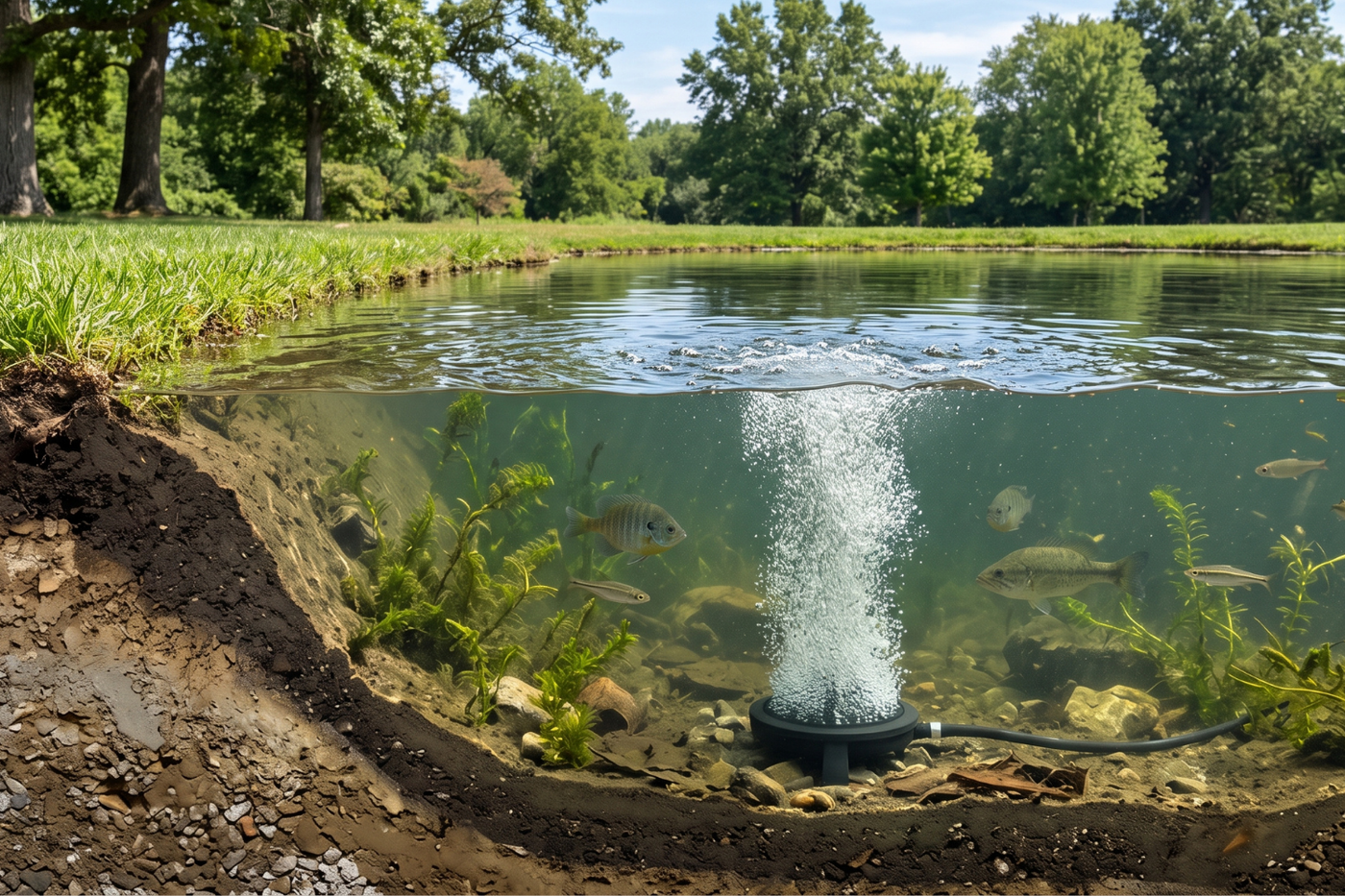

Where you place a pond aerator determines which part of the pond receives circulation and how far the water moves across the pond—put the unit in the wrong spot, and part of your pond stays oxygen-starved no matter how well the system is sized.
A diffuser’s rising bubble plume draws deeper water upward and circulates it through the water column. A surface aerator needs surrounding open water to establish a useful circulation pattern beyond the immediate area around the unit. The deepest point isn’t always the final placement decision because bottom conditions, separate basins, shoreline exposure, and seasonal water levels can affect how circulation develops.
Learning how to install a pond aerator begins with mapping the pond and matching each aerator to the intended circulation zone. Placement based on depth and shape helps the system reach coves and separate basins that one circulation pattern may not cover.
How Does Pond Depth Affect Aerator Placement?
Pond depth affects diffuser placement differently from surface-aerator placement because the two systems move water from different parts of the pond. A diffuser creates vertical circulation from its position below the surface, while a surface unit moves water around and beneath its floating position. These different circulation patterns make aerator type the first placement decision within a pond aerator installation plan.
Depth also decides which system belongs in the pond in the first place. Under about 6 feet, a surface aerator can agitate enough of the water column to do useful work. From roughly 6–8 feet, subsurface diffusion becomes viable, and beyond 8 feet, it is usually the more efficient choice—surface agitation simply can’t reach deep enough to prevent the oxygen-depleted zones where fish stress and muck build-up begin.
Diffused aerator placement
A diffuser belongs in a deeper area when the goal is to move water from near the pond floor toward the surface. Bubbles released at greater depth have more time to interact with the water as they rise through the water column. The rising plume also draws surrounding water upward, creating circulation between the diffuser’s location and the surface.
The deepest suitable area often provides the longest vertical circulation path, and diffuser assemblies can sit flat on the pond bottom when conditions support them. Where loose sediment is present, raising diffuser stones above the pond bottom can limit the suspension of bottom material.
The selected depth must also fall within the operating range of the aeration system, since placement cannot compensate for inadequate airflow—a compressor’s rated output is measured at the surface and drops as the diffuser sits deeper, because the unit must push air against the water pressure above it. A diffuser placed beyond the compressor’s rated depth produces a weak plume that moves far less water than the system’s coverage figures suggest.
The compressor itself sits on shore, not in the pond, and it doesn’t need to sit at the water’s edge—the airline can run a considerable distance from a shed, fence line, or power source to the diffuser. That separation gives you real freedom in placing the diffuser where the pond needs it, though longer airline routes add friction, so tubing length and diameter belong in the same placement decision.
Surface aerator placement
A surface aerator belongs in open water where its intake and discharge can move water beyond the unit’s immediate position. Central placement can suit a compact pond because circulation can extend outward without meeting the bank immediately.
Long ponds require a more deliberate position because a central point may leave distant ends with less water movement. Placing one unit near the middle of the pond’s long axis and directing circulation across its shorter dimension can distribute oxygenated water more effectively. The chosen location must retain enough depth during seasonal water-level changes for the unit to remain within its required operating range.
How Far Should a Pond Aerator Be From the Bank?

No fixed distance from the bank applies to every pond because the required separation depends on water depth, shoreline condition, and circulation direction. In one pond, a diffuser may sit far from shore when the intended circulation zone follows a deep basin near the pond’s center. In another, the diffuser may sit closer when a cove or separate depression requires its own circulation point.
A surface aerator needs enough open water for its current to spread without repeatedly directing concentrated flow against an exposed bank. Water moving parallel to the perimeter can contribute to shoreline erosion and move sediment toward the pond’s central area. A stable or protected shoreline may tolerate a closer position, while loose soil may require greater separation or a different flow direction.
Before finalizing how to install a pond aerator, assess four placement conditions around the proposed location:
- Open-water clearance: Leave enough surrounding water for circulation to move away from the unit before reaching the shoreline.
- Shoreline condition: Increase separation where concentrated flow could disturb exposed soil or resuspend sediment along the bank.
- Target area: Place the aerator near the zone requiring circulation instead of following an arbitrary shoreline measurement.
- Seasonal depth: Choose a location that retains the water depth required by the unit when the pond level falls.
Why Isn’t the Deepest Point Always the Best Position?
The deepest point provides a useful starting location for a diffuser because greater depth supports a longer bubble path and stronger vertical circulation. However, that position may not suit the pond when loose sediment, divided basins, seasonal conditions, or regular pond use change the placement requirements.
Soft sediment
The deepest hole may collect soft sediment that shifts when the diffuser draws nearby water into its rising plume. When loose sediment is present, raising the diffuser above the pond floor can reduce sediment suspension while preserving circulation through the deeper water column. A stable contour beside the absolute low point may also provide a suitable position when the deepest bottom can’t support the diffuser.
Separate deep areas
One depth measurement can’t represent a pond with several basins separated by an underwater rise, narrow channel, or bend. A diffuser placed in the lowest basin may circulate that section without creating sufficient movement in another deep area. Each separated basin should be assessed as its own circulation zone before the diffusers receive their final positions.
Seasonal position
The position used during warm weather may not serve the same purpose when winter conditions change the pond’s circulation needs. Moving a diffuser into shallower water can preserve a deeper refuge for overwintering fish while concentrating circulation closer to the pond’s edge. Running the deepest station all winter can chill the very water fish rely on to survive the cold months.
Pond use
Swimming areas, docks, and regular boat routes can make an otherwise suitable open-water position impractical for a surface aerator. The selected location should serve the required circulation zone without occupying the pond area used most often for access or recreation.
How Should You Arrange Multiple Diffusers by Acre?
Acreage shows how much surface area requires coverage, but it does not determine the number of diffusers without depth and shape information. Each diffuser creates a vertical circulation cell with limited horizontal reach, so larger or divided ponds may need several diffusers arranged across the waterbody. A shallow pond may require more circulation points than a deeper, compact pond covering the same surface area.
The following acreage bands provide a placement framework rather than a fixed diffuser count:
| Pond acreage | Placement approach | Conditions to assess |
|---|---|---|
| Up to 1 acre | Begin with the primary deep-water circulation zone. | Check for isolated coves, separate holes, uneven depth, and soft sediment before treating the pond as one zone. |
| 1–2 acres | Divide the pond into circulation zones before positioning multiple diffusers. | Compare the central basin, shallow ends, coves, and changes in bottom contour instead of spacing stations by appearance. |
| More than 2 acres | Map the depth contours and distribute stations across the resulting zones. | Account for separate basins, long shorelines, peninsulas, and areas beyond another diffuser’s horizontal reach. |
The aeration system’s rated coverage determines how many diffuser stations can serve each acreage band at the measured average depth. A regular basin may allow relatively even spacing, while an irregular pond needs positions based on its separate water zones. Equal spacing provides little benefit when several diffusers serve one basin while another remains outside their circulation patterns.
When multiple aerators serve the same pond, position them so their currents support the intended circulation pattern rather than working against it. This approach doesn’t require every current to travel in the same direction because the preferred pattern depends on the pond’s layout.
How Does Pond Shape Change Aerator Placement?

Pond shape determines whether one aerator can move water through the complete basin or only through the area around its position. Two ponds with the same acreage may therefore need different layouts when their shorelines and bottom contours create different circulation paths.
- Round or compact ponds: Start with the central deep-water zone when the bottom conditions allow a diffuser to operate there without disturbing sediment.
- Long or narrow ponds: Distribute circulation points along the pond’s length instead of concentrating every diffuser at one end.
- L-shaped ponds: Treat each arm as a separate zone when the bend restricts water movement between the two sections.
- Ponds with coves: Place a diffuser within an isolated cove when circulation from the main basin does not reach that area.
- Multi-basin ponds: Position diffusers within separate deep areas rather than grouping them around the pond’s single lowest measurement.
Wind also moves surface water, so surface-aerator placement should account for the direction of the existing current across an open pond. Positioning aerators to work with wind-driven currents can improve the distribution of oxygenated water throughout the intended circulation area. Site conditions may require another orientation when prevailing winds push surface flow toward an exposed or erosion-prone shoreline.
Where Should You Place Air Stones in a Pond?
The answer to where to place air stones in a pond depends on the zone that requires circulation and the depth the air pump can support. Air stones belong on or near the bottom of that zone, where their bubbles can draw deeper water upward as they rise. When loose sediment is present, positioning them slightly above the pond floor can maintain airflow and reduce material entering the bubble plume.
Separate air stones can serve coves or deep pockets that lie beyond one circulation pattern, although clustering them in one location limits their coverage. Small air stones may not create the same circulation area as purpose-built diffuser stations, so their positions should reflect the system’s rated capacity—for a pond with real oxygen demand, compare subsurface diffuser systems rated for your depth and acreage.
Get the Right Aerator Placement for Your Pond
Pond Haven helps property owners, homeowners associations, golf courses, and municipal teams compare pond aerators for their waterbody using site-specific measurements. Share your pond’s measurements and intended use to narrow the available options and develop a placement plan for the areas requiring circulation. For an irregular pond, include a depth map showing its coves, separate basins, and deepest practical placement areas.
FAQs on Where to Place a Pond Aerator
Can you move a pond aerator after it’s installed?
Yes, and planning for it is smart. Diffused systems are the easiest to reposition: leave slack in the weighted airline during installation, and you can slide a diffuser to a new station or move it to a shallower shelf for winter without re-plumbing the system. Many owners treat the first season as a trial run, watching where circulation actually develops before committing to final positions. Surface units can also be re-anchored, though their mooring lines and power cord routing set the practical limits.
Do you need an electrician to install a pond aerator?
It depends on the voltage. A 115-volt compressor plugs into a standard outlet, but that outlet must have ground-fault circuit interrupter (GFCI) protection, and manufacturers universally prohibit extension cords—an undersized cord causes voltage drop that can damage the motor and void the warranty. If the factory cord won’t reach, order a longer factory cord or have permanent wiring run. A 230-volt unit is typically hardwired to the breaker panel, which puts it in licensed-electrician territory in virtually all cases.
Should a pond aerator run all the time?
Once established, most systems run continuously through the warm months because dissolved oxygen falls to its lowest point in the pre-dawn hours—shutting the aerator off overnight removes it exactly when the pond needs it most. The exception is startup on an established pond: begin with about 30 minutes on the first day and roughly double the runtime daily over the first week, so low-oxygen bottom water mixes upward gradually instead of all at once.
Can one aerator serve two connected ponds?
Usually not well. A narrow channel between basins restricts circulation, so a plume in one pond rarely moves meaningful water through the connection—treat each basin as its own zone. The practical solution is often a single shore-mounted compressor feeding two diffusers through a manifold, with one station in each basin, provided the compressor maintains adequate airflow at both diffusers’ depths.
Back to Top: Where to Place a Pond Aerator: Best Positions