
Pond Depth
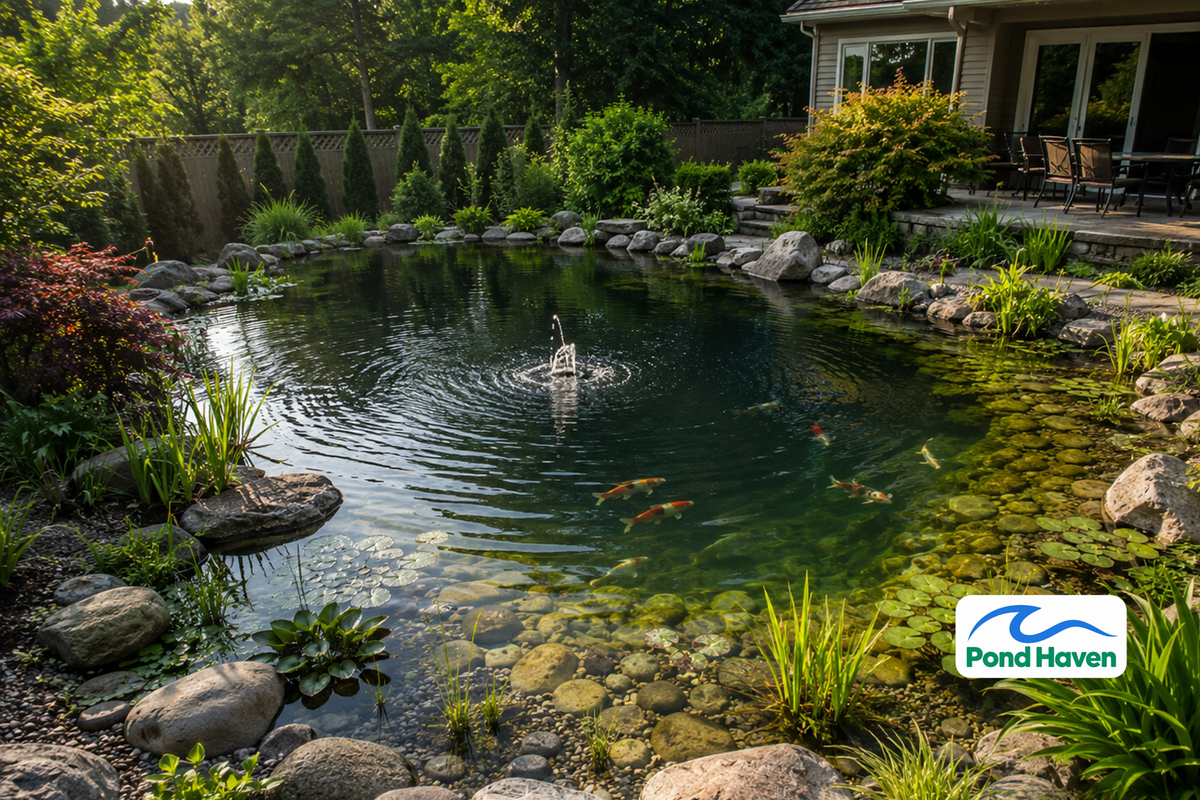

Depth is the most overlooked variable in pond design. Most owners obsess over liner type, pump size, and fish selection, then let the excavator decide how deep to dig. That's backwards.
The right depth depends on your goals, your climate, and your budget. But getting it wrong has real consequences: winter fish kills, toxic water in summer, and a pond that fills with silt decades before it should. Here's what you actually need to know.
- Most backyard ponds need 3–4 feet; koi ponds need 4+ feet; game fish ponds need 6–12 feet.
- Ponds don't freeze solid thanks to geothermal heat, but rapid temperature swings can kill fish.
- Depth determines your aeration equipment: fountains suit ponds under 6 feet, diffused systems work better deeper.
- Ponds fill in with silt at roughly 0.1 ft/year on average, so plan for the pond your pond will become.
- Deeper isn't always better. Surface area often matters more than depth for overall pond health.
The Short Answer: How Deep Should Your Pond Be?
There's no single "right" depth. The professional minimum for any pond meant to support life is 2 feet. But that's a floor, not a target.
Here's a quick-reference guide by pond type:
| Pond Type | Recommended Depth | Why It Matters |
|---|---|---|
| Ecosystem/ornamental | 2–3 feet | Supports plants, beneficial bacteria, and small fish |
| Koi pond (mild climate) | 3–4 feet | Room for fish to grow, stable temperatures |
| Koi pond (cold climate) | 4–5 feet | Protects against deep freezes and temperature swings |
| Game fish (bass, bluegill) | 6+ feet, ideally 8–12 | Oxygen distribution, summer thermocline management |
| Livestock/agricultural | 8+ feet in dry regions | Drought reliability, water quality stability |
The 2-foot minimum comes from simple physics. At that depth, a pond holds enough water volume to buffer against rapid temperature changes and supports the bacteria that break down fish waste. Shallower than 2 feet, and you're essentially maintaining a puddle that swings wildly between hot and cold.
But "deeper is better" isn't true either. A 20-foot-deep pond with a tiny surface area gives you very little. What matters is the relationship between depth, surface area, and volume. A shallow 1-acre pond holds more water and supports more fish than a deep 0.1-acre pond.
How Pond Depth Affects Water Temperature and Winter Survival
The most common myth about pond depth is that fish die when the pond freezes over. That's rarely true. Ice itself isn't the killer.
Here's what actually happens. Water is densest at 39°F (4°C). As surface water cools in fall, it sinks. Warmer water rises. This creates a stable temperature gradient, with the warmest water at the bottom. Geothermal heat from the earth below keeps that bottom layer from freezing, even when the surface is locked in ice.
A 4-foot-deep pond in a harsh winter will typically hold 39–40°F water at the bottom. Fish survive there in a slowed metabolic state. That's why depth matters so much in cold climates: a shallow pond simply doesn't have enough thermal mass to hold that stable bottom layer.
The real killer is temperature swings, not ice. A shallow pond can swing 10–15°F in a single day in spring or fall. Those swings stress fish, suppress their immune systems, and leave them vulnerable to parasites and bacterial infections. Deep water buffers those swings.
Regional depth recommendations vary dramatically. In dry regions with high evaporation, ponds need significantly more depth to maintain a reliable water supply through droughts. The same logic applies across the US. A pond in Minnesota needs different depth planning than one in Georgia, even though both face winter.
Check your regional frost line and historical drought data before finalizing depth. A pond built for the wrong zone will fail within a decade.

Depth and Fish Health: Koi, Bass, and More
Different fish have different depth needs. Getting this wrong means stressed fish, stunted growth, or winter losses.
Koi. Koi need 3 feet minimum, and 4–5 feet in cold climates. They're large fish that need swimming room and stable temperatures. Depth also feeds directly into your gallon calculation: length × width × depth × 7.48 = gallons. A 10 × 12 × 4-foot koi pond holds roughly 3,590 gallons. That number drives your filtration sizing, stocking density, and aeration needs.
Game fish. Largemouth bass need 6 feet minimum, with 8–12 feet ideal. The reason is oxygen distribution. In summer, deep ponds stratify into warm, oxygen-rich surface water and cooler, oxygen-poor bottom water. Bass need access to both temperature zones. A pond too shallow to stratify properly can't support a healthy bass population through summer heat.
Catfish and other species. Channel catfish tolerate shallower water and prefer sloping depths. They'll use deep holes for daytime cover and move shallow to feed at night. A pond with varied depth, not a uniform basin, supports more species.
Stocking density. Depth determines how many fish your pond can carry. A 1-acre pond averaging 3 feet deep holds about 1 million gallons. The same pond at 6 feet average holds 2 million gallons. More water volume means more oxygen, more dilution of fish waste, and more room for fish to grow. Stocking rates are calculated per acre of surface, but depth determines whether those fish actually thrive.
Predator Protection: Does Depth Actually Help?
Depth deters some predators. It doesn't stop others.
Herons and other wading birds hunt in shallow water. A pond with deep drop-offs near the edge gives them nowhere to stand. If the bottom drops to 3 feet within a foot of the bank, a heron can't wade in. That's a genuine deterrent.
But depth means nothing to minks, otters, raccoons, and bears. These predators swim. A 6-foot-deep pond is no obstacle to an otter that can dive 30 feet. Raccoons will wade, swim, and fish from the bank. Bears don't care about depth at all.
Depth helps against
- Herons and egrets that need shallow water to wade
- Raccoons that prefer easy shallow-water fishing
- Surface-feeding birds that can't dive deep
Depth won't stop
- Minks and otters, which are strong swimmers and divers
- Bears, which will fish any pond regardless of depth
- Snapping turtles and other aquatic predators
Design strategies matter more than raw depth. Vertical edges at the pond perimeter deny wading birds a foothold. Fish caves, made from stacked rock or PVC pipe, give fish a place to hide. Netting over the pond is the only reliable defense against determined predators.
One warning: don't train fish to associate humans with food. Fish that surface when people approach become easy targets for predators that learn the same behavior.
Depth and Aeration: Getting the Equipment Right
Depth directly determines which aeration system works for your pond. This is where most owners get it wrong.
Diffuser efficiency. Bottom diffusers work by releasing bubbles that rise and pull oxygen-depleted bottom water to the surface. The deeper the diffuser, the longer the bubbles are in contact with the water, and the more oxygen transfer occurs. A diffuser at 8 feet moves more oxygen per bubble than one at 3 feet. That's why diffused aeration systems are the standard choice for ponds 6 feet and deeper.
Surface vs. bottom aeration. Fountains and surface aerators work well in ponds under 6 feet. They mix the upper water column and look great doing it. But they don't address the bottom layer. In deeper ponds, that's a problem.
The thermocline problem. In summer, deep ponds stratify. Warm, oxygen-rich water sits on top. Cooler, oxygen-poor water sits below. The boundary is called the thermocline. Without aeration, the bottom layer can become completely depleted of oxygen and accumulate toxic gases like hydrogen sulfide and ammonia. If that layer turns over, it can kill fish in hours.
A diffused aeration system breaks the thermocline by continuously circulating bottom water to the surface. This keeps oxygen distributed throughout the water column and prevents toxic buildup.
Equipment selection by depth:
| Pond Depth | Recommended Aeration |
|---|---|
| Under 6 feet | Fountain or surface aerator |
| 6–12 feet | Diffused aeration system |
| 12+ feet | Multiple diffusers, sized to pond volume |

How to Measure Your Pond's Depth
You can't choose the right aeration or stocking plan without knowing your actual depth. Here's how to measure it properly.
Tools you'll need:
- A weighted line (a rope with a weight tied to the end, marked in feet)
- A boat or kayak
- A notepad and pen
- A tape measure for the line
Step-by-step process:
- Mark your line in 1-foot increments using tape or a permanent marker.
- Take a grid approach. Divide your pond into a mental grid with points roughly 10–20 feet apart, depending on pond size.
- Lower the weighted line at each grid point until it touches bottom. Record the depth.
- Note the deepest point you find. That's your maximum depth.
- Average all your readings for your average depth.
Why average depth matters more than maximum. A pond that's 10 feet deep in one corner but averages 2 feet is effectively a shallow pond. Fish use the whole pond, not just the deep hole. Your water volume calculation should use average depth.
Re-measure periodically. Ponds fill in with silt over time. Siltation rates vary widely depending on your watershed, from a fraction of an inch to several inches per year. That means a pond built 3 feet deep could be significantly shallower in a decade. Re-measure every 3–5 years and adjust your aeration and stocking plans accordingly.
- Measure at multiple points, not just the deepest spot you can find.
- Use average depth for volume and stocking calculations.
- Re-measure every 3–5 years to track siltation.
- Record your measurements so you can compare over time.
Construction Considerations: Cost, Frost Lines, and Longevity
Depth decisions made during construction are expensive to reverse. Get them right the first time.
Excavation costs scale exponentially. Digging from 2 to 4 feet roughly doubles your excavation volume. Going from 4 to 8 feet more than doubles it again. You're paying for cubic yards of soil removal, and deeper holes require more benching and slope stabilization. A 6-foot-deep pond costs significantly more than twice as much as a 3-foot pond.
Frost lines matter. In cold climates, any plumbing, pumps, or aerator lines must sit below the frost line to avoid freeze damage. That means your equipment trench depth is dictated by your local frost line, not your pond depth. Check your regional frost depth before finalizing equipment placement.
Plan for siltation. Your pond won't stay as deep as you build it. With average siltation of 0.1 ft/year, a pond built 4 feet deep will be 3 feet deep in a decade. Build 1–2 feet deeper than your minimum requirement to extend the pond's useful life.
Match volume to watershed. A pond's depth and surface area must match its catchment area. Too much watershed means the pond fills with runoff, sediment, and nutrients. Too little means it never fills. Your excavator or a local extension agent can help calculate the right ratio for your property.
Extra depth costs more now but buys decades of stability, better fish survival, and more forgiving water chemistry. Skimping on depth is the most common regret among pond owners.

Frequently Asked Questions
Will a 2-foot pond freeze solid?
In most of the US, no. Geothermal heat from the ground below prevents complete freezing in ponds 2 feet or deeper. But a 2-foot pond has very little thermal mass, so it will experience rapid temperature swings that stress fish. For fish survival, 3–4 feet is safer in cold climates.
How deep should a koi pond be?
Koi need 3 feet minimum, and 4–5 feet in cold climates. They're large fish that need swimming room and stable water temperatures. Depth also drives your gallon calculation (length × width × depth × 7.48), which determines filtration and stocking capacity.
Is 25 feet better than 15 feet for a 1-acre pond?
Not necessarily. Beyond about 12 feet, extra depth adds little benefit for most ponds. It increases excavation costs dramatically and can create a large, oxygen-depleted bottom layer that's hard to aerate. Surface area matters more than extreme depth for overall pond health.
Does depth affect algae and water clarity?
Indirectly, yes. Deeper ponds have more water volume to dilute nutrients, which can reduce algae blooms. But shallow ponds with good aeration and nutrient management can stay clear too. Depth is one factor among several, not a cure-all.
Can I make an existing pond deeper?
Yes, but it's expensive and disruptive. You'll need to drain the pond, let the bottom dry, and excavate. This typically costs more than building new. Before you commit, measure your current depth and consider whether aeration upgrades or silt removal might solve the problem instead.
The Bottom Line
Depth is a tradeoff between stability, cost, and your goals. Build as deep as you can responsibly afford, but don't chase maximum depth at the expense of surface area, aeration, or water quality management.
Match your depth to your fish, your climate, and your budget. Measure what you actually have. Plan for siltation. And when in doubt, consult a local pond professional or your state's extension service for region-specific recommendations. They know your frost line, your drought risk, and your soil conditions better than any national guide.