

Stone Water Fountains








Guide & FAQ
How to choose the right stone fountain
- 4 min overview
- Materials, styles, sound & setup
- 5 common questions
Why add a stone fountain?
A stone fountain gives an outdoor space a fixed focal point and the sound of running water in one piece. The moving water can help cover street and neighborhood noise, and shallow wet surfaces give birds and pollinators a place to drink.
Rough, chiseled, and raw-cut textures sit naturally among garden beds and rock work, while polished pieces read as sculpture on a patio or in a courtyard.
People usually add one for:
- a visual centerpiece on a patio, courtyard, or driveway
- background water sound near a seating area
- a water source for birds and other wildlife
- a natural rock look that fits with planting and stone work
This kind of fountain is a decorative water feature, not a pond filter or aerator, so it will not clean pond water on its own.
Natural stone or GFRC?
Both are sold here, and they feel quite different to work with.
Natural quarried stone
Basalt, granite, marble, onyx, and blue limestone pieces are cut and shaped by hand, and many are polished or chiseled on selected faces. Each one has its own veining, color, and shape, and the weight is substantial.
Choose natural stone when the fountain is a permanent centerpiece and you can handle moving and setting something heavy on a prepared base.
GFRC (glass fiber reinforced concrete)
Several Blue Thumb pieces are molded from real rock into GFRC, which keeps the texture of the original boulder at a lower weight.
Choose GFRC when the piece is going onto a patio, into a spot with tight access, or anywhere a crew and equipment would be awkward.
The main styles, and when to choose each
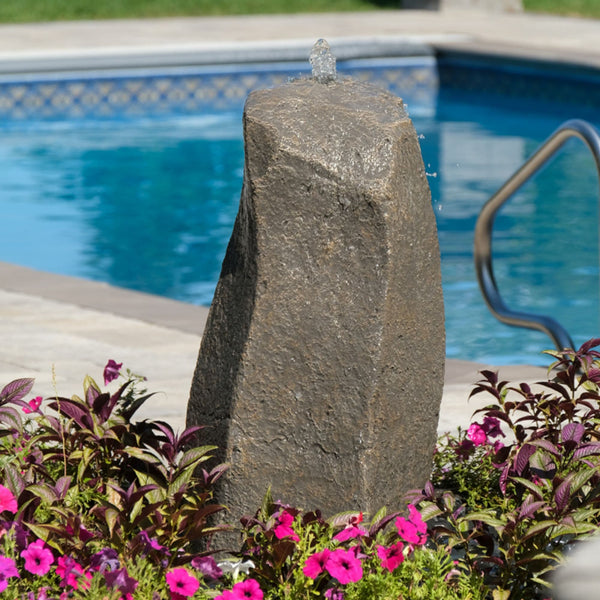
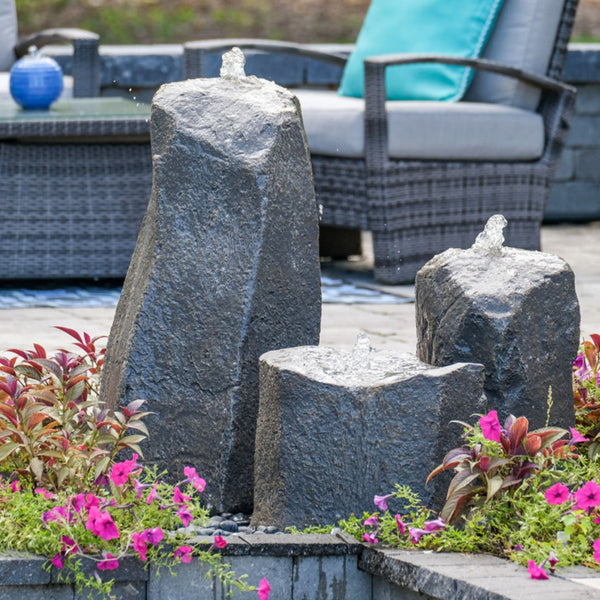
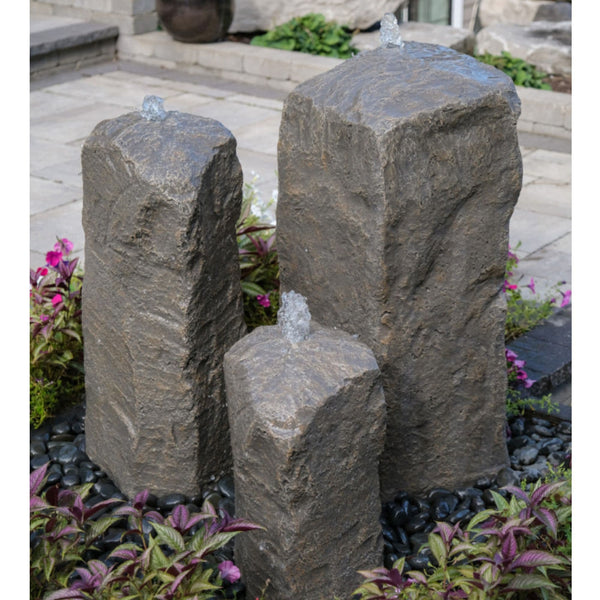
Basalt columns
Tall volcanic columns with polished, semi-polished, or raw faces, sold as single pieces and sets of three. Water pools on the top and runs down the sides.
Choose basalt columns when you want vertical height and a clean, modern, or Japanese-inspired look.
Spheres, cubes, urns, and millstones
Granite, onyx, marble, and limestone shaped into spheres, cubes, tapered urns, and millstone discs, where water sheets across the finished surface.
Choose these when you want a formal or geometric piece that reads as sculpture at ground level.
Bubbling boulders and cascades
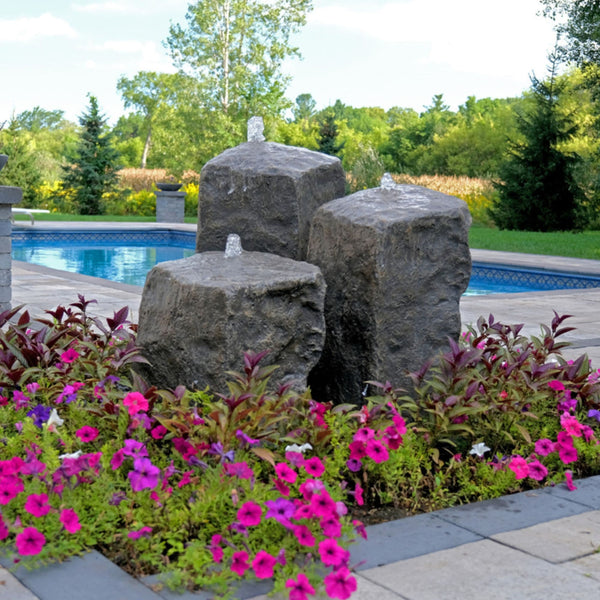
Low-profile rock forms where water bubbles from the top and runs across the surface or down stacked stones.
Choose these when you want a natural rock garden look and a gentler trickle.
Bird baths and spillway bowls
Shallow scooped tops and tiered bowls that pool water before spilling over an edge. Some bowls are sold as singles and some as sets of three.
Choose these when birds and pollinators are part of the plan, or when you want layered spillway sound.
Fire and crystal pieces
One boulder fountain combines fire and water, and one kit uses a clear acrylic sphere that overflows with water.
Choose these when the fountain is for an entertainment area and you want more than moving water alone.
How to choose the right size and arrangement
Start with the space, then the sound.
- Footprint. A single column or sphere fits a garden corner or small courtyard. Triple-column and multi-rock sets spread wider and need more clearance from paths.
- Height. Short pieces sit within a planting bed. Taller columns act as a vertical feature and read from a distance or from indoors.
- Sound. Bubbling stones and smooth spheres are usually the quietest. Cascading rocks, spillway bowls, and tiered sets move more water and make more sound.
- Color and finish. Pieces come in basalt, black and speckled granite, red and yellow onyx, pink and green marble, and blue limestone, with polished, semi-polished, chiseled, and raw-cut finishes.
Natural stone color and shape vary from piece to piece, so treat photos as representative rather than exact.
Setup, power, and what comes with it
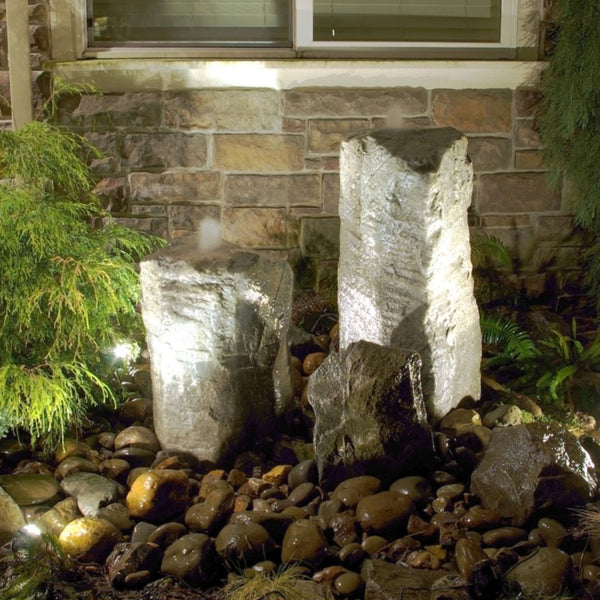
Fountains of this kind generally recirculate water from a reservoir beneath the stone. A common pondless setup is a basin set below grade, a support grate holding the fountain, and river rock over the grate, with a submersible pump pushing water up through the drilled channel.
What comes with a listing is not the same for every product. Check the product page before ordering to see whether the reservoir, pump, plumbing, and fittings are included or whether the listing is the stone itself.
- Base. Solid basalt and granite need a level, well compacted gravel base that can carry the weight.
- Power. The pump needs an outdoor outlet that is easy to reach and GFCI protected.
- Water. Plan on topping up with a hose to replace what wind and splashing remove, unless an auto-fill line is added. Leave clearance from seating and walking paths where the piece splashes.
Not sure which one you need?
Tell PondHaven where the fountain will sit, roughly how much room you have, which material suits the spot, and how much sound you want. We can point you to the pieces that fit and confirm what each listing includes.
No page change, it expands right here
Frequently asked questions
Quick answers to the most common questions about our stone water fountains.
Are these fountains solid quarried stone or molded concrete?
Both. Some pieces are cut from natural stone such as basalt, granite, marble, onyx, and blue limestone, and others are molded from GFRC (glass fiber reinforced concrete) using real rock molds. Each product page names the material.
Does a stone fountain come with a basin and a pump?
Not always, so check the product page before you order. Some listings are the fountain stone alone and others include more of the setup, and the page states what you are getting.
How heavy is natural stone, and will I need help placing it?
Natural basalt, granite, and marble pieces are heavy and usually need several people or equipment to move and set. GFRC versions are molded from real rock to weigh less, which helps on patios and in tight access.
Do I need to dig a hole for a buried basin?
Often yes for a bubbling stone fountain, since the reservoir usually sits below grade with a grate and river rock on top. If you want a piece that sits on an existing patio or over an existing basin, ask us and we will point out the ones that suit it.
How do I winterize a stone water fountain?
Shut it down and drain the water before the first hard freeze, then store the pump indoors. Water left in the drilled channels can freeze and split the stone, so it is worth doing even in mild cold snaps.
Need expert help finding the right setup?
Contact Pond Haven Support