
How to Choose an Outdoor Fountain
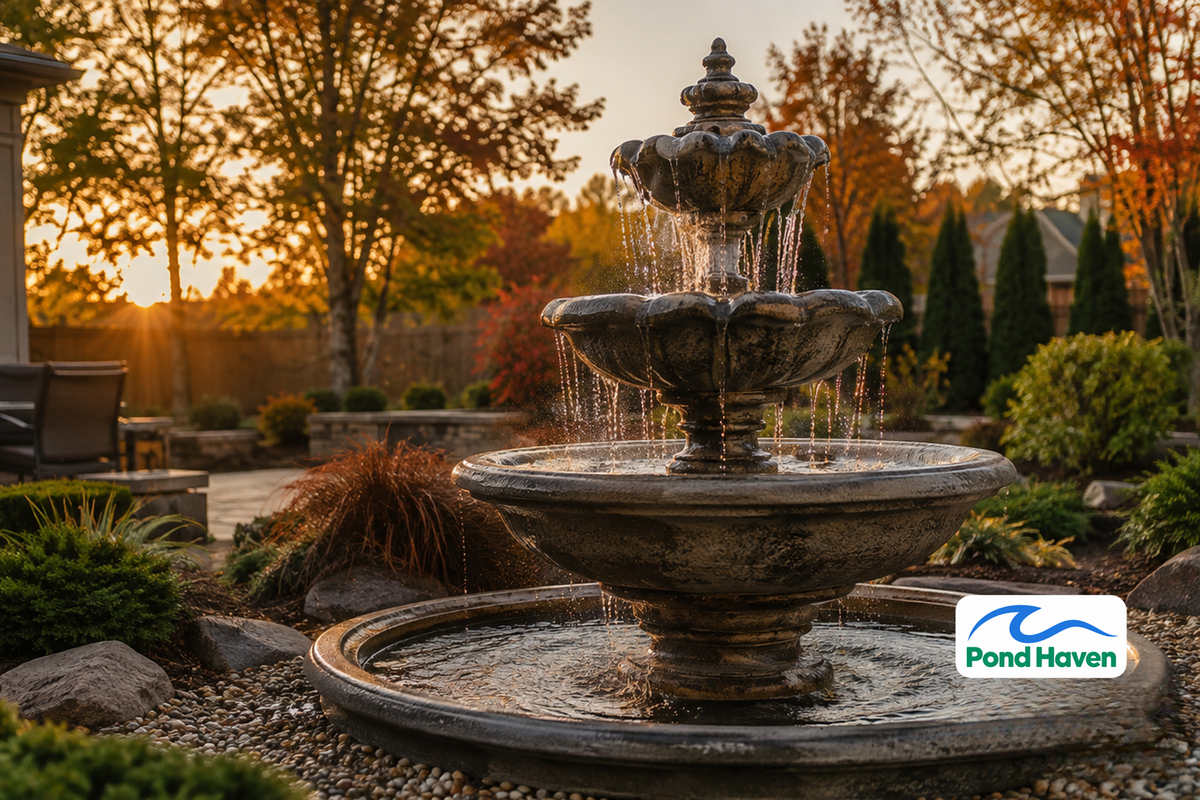

A fountain is a multi-sensory investment. It adds a visual focal point, masks traffic noise, and attracts birds and pollinators. But the difference between a fountain you love and one you regret comes down to decisions made before you buy.
Identical-looking designs can range from $120 to $1,200 based strictly on material quality. That gap is why a structured buying process matters.
This guide walks you through six decision areas: type, material, power, sound, scale, and maintenance. Get these right and you avoid the three most common purchase failures: excessive water loss from splash, premature pump burnout, and material degradation from climate mismatch.
- Match fountain type to your space and lifestyle before considering aesthetics — safety, maintenance, and sound all flow from type.
- Cast stone lasts decades; resin lasts a few years. The $120-to-$1,200 price gap on identical designs is material quality.
- Size your basin 16–24 inches larger than the fountain's widest point, and plan for the full operating footprint, not just visible dimensions.
- Circulate the total water volume at least once per hour. Use the cascade formula to calculate required pump head.
- Budget for total cost of ownership, not just purchase price. A 100-watt pump running 24/7 costs about $13 per month.
Part 1: Fountain Types — Matching Form to Function
Freestanding and Floor Fountains
Freestanding units sit directly on a level surface with no wall attachment. They are the most versatile in placement and work best as a primary garden focal point visible from multiple angles.
Heavy units (200–1,000+ lbs) require a compacted gravel base or concrete pad. Professional placement and leveling are mandatory for cast stone. The weight is a technical advantage: heavy freestanding fountains resist wind tipping in open spaces.
Best for: Homeowners seeking a dominant visual anchor for a patio, courtyard, or garden bed.
Wall-Mounted Fountains
Wall-mounted fountains attach to or recess into a wall, eliminating ground footprint entirely. They suit small patios, entryways, and narrow side yards.
Before buying, assess wall structural integrity. A concrete or natural stone wall fountain can weigh 50–200+ lbs. Plumbing and electrical lines may need routing through wall cavities, which usually means professional installation.
Wall fountains produce a more concentrated sound profile because the wall reflects and projects the water noise toward your seating area.
Best for: Small spaces where floor area is precious.
Disappearing and Pondless Fountains
Disappearing fountains hide the reservoir underground, creating the illusion that water flows directly from the ground or a decorative urn. The water drains through gravel into a buried basin and recirculates.
Safety advantage: No open standing water, making these the safest choice for households with small children or pets.
Maintenance advantage: Smaller water volume means less algae and fewer treatment requirements.
Installation cost: Excavation of 18–24 inches for the reservoir basin, plus careful grading for proper water return. Preformed plastic basins typically have weight limits under 2,000 pounds.
Best for: Families with kids or pets, modern minimalist landscapes, and anyone who wants a water feature without a pond.
Tabletop Fountains
Tabletop units are small-scale features for patio tables, decks, and balconies. Resin models typically cost $100–$300. They are light enough for one or two people to reposition without professional help.
Sound output is subtle, suited to close-proximity seating. Tabletop units are the most common category paired with 6–8W solar pumps (about 80 GPH output).
Best for: Renters, apartments, condos, and first-time water feature owners.
Tiered Garden Fountains
Tiered fountains create a separate sound layer at each level. The overlapping noise produces a fuller, more complex acoustic profile that is the preferred style for masking traffic or neighbor noise.
Deeper tiers absorb sound and soften the profile. Shallow tiers create a sharper splash.
Each tier increases total water volume and pumping capacity needed. Winterization is more complex — every basin must be drained individually.
Best for: Traditional, classical, Mediterranean, and formal gardens where noise masking matters.
Specialty and Artistic Fountains
Sphere fountains, zen designs, acrylic features, and copper art fountains serve as conversation-piece focal points. Animal and rustic styles suit naturalized gardens; bronze and classical styles fit formal landscapes.
Custom fabrication carries longer lead times and higher costs. Budget for design consultation if you commission a piece.
Part 2: Material Science — Durability, Weight, and Aesthetics
| Material | Weight | Lifespan | Price Range | Climate Suitability |
|---|---|---|---|---|
| Cast stone | 200–1,000+ lbs | Decades | High end | All climates, including freeze-thaw |
| Resin/fiberglass | 20–80 lbs | A few years | $100–$700 | Mild climates only |
| Concrete | Very heavy | Decades | Moderate | All climates |
| GFRC | Moderate | Decades | Mid-to-high | Freeze-thaw resistant |
| Copper | Moderate | Decades | Premium | All climates |
| Ceramic | Moderate | Years, if protected | Varies | Freeze risk below 32°F |
Cast Stone
Cast stone is a blend of cement, sand, crushed stone aggregates, and mineral pigments poured into molds and cured. It is the dominant material in the premium fountain market.
It handles high humidity, extended UV exposure, and seasonal freeze-thaw cycles. Over 1–2 years it develops a natural patina as minerals interact with the surface. Density provides stability that birds prefer for footing.
Drawback: Freight shipping on pallets. This is a lifetime architectural piece, not seasonal décor.
Resin and Fiberglass
Resin is molded plastic composite designed to mimic stone. It ships via standard carriers and costs $100–$700. One or two people can carry and reposition it.
Limitations: Susceptible to warping in prolonged heat, fading under strong UV, and cracking during freeze cycles. The finish chips and peels after a few years rather than developing a patina.
Consider resin "seasonal décor" or a short-term investment. It suits renters, those still arranging patio layouts, and budget-conscious buyers.
Concrete
Concrete is thicker and simpler in finish than cast stone. It is built as an architectural element rather than purely decorative. It tolerates harsh weather, heat, and constant water exposure.
Concrete tends to lighten over time and may develop mineral streaking where water flows. Cracks can be patched and sealed more readily than resin.
GFRC (Glass-Fiber Reinforced Concrete)
GFRC is concrete reinforced with glass fibers, providing high tensile strength at reduced weight. It delivers the texture of natural stone at a fraction of the weight.
It resists freeze-thaw cycling better than standard concrete due to reduced water absorption, and it reduces seismic load. GFRC is the primary material for durable pondless features and is ideal for elevated decks and rooftops where structural load matters.
Copper and Metals
Copper is a living material. It arrives with a warm metallic shine and develops a patina after exposure to air and running water. It is naturally antimicrobial, reducing algae and bacterial growth.
Copper lasts decades with proper maintenance. Some homeowners apply clear sealants to preserve the original finish; others let the green patina develop. Copper and bronze sit at the premium end of the price spectrum.
Ceramic and Glazed Pottery
Ceramic is common in disappearing fountain designs and decorative tabletop units. Glazed surfaces resist UV fading but chip and crack on impact.
Freeze risk: Ceramic must be fully drained and protected below 32°F. Trapped water cracks the glaze or body.
Best for: Courtyards, patios, and covered outdoor spaces where freezing is rare.

Part 3: Sizing, Scale, and Spatial Planning
The Complete Operating Footprint
Plan for the complete operating footprint, not just the visible fountain structure. The footprint includes the underground reservoir, splash zone, and pump access points.
Leave 12–18 inches of clearance around the perimeter for maintenance access. You need to reach the pump without dismantling the fountain.
Mockup technique: Cut cardboard to the fountain's footprint and place it in your yard for 48 hours. Evaluate sightlines from kitchen windows, patio chairs, and entry points. A garden hose laid out on the ground works too.
Splash Radius Rule
The standard engineering rule is Height = Radius. Water falls outward roughly as far as it falls downward. A 36-inch fountain needs 36 inches of splash clearance on all sides.
Wide splash radii require larger basins or repositioning away from home exteriors, walkways, and outdoor furniture.
Basin Sizing
Most fountains require a basin 16–24 inches larger than the fountain's widest measurement to recapture water. A 20-inch diameter antique millstone fountain weighing about 150 pounds suits a 36-inch plastic basin.
Concrete pads or footers may be required below basins to reduce settling over time, depending on local soil conditions.
Circulation Rule
Circulate the total water volume at least once per hour. A 20-gallon basin requires a pump rated for at least 20 GPH. This prevents stagnation and algae buildup.
Landscape Proportion
The golden ratio (1.616) is a generic scale rule for fountain-to-yard proportion. A small fountain makes a large patio look more expansive; a large fountain fills open space with vitality.
Line direction matters too. Horizontal lines imply tranquility. Vertical lines imply formality. Diagonal lines imply movement. Curved lines imply naturalness. Choose a form whose dominant line reinforces the mood of your outdoor room.
Part 4: Pump Technology — Power, Flow, and Performance
The Four Critical Pump Metrics
- GPH (gallons per hour): The volume of water the pump moves.
- Head height: The vertical distance from the water surface to the fountain head where water exits.
- Lift: The distance from the pump unit itself to the water exit point.
- Cord length: Submersible pumps sit at basin bottoms; cord length must cover depth plus distance to the power source.
Calculating Required GPH
Base rule: Circulate the total water volume at least once per hour.
Overflowing fountain formula: 10–20 GPH × 3.14 × diameter in inches. A 12-inch overflowing fountain requires 400–800 GPH.
Cascade formula for non-vertical features:
- Measure vertical height from water level to the waterfall top (e.g., 5 feet).
- Measure horizontal distance of the river or tubing (e.g., 20 feet).
- Divide horizontal distance by 10 (20 ÷ 10 = 2 feet).
- Add to vertical height (5 + 2 = 7 feet required max head).
Using a pump with higher GPH is fine — diverters adjust flow strength.
Electric vs. Solar Pumps
Solar pumps without battery backups stop immediately if a person walks past and shades the panel, or if clouds appear. In side-by-side tests, a solar pump rated at 160 GPH produced roughly half the visible power of a 264 GPH electric pump.
Battery backup is essential for steady operation. High-end kits chain the solar panel to a battery, which then connects to the pump, allowing operation after sunset.
Even "wireless" solar fountains require a cord connecting the pump to the solar panel.
Solar Pump Wattage Benchmarks
| Pump Wattage | Output | Application |
|---|---|---|
| 6–8W | ~80 GPH | Bird baths, patio bowls, mini features |
| 10–12W | 120–160 GPH | Small patio ponds, 60–160 gallons |
| 20W | ~280 GPH | Medium patio ponds, 140–280 gallons |
| 25–35W | 320–340 GPH | Large garden ponds, 160–340 gallons |
| 45–55W | 290–580 GPH | Koi-friendly features, 290–580 gallons |
| 70W | ~680 GPH | Off-grid circulation for large features |
Solar panel wattage represents peak output in midday sun. Actual performance varies by orientation and conditions.
Dry Run Protection
Dry run protection shuts the motor off if water levels drop, preventing burnout. High-quality pumps include sensors for this. Budget pumps often skip it — some 6V models (around 65 GPH) have no dry run protection and risk motor burnout if water levels drop.
Energy Efficiency
Variable-speed pumps save significantly in real-world energy costs. The affinity laws explain why: power draw has a cubic relationship with pump speed. Reducing speed by 50% drops energy use to a fraction of full-speed consumption.
Energy-efficient asynchronous or hybrid-drive motors use substantially less electricity than older mag-drive motors for identical flow rates.
Part 5: Sound Engineering — Selecting an Acoustic Profile
The Four Acoustic Drivers
- Water drop distance: The single strongest influence on volume. Taller fountains are louder due to higher impact velocity.
- Tier count: Each level creates a separate sound layer. Multi-tier fountains produce a fuller, more complex profile.
- Pump speed: Acts as a volume dial. High flow creates active splashing; lower flow creates calmer tones.
- Basin depth: Deeper pools absorb sound and soften the profile. Shallow surfaces create a sharper splash.
The Visual-Acoustic Spectrum
From quietest to loudest:
- Mist on a pond — quietest profile
- Water hugging the surface / spilling over edges — subtle, ideal for seating areas
- Water falling through open air — noticeable to loud
- Water pouring from a gutter — loudest impact profile
Noise Masking Applications
To soften traffic or neighbor noise, you need multiple drops or steady cascades. A soft trickle is insufficient for noise cancellation.
For meditation and yoga spaces, choose gentle murmurs. Some manufacturers now publish proprietary sound ratings so you can compare noise levels before purchase.
Seating areas: Use water-hugging-surface designs near seating so conversation stays possible. Multi-tier designs are better for privacy and ambient noise reduction.
Part 6: Cost, Budget, and Market Benchmarks
Material Price Disparity
Identical-looking designs range from $120 to $1,200 based strictly on material quality. Resin small units run $100–$300; mid-sized designs stay under $700. Cast stone sits at the high end due to material costs and freight shipping.
Your budget must include the basin, pump, plumbing, foundation materials, and potential professional installation — not just the fountain itself.
Energy Cost Formula
Annual cost = (Wattage × 24 × 365) ÷ 1000 × electricity rate
At the national average of $0.1805/kWh:
| Pump Size | Wattage | Monthly Cost |
|---|---|---|
| Small/decorative | 40–100W | $5–$13 |
| Medium koi/garden | 200–400W | $26–$52 |
| Large waterfall | 600–1,500W | $78–$195 |
State rates vary widely: Idaho runs about $0.10/kWh; Hawaii runs $0.35–$0.40/kWh. A 100-watt pump running 24/7 costs about $13/month — more than a modern refrigerator ($5–$8/month) because of continuous runtime.
3-Year Total Cost of Ownership
Calculated at 24/7 operation and $0.16/kWh over 3 years:
| Pump Model | Type | 3-Year TCO |
|---|---|---|
| Evolution Aqua Adjustable | Submersible variable, 65–85W | $702 |
| Little Giant F-Series | Submersible, ~175W | $936 |
| Anjon Monsoon | Submersible, 145–265W | $1,062 |
| Anjon Landshark | External, 182–360W | $1,495 |
| ProEco HPP Series | External, ~346W | $1,801 |
| PerformancePro Cascade (Low RPM) | External, 170–430W | $1,867 |
| OASE AquaMax Eco Expert | Submersible, 175–320W | $2,637 |
| EasyPro VSP165 | External variable, 100–550W | $2,799 |
| Sequence Power 4000 | External, 440–750W | $3,960 |
| Sequence Titan | External, 750–1,050W | $6,910 |
Seasonal shutoff savings: Decorative fountains can be shut off for 4–5 months in cold climates, reducing annual costs by 33–40%.

Part 7: Installation, Site Preparation, and Structural Requirements
Foundation Requirements
Heavy cast stone units (200+ lbs) need a solid, level foundation to prevent shifting or wobbling. Concrete pads or footers may be required below basins to reduce settling over time, depending on local soil conditions.
Verify deck weight ratings before positioning any fountain weighing more than 100 pounds. For elevated decks and rooftops, GFRC is recommended over solid stone to reduce structural load.
Hydraulic Engineering Basics
Fountain plumbing involves the pump unit, nozzles, piping, elbows, and valves. Two equations govern performance:
- Bernoulli's equation calculates pressure at any point along a pipe, accounting for elevation, velocity, and energy losses.
- The Darcy-Weisbach equation calculates pressure losses in straight pipe sections based on friction factor, length, inside diameter, and flow velocity.
The practical takeaway: pipe diameter and fitting restrictions reduce flow. Use the largest practical pipe diameter and minimize elbows to protect pump performance.
Access Requirements
Access doors must be a minimum of 24" × 24" to reach mechanical equipment. Plan for pump removal without dismantling the fountain.
Professional Installation Indicators
Hire a professional when:
- Excavation exceeds 12 inches
- Electrical work requires new circuits
- Unit weight exceeds 300 lbs
Part 8: Electrical Safety, Codes, and Compliance
GFCI Requirements
GFCI grounding is mandatory for all outdoor water feature pumps. Test monthly and replace every 5–10 years.
The National Electrical Code periodically updates GFCI protection requirements for outdoor outlets. Verify current local codes with your authority having jurisdiction.
Poolside Rules
- No receptacles within 10 feet of a pool, except a single locking-type GFCI-protected receptacle intended for water pumps.
- All receptacles within 20 feet of a pool must have GFCI protection.
Local Code Verification
Permits are required for new circuits or structural modifications. Always verify local codes — requirements vary by state and municipality.
Use outdoor-rated extension cords and water-tight outdoor cord cover boxes for all electrical connections.
Part 9: Maintenance, Longevity, and Seasonal Care
Water Treatment
Never use chlorine bleach. It corrodes modern pumps and fades newer fountain finishes. Use enzyme-based treatments for organic debris and specialized scale and stain removers for mineral buildup.
Algae Control and Filter Maintenance
Clean filters monthly during peak season. Shade and circulation reduce algae growth. Solar pumps should be paired with small filter pads or sponge filters to prevent intake clogging.
Longevity by Material
- Cast stone: Decades with proper care
- Resin/fiberglass: A few years — seasonal décor
- Copper: Decades with maintenance; naturally antimicrobial
- GFRC: Freeze-thaw resistant
- Ceramic: Years if protected from freezing
- Concrete: Extremely high tolerance for harsh weather
Winterization Protocols
Extreme temperature protocols activate within a 12-to-48-hour window before hard freeze. Drain all materials — trapped water expands during freezing and cracks stone, concrete, ceramic, and resin.
- Cast stone handles freeze-thaw cycles when properly drained and covered.
- Resin becomes brittle and cracks during freeze cycles. Bring it indoors when possible.
- Cover fountains with breathable covers to prevent debris accumulation and ice damage.
Regional Considerations
Southeast: High humidity accelerates algae growth; heavy pollen creates organic debris that clogs pumps. Sudden freeze cycles require vigilance.
Southwest: High evaporation rates and hard water scaling. Budget for more frequent water top-ups and scale treatment.
Northeast/Midwest: Deep freeze and ice expansion. Winterization is non-negotiable.

Conclusion: Your Buying Checklist
Before you purchase, work through this sequence:
- Measure your space — the complete operating footprint, not just visible dimensions. Include 12–18 inches of maintenance clearance.
- Match type to lifestyle — safety (pondless for kids/pets), maintenance tolerance, and sound preference.
- Select material for climate and budget — cast stone for longevity, GFRC for weight-restricted locations, resin only for mild climates.
- Size the basin 16–24 inches larger than the fountain's widest point.
- Size the pump using the GPH formulas — circulate volume once per hour, add 25–50% for overflowing designs, use the cascade formula for waterfalls.
- Plan installation — foundation, electrical (GFCI mandatory), and access for pump removal.
- Budget for total cost of ownership — pump energy at $5–$195/month depending on wattage, plus winterization and maintenance.
Size your basin and measure your fountain's height and plumbing run before choosing a pump. A pump matched to your actual head height and volume runs quieter, lasts longer, and costs less to operate than an oversized unit throttled back with diverters.
Frequently Asked Questions
What size fountain do I need for my yard?
Plan for the complete operating footprint: the visible fountain plus a splash zone equal to its height on all sides, plus 12–18 inches of maintenance clearance. Use the golden ratio (1.616) as a proportion guide — a small fountain makes a large patio look more expansive, while a large fountain fills open space.
How much does it cost to run an outdoor fountain?
A 100-watt pump running 24/7 costs about $13 per month at the national average rate of $0.1805/kWh. Small decorative pumps (40–100W) run $5–$13/month; large waterfall pumps (600–1,500W) run $78–$195/month. Shutting down for 4–5 winter months cuts annual costs by 33–40%.
Is cast stone worth the extra cost over resin?
Cast stone lasts decades and handles freeze-thaw cycles, UV exposure, and high humidity. Resin lasts a few years, fades in strong sun, and cracks in freezing temperatures. If you want a permanent landscape feature, cast stone or GFRC is the better investment. Resin suits renters and temporary setups.
Do I need a GFCI outlet for a fountain pump?
Yes. GFCI grounding is mandatory for all outdoor water feature pumps. The National Electrical Code requires GFCI protection for these installations. All receptacles near a water feature must be GFCI protected, and specific placement rules apply for safety.
Can I leave my fountain running in winter?
Decorative fountains should be drained and shut off before hard freeze — you have a 12-to-48-hour window before temperatures drop. Fish ponds are different: koi and goldfish need continuous water movement or a de-icer. Switch to a smaller circulation pump or lower variable speed setting rather than full shutdown.