
Winterize Pond Fountain
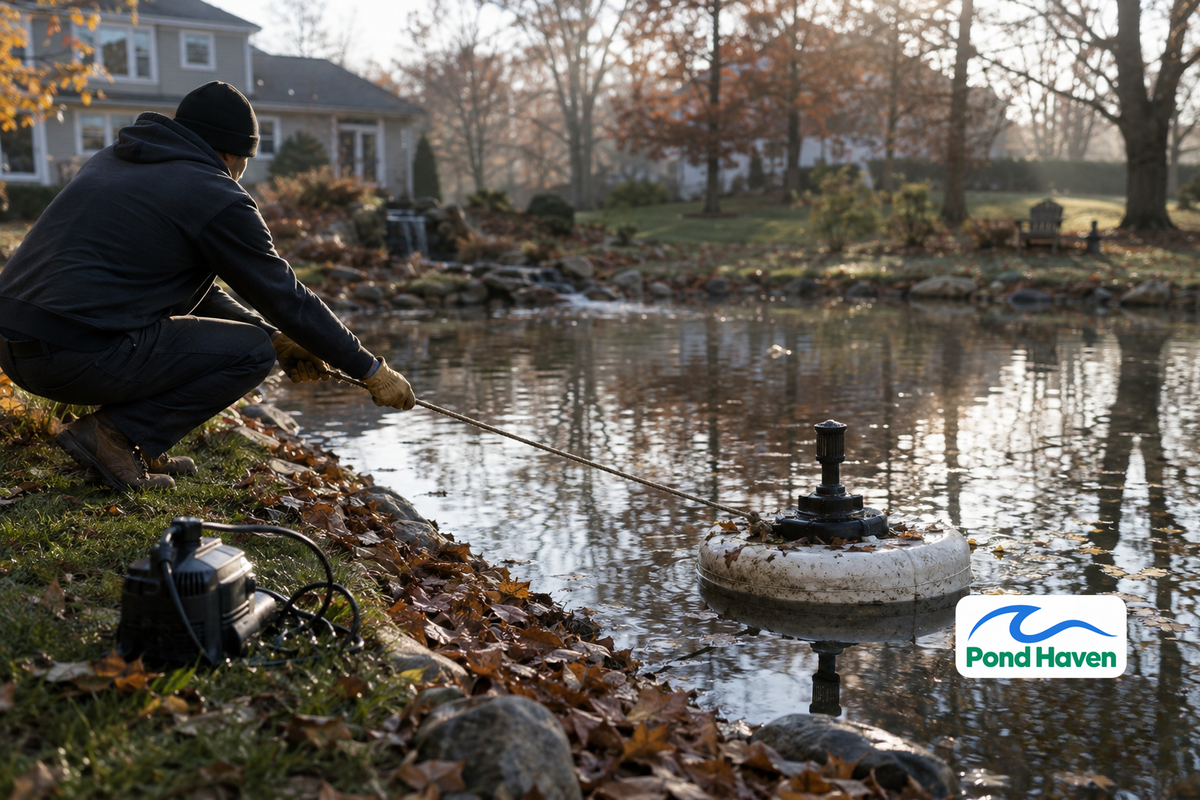

A frozen, cracked fountain pump costs $100 to $500+ to replace. A cracked decorative basin can run into the thousands. Winterizing your fountain properly takes about 30 minutes and costs nothing but a little elbow grease.
This guide covers the climate-based pull vs. run decision, step-by-step removal, the two pump storage methods, electrical safety, and spring reinstallation. You'll get regional specifics, wildlife protection tips, and solar fountain coverage most guides skip.
- Remove your fountain before water temperatures drop below 32°F (0°C); ice expands as it forms and can crack floats, basins, and pump housings.
- If you run a fountain through winter, it must operate continuously at low flow below 23°F (-5°C) or the spray pattern will ice over and damage the pump.
- Store pumps either fully submerged in a bucket of water or completely dry, never partially moist; the storage area must stay above freezing.
- After removing the fountain, keep at least 10% of the pond surface ice-free with a de-icer or diffused aeration for gas exchange.
- Clean the pump with white vinegar or citric acid before storage; algae and debris become acidic as they decompose and eat into seals.
Understanding the Risks: What Happens if You Skip Winterization
Water expands roughly 9% by volume when it freezes. That expansion exerts tremendous pressure on anything containing it. Fountain basins, floats, pump housings, and decorative statues all crack or shatter when trapped water freezes.
Floating fountain floats are especially vulnerable. Ice pressure against the large float body is the primary damage risk, and it's a form of damage explicitly excluded from most manufacturer warranties. Wind moving across a frozen pond shifts ice sheets that can physically impact fountain units even if they're properly installed.
Pump damage follows a different mechanism. When water freezes inside a pump motor or housing, ice expansion permanently distorts seals, O-rings, and internal components. Frozen impellers, warped shafts, and destroyed ceramic bearings are common failure points.
Debris makes it worse. Leaves, twigs, and plastic bags clog fountains during autumn, impairing water flow and allowing ice to solidify around the unit. That ice damages motor seals. Mineral layers and debris also act as insulators, trapping heat around the motor and causing overheating on spring startup if the fountain wasn't cleaned before storage.
The economics are stark. A single residential pump replacement runs $100 to $500+, and commercial floating fountains cost thousands. Winterization is the cheapest maintenance you'll ever do.
The Pull vs. Run Decision: A Climate-Based Guide
The core question: should you remove your fountain or run it all winter? The answer depends on your climate, pond depth, and fountain type.
Temperature Thresholds That Matter
Two numbers drive the decision:
- 32°F (0°C): The freezing point. Remove most fountains before water temperatures drop below this.
- 23°F (-5°C): The operational threshold. If you run a fountain below this temperature, it must operate continuously at low flow. Below 23°F, spray patterns ice over, and the pump can run dry or suffer ice buildup damage.
Running a fountain also cools the pond. A fountain introduces cold air to the water, dropping pond temperature by several degrees. In a fish pond, that can push water toward dangerous lows and cause supercooling, a phenomenon where water drops below its normal freezing point without freezing, which can be lethal to fish.
Regional Guidelines
Northern U.S. (USDA zones 3-5): Always remove and store indoors. Ice formation is guaranteed for months, and a fountain cannot function under those conditions.
Transitional zones (USDA zones 6-7): Case-by-case. If the pond surface freezes for extended periods, remove the fountain. If freezes are sporadic, you may run it with safeguards.
Southern U.S. (USDA zones 8-10): Fountains can typically remain in the water year-round. You still need freeze protection during cold snaps.
Pond Depth and Fountain Type
Ponds under 24 inches deep freeze solid more quickly and put fish and equipment at higher risk. Deeper ponds offer thermal refuge. If your pond is shallow and you keep fish, remove the fountain and consider relocating fish to deeper water or indoor tanks.
Floating fountains face the highest ice damage risk because of their large float bodies. Stationary submerged pumps are easier to protect. Decorative spillways and statuary should always come indoors or be fully drained.
The Stay On/Stay Off Rule
If a floating fountain is running when freezing temperatures arrive, keep it on. If it's already off, leave it off for the duration of the freeze. Switching states mid-freeze shocks the system and invites ice damage.
Fountains on timers should be reprogrammed to 24/7 operation during subfreezing periods. A pump that cycles off in freezing weather has water in the housing that freezes while idle.

Step-by-Step Fountain Winterization & Removal
Pre-Removal Preparation & Safety
Check the forecast and pick a day above freezing, ideally above 40°F. Working with cold, brittle plastic components in freezing weather invites cracks.
Gather your tools: screwdrivers, pliers, a bucket, a hose, a soft brush, and white vinegar or citric acid for cleaning.
Turn off power at the GFCI breaker, not just the switch. The breaker prevents accidental energizing while you work. Every outdoor pond outlet should be GFCI-protected for safety.
Take photos of the setup before disconnecting anything. Document the wiring, connections, and how the fountain sits in the pond. You'll thank yourself in spring.
Disconnecting, Retrieving, and Draining
Step 1: Disconnect the power cord from the GFCI outlet. Never disconnect under load.
Step 2: For floating fountains, carefully pull the unit to the pond edge using the anchor rope. Reel the float to shore using anchor ties or a boat if the pond is large.
Step 3: For submerged pumps, disconnect the hose or pipe fitting before lifting.
Step 4: Lift the fountain and pump out of the water. Support the weight properly to avoid back strain; a large floating fountain is heavier than it looks.
Step 5: Drain all water from the pump housing and fountain basin. Use a submersible utility pump for large basins, then towel out interiors. Moisture left inside freezes and splits components.
Step 6: Remove the pump from the fountain housing if it's a separate unit.
Step 7: Allow all components to air dry completely before storage.
Deep Cleaning the Pump & Components
Clean before storage. Algae and debris become acidic as they decompose, eating into seals and gaskets over the winter.
Disassemble the pump: remove the impeller cover, impeller, and volute. Clean each part with a soft brush and clean water. Never use a wire brush or metal tools, which scratch surfaces and create places for scale to grab.
For scale and mineral buildup, soak parts in a 1:1 white vinegar and water solution for 30 to 60 minutes. Vinegar is the safest option for pumps, gentle on rubber components including O-rings and seals.
For heavier scale, use citric acid: 1 cup per gallon of water. It dissolves lime deposits faster than vinegar but is slightly less gentle on rubber. Rinse thoroughly after any acidic cleaning.
Do not use soap or detergents. They leave residues harmful to fish.
Inspect the power cord for cracks, nicks, or rodent damage. Check the impeller for wear, cracking, or blockage. Inspect all O-rings and elastomers; replace any showing cracks or deformation. Lubricate O-rings with silicone-based lubricant, never petroleum jelly.
How to Store Your Fountain Pump: Submerged vs. Dry Methods
Two accepted methods exist for pump storage, and the debate over which is better rarely gets covered in depth. Here's the real answer.
The Submerged "Bucket Method"
Place the pump in a 5-gallon bucket filled with clean water. Store it in a frost-free location: garage, basement, or shed that stays above 32°F.
This method keeps seals and gaskets hydrated, preventing them from drying out and cracking. It also keeps the unit dust-free.
The critical caveat: the water must not freeze. If the bucket water freezes, the pump suffers freeze damage anyway. If you're storing in an unheated garage, add a small aquarium heater to the bucket.
Best for pumps with mechanical seals that dry out and fail. Professionals typically prefer this method for high-end fountain pumps.
Dry Storage Method
Fully drain, dry, and store the pump in a sealed plastic bag or container. Add a desiccant pack to absorb residual moisture.
This method eliminates any risk of freezing water damaging the pump. The trade-off: seals and O-rings can dry out and crack over winter.
Store the pump elevated off the ground on a shelf or pallet in a cool, dry, well-ventilated, dust-free area. If stored dry, rotate the pump shaft periodically to prevent it from rusting or seizing.
Best for pumps with oil-filled motors or magnetic drive pumps with no mechanical seals, plus simpler utility pumps and lower-cost submersibles.
How to Choose
| Factor | Bucket Method | Dry Storage |
|---|---|---|
| Seal protection | Excellent | Risk of drying |
| Freeze risk | Must stay above 32°F | None |
| Space needed | 5-gallon bucket | Small container |
| Best for | Mechanical seal pumps | Magnetic drive pumps |
Never store a pump partially submerged or in a damp environment. Partial moisture promotes corrosion and seal deterioration. Check your pump manual; models like the SUNSUN CQB-2000 and Oase 45414 have specific storage instructions.
Protecting Electrical Components & Cables
Every outdoor pond outlet should be GFCI-protected for safety. Test your GFCI before winter: press the test button and confirm power cuts, then press reset.
Disconnect and coil the power cord. Never leave cords stretched across the yard where they can be damaged by foot traffic, mowers, or ice movement.
Protect cord ends from moisture. Use dielectric grease on connections and cap with electrical tape. Airmax provides dedicated caps for their cord ends; plastic bags work for other brands.
Wildlife is a real threat. Muskrats and rodents frequently chew through fountain power cords in winter. Inspect all underwater power cables for nicks, cuts, and chew marks before storage.
Protect cables with stainless steel sleeves or PolyFlex power cord sleeves. Bury cables, run them through PVC conduit, or wrap them in metal mesh. Secure cables so they don't float and get damaged by ice movement.
Store cords indoors in a dry location. Coil them loosely and label them for spring.
Winter Pond Care: Aeration and Ice Management After Fountain Removal
Your pond still needs oxygen in winter. Fish and beneficial bacteria consume oxygen year-round, and ice blocks oxygen entry while trapping toxic gases like carbon dioxide, methane, and hydrogen sulfide.
Maintain at least 10% of the pond surface ice-free for gas exchange. An open hole lets toxic gases escape and atmospheric oxygen dissolve into the water.
Option 1: Floating de-icer. These run 300 to 1,500 watts depending on pond size. Impeller deicers like Kasco Marine models maintain an open hole in the ice. Place near the pond's deepest point.
Option 2: Diffused aeration. An air pump pushes air through weighted airline to a diffuser at the pond bottom. Rising bubbles create an upwelling of warmer bottom water that keeps a hole open. A 1/4 HP air pump handles ponds up to 1 acre; larger ponds need more.
Do not use a fountain to keep a hole open. The spray freezes, the pump runs dry, and damage occurs. Fountains alone for winter aeration can also cause supercooling in fish ponds.
Never walk on pond ice near aeration equipment. The upwelling weakens ice unpredictably.

Special Instructions by Fountain Type
Floating Fountains
Inspect anchor ropes for fraying or rot before winter. Remove the entire unit: fountain head, pump, and float. Drain all water from the float chamber. Store the float upside down to prevent water pooling. Clean spray ring nozzles and store indoors.
Release mooring lines but leave the stakes in place. That simplifies reinstallation and positioning in spring.
Stationary/Submerged Pumps
Disconnect plumbing: unscrew hose clamps and fittings. Cap or plug open pipe ends to keep rodents out. Blow out or drain any above-ground plumbing lines.
If you use antifreeze in plumbing lines, use propylene glycol only. Never automotive antifreeze, which is toxic to fish and wildlife.
Decorative/Architectural Fountains
Stone, concrete, and ceramic basins must drain completely. Water left in basins will crack them when it freezes.
Cover basins with a tarp or fountain cover to keep out leaves, snow, and ice. Weight the cover down so wind can't displace it.
Copper and bronze fountains: clean and apply a protective sealant if the manufacturer recommends it. Statuary fountains: remove pumps and disconnect all recirculating lines.
If the fountain is too large to move, cover it and use a de-icer in the basin. For large fixed basins, use foam or insulating blankets around the edges. Keep insulation away from electrical components and the pump; contact creates a fire hazard.
Solar-Powered Fountains
Remove the solar panel and store indoors. Panels are not rated for winter weather. Disconnect and drain the pump; most solar fountain pumps are low-voltage and not freeze-rated. Clean the panel with a soft cloth before storage. Store batteries, if any, at partial charge in a cool, dry location.
DIY vs. Professional Service: What to Expect
DIY winterization costs $0 to $50: cleaning supplies, storage containers, and any replacement parts. Your time is the main investment.
Professional service runs $150 to $400 depending on fountain size and complexity. Pros do full disassembly, pressure washing, ultrasonic cleaning, seal replacement, amperage draw testing, and cord inspection. They also provide dry storage in temperature-controlled facilities and spring reinstallation.
| Service | DIY | Professional |
|---|---|---|
| Cleaning | $0-$15 (vinegar, brush) | Included |
| Storage | $0-$20 (bucket, container) | Included (climate-controlled) |
| Parts/replacements | $10-$50 | Varies |
| Labor | Your time | $150-$400 |
| Amperage testing | Not available to most | Included |
Call a pro for large architectural fountains, complex plumbing, or if you lack indoor storage space. If your fountain is a simple submersible pump in a small pond, DIY is straightforward.
Spring Startup: Reinstallation Checklist
Reinstall after the last hard freeze, typically when nighttime temperatures stay above 32°F.
- Inspect all components: pump housing, impeller, seals, cord, fountain head.
- Reassemble the pump and test it in a bucket of water before placing it in the pond.
- Check the pond water level; top off if needed.
- Reconnect plumbing and hose clamps.
- Plug into the GFCI outlet and test the GFCI before running.
- Run the fountain for 24 hours and watch for leaks, vibration, or unusual noise.
- Clean the pond: remove leaves and debris that accumulated over winter.
Check power cable ends to ensure they were properly protected during storage. Check mooring lines for wear and replace if necessary. Verify float integrity for cracks or ice damage before reentering the water. Use the stakes left in place from fall to simplify positioning.
Test the fountain at low flow first to verify proper water flow and check for leaks. Monitor for 30 minutes after startup for unusual noises, vibrations, or electrical issues.

Winterization Do's and Don'ts
Do:
- Clean your pump before storage
- Store pumps in a frost-free location
- Maintain an ice-free area on your pond
- Test your GFCI before and after winter
- Protect cables from wildlife
Don't:
- Leave water in fountain basins or pump housings
- Run a fountain below 23°F unless it runs continuously at low flow
- Use automotive antifreeze anywhere near your pond
- Store pumps where they can freeze
- Skip the spring bucket test before reinstallation
Frequently Asked Questions
Can I leave my fountain running all winter?
In Southern U.S. climates (USDA zones 8-10), yes, with freeze protection during cold snaps. In Northern climates, no. If you run a fountain in freezing weather, it must operate continuously at low flow below 23°F, and you risk ice buildup on the spray pattern and pump damage.
What temperature is too cold for a pond fountain?
Remove most fountains before water temperatures drop below 32°F (0°C). If you choose to run one, 23°F (-5°C) is the operational limit, and only with continuous low-flow operation. Below that, spray patterns ice over and the pump can run dry.
How do I keep my pond fountain from freezing?
You don't keep the fountain from freezing; you remove it before freezing happens. After removal, maintain an ice-free area on the pond with a floating de-icer (300-1,500 watts) or diffused aeration system. Keep at least 10% of the surface open for gas exchange.
Can I use a fountain de-icer instead of removing the fountain?
No. A de-icer maintains an open hole in the ice for gas exchange; it doesn't protect the fountain from ice damage. The fountain itself must still be removed and stored. Running a fountain in freezing weather risks supercooling the water and damaging the pump.
How do I winterize a fountain with a solar pump?
Remove the solar panel and store it indoors; panels aren't rated for winter weather. Disconnect and drain the pump, since most solar fountain pumps are low-voltage and not freeze-rated. Clean the panel with a soft cloth and store batteries at partial charge in a cool, dry location.
Should I cover my pond fountain in winter?
If the fountain is removed and stored indoors, no cover is needed. If a large decorative fountain must stay outdoors, use a fitted fountain cover or weighted tarp to keep out leaves, snow, and ice. Drain all water from basins first; trapped water will crack them.