
How Much Aeration Does a Pond Need?
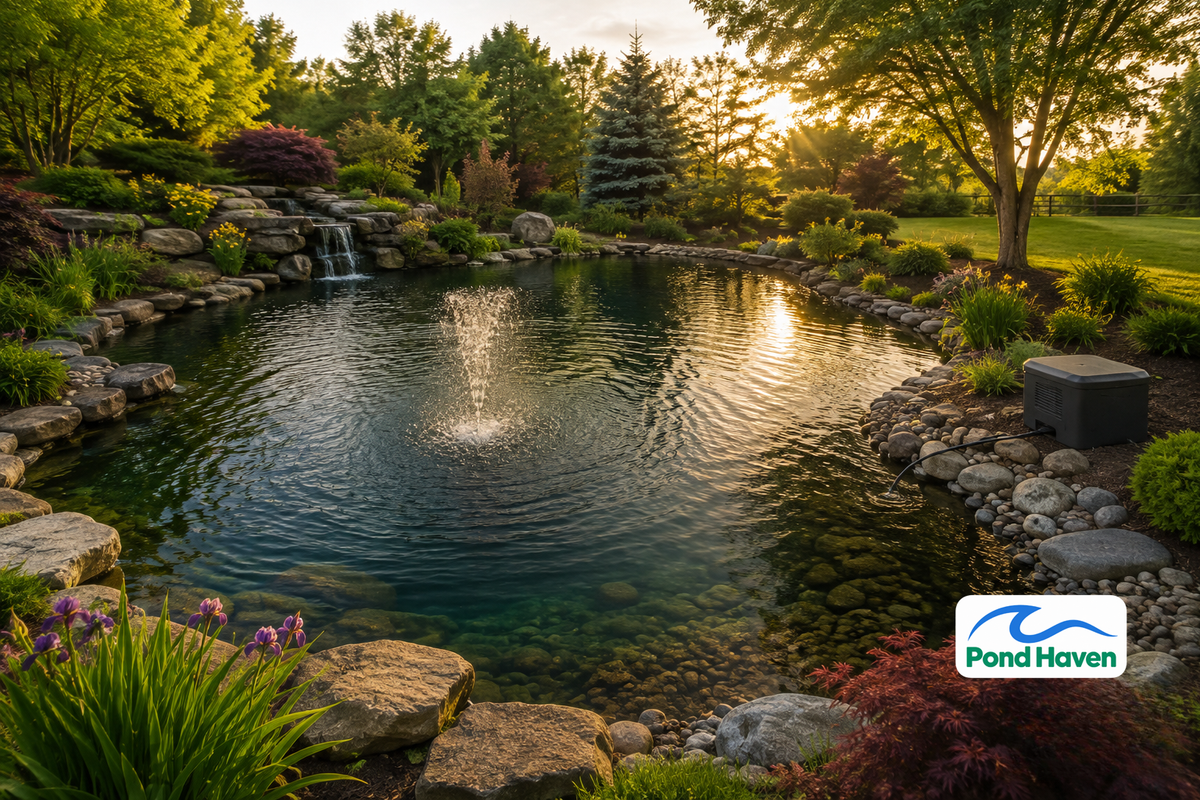

The most common mistake pond owners make is sizing aeration by surface acreage alone. That approach fails because depth, not acreage, is the primary factor that determines what size pond aerator you need.
Aeration delivers oxygen-rich air to the bottom of the water column, where it rises and circulates the entire pond. Undersized systems leave ponds stratified, allow toxic gases to build up, and can kill fish. This guide walks through the exact calculations: CFM, PSI, pond volume, and biological load, then maps the results onto specific compressor systems.
- Depth dictates system type: ponds under 6-8 feet use linear diaphragm compressors; deeper ponds need rocking piston units.
- Base airflow is 1-1.5 CFM per surface acre, adjusted upward for fish stocking and organic muck.
- Every 2.31 feet of water depth adds 1 PSI of backpressure, which reduces compressor output.
- Your system must turn over the entire pond volume at least once every 24 hours.
- Real-world oxygen transfer is less than advertised ratings in warm, oxygenated water, so size conservatively.
Why Pond Aeration and Correct Sizing Are Non-Negotiable
The Science: Oxygen Levels, Fish Health, and Muck Reduction
Dissolved oxygen (DO) is the lifeblood of your pond. Fish need 5-8 mg/L for healthy metabolic function. Below 3 mg/L, most fish experience physiological stress. Below 1-2 mg/L, death is likely.
Aeration does more than keep fish alive. It prevents thermal stratification, where a pond separates into warm, oxygen-rich surface water and cold, oxygen-depleted bottom water during summer. That bottom layer becomes a trap for hydrogen sulfide and ammonia.
Aerobic bacteria, which require oxygen, break down organic muck far more efficiently than anaerobic bacteria. Without aeration, sludge accumulates and decomposition produces toxic byproducts instead of harmless carbon dioxide and water.
The Consequences of Undersizing: Stratification, Toxins, and Fish Kills
An undersized aerator creates a false sense of security. Consider a 1/4-acre pond with a small fountain aerator. The fountain circulates only the top 2-4 feet of water. Below that, the pond stratifies, and the bottom layer slowly depletes of oxygen.
When a summer storm or sudden temperature drop triggers turnover, that oxygen-depleted bottom water mixes with the entire pond. Fish can die within hours.
Winter brings a different risk. Under ice, no oxygen exchange occurs. Without aeration or a de-icer keeping a hole open, toxic gases like hydrogen sulfide and ammonia build up, causing winter fish kills.
The #1 Rule: Depth Dictates Everything
Understanding Water Pressure (PSI) and the "6-8 Foot Rule"
Water exerts pressure on anything submerged in it. That pressure, measured in PSI, is what your compressor must overcome to push air to the bottom.
Water pressure increases 0.433 PSI per foot of depth. Equivalently, every 2.31 feet of water equals 1 PSI.
| Pond Depth | Water Pressure (PSI) |
|---|---|
| 5 ft | 2.17 PSI |
| 8 ft | 3.46 PSI |
| 10 ft | 4.33 PSI |
| 15 ft | 6.50 PSI |
| 20 ft | 8.66 PSI |
The "6-8 foot rule" is simple: ponds shallower than 6-8 feet may not need bottom aeration. Surface agitation from a fountain or surface aerator can suffice. Ponds deeper than 8 feet require bottom-diffused aeration to overcome stratification, because surface systems only affect the top 2-4 feet of water.
How Backpressure Kills Airflow (CFM): The Inverse Relationship
Here is the concept most sizing guides miss: a compressor's airflow output drops as backpressure increases. This is an inverse relationship.
A compressor rated at 4 CFM at 0 PSI may only deliver 2 CFM when operating against 10 feet of water (about 4.3 PSI). A compressor rated at 10 CFM at 0 PSI might deliver just 5 CFM at 10 PSI.
This is why you must match the compressor's performance curve to your pond's depth, not just its maximum rating. Manufacturer spec sheets show CFM at specific PSI values. Always check the curve, not the headline number.
System Type by Depth: Linear Diaphragm vs. Rocking Piston
Depth determines which compressor technology you need.
Linear diaphragm compressors produce high airflow at low pressure, typically maxing out around 4.5-6 PSI. They are quiet, energy-efficient, and ideal for ponds under 7 feet deep. They run 20,000+ hours and cost less upfront.
Rocking piston compressors generate high pressure, rated for 30-50 PSI. They push air to depths of 20, 30, or even 50 feet through weighted tubing. They are louder, require ventilated housing, and need rebuild kits every 3-5 years, but they are the only choice for deep ponds.
Rotary vane compressors sit in the middle. They offer higher air volumes and pressure than linear diaphragms, making them suitable for large ponds or multiple diffuser stations.
| Compressor Type | Max Depth | PSI Range | CFM Range | Noise | Lifespan | Typical Price |
|---|---|---|---|---|---|---|
| Linear Diaphragm | Under 7 ft | Up to 4.5-6 PSI | 0.5-5 CFM | Quiet | 20,000+ hours | $150-$500 |
| Rocking Piston | 8-50 ft | 10-50 PSI | 1-10+ CFM | Loud | 10,000-15,000 hours | $400-$1,500 |
| Rotary Vane | 8-20 ft | 10-15 PSI | 1-8 CFM | Moderate | 15,000+ hours | $500-$1,200 |

How to Calculate What Size Pond Aerator You Need
Step 1: Measure Your Pond
Start with surface acreage. For a rectangular pond: Length (ft) × Width (ft) ÷ 43,560 = Acres. A 100 × 100 foot pond equals 0.23 acres.
Next, measure depth. Take multiple readings across the pond, not just at the deepest point. Average them for volume calculations, but record the maximum depth for pressure calculations.
Calculate volume in acre-feet: Surface acreage × Average depth. A 1-acre pond with a 10-foot average depth equals 10 acre-feet. Convert to gallons: 1 acre-foot = 325,851 gallons.
Worked example: A 1/2-acre pond with an 8-foot average depth = 4 acre-feet = roughly 1.3 million gallons.
Step 2: Determine Your Base Airflow (CFM)
Two rules of thumb establish your starting point:
- By acreage: 1-1.5 CFM per surface acre for diffused systems
- By volume: 1 CFM per 1,000 gallons for lightly stocked ponds; 1.5-2 CFM per 1,000 gallons for heavily stocked ponds
Worked example: A 1/2-acre pond needs 0.5-0.75 CFM as a baseline. Cross-check by volume: 1.3 million gallons ÷ 1,000 = 1,300; at 1 CFM per 1,000 gallons, that suggests roughly 1.3 CFM. Use the higher figure.
Step 3: Calculate Total System Pressure (PSI)
Total system pressure = water column pressure + diffuser backpressure + friction loss.
- Water column: Depth (ft) × 0.433 PSI
- Diffuser backpressure: Fine bubble stone diffusers add up to 1.5 PSI; medium bubble diffusers add less than 0.25 PSI
- Friction loss: Depends on tubing diameter and run length (see the tubing section below)
Worked example: A 10-foot-deep pond = 4.33 PSI water + 1.0 PSI diffuser + 0.5 PSI friction = 5.83 PSI total.
Step 4: Adjust for Your Pond's Biological Load
Fish stocking, feeding, and organic muck all increase oxygen demand.
Heavy stocking (koi, catfish, or high-density baitfish) increases oxygen demand by 25-50%. Each pound of feed requires significant oxygen for digestion and for breaking down fish waste.
Organic muck raises Biochemical Oxygen Demand (BOD). For every 1 pound of organic matter, 1.5-2 pounds of oxygen are required for complete aerobic digestion.
Adjust your CFM upward: add 0.5 CFM per acre for moderate biological load, 1.0+ CFM per acre for heavy load.
Step 5: Factor in Pond Shape and Diffuser Layout
Pond geometry matters more than simple acreage. Coves, bays, and islands create dead zones where water stagnates and toxic gases accumulate.
Each diffuser effectively aerates a roughly circular area. The general rule is one diffuser per 1-2 acres, but irregular shapes need more. Break odd-shaped ponds into sections and place a diffuser in each basin.
| Pond Shape | Diffuser Count |
|---|---|
| Rectangular, uniform | 1 per 1-2 acres |
| Irregular, kidney-shaped | 1 per 0.5-1 acre |
| Multi-basin | 1 per basin minimum |
| With islands or long coves | 1 per cove + 1 per open-water basin |
Place diffusers in the deepest point first, then secondary basins and coves. Diffusers should be spaced 15-20 feet apart.
Choosing Your System: Compressors, Diffusers and Layout
Compressor Deep Dive
Linear diaphragm compressors deliver 0.5-5 CFM at up to 4.5-6 PSI. They are ideal for ponds under 7 feet deep. They run quietly, draw 50-150 watts, and typically last 3-5 years of continuous operation. The HIBLOW HP-80 produces about 2 CFM at 3.71 PSI, making it a solid choice for a 7-foot pond.
Rocking piston compressors deliver 1-10+ CFM at 10-50 PSI. They handle ponds 8-20+ feet deep. They draw 200-500+ watts and last 5-10 years with rebuild kits every 3-5 years. The Airmax PS10 (1/4 HP, 1.7 CFM) aerates up to 1 acre depending on depth. A typical 1/2 HP rotary vane compressor around 3.9 CFM handles larger or deeper applications.
Rotary vane compressors offer a middle path: higher volumes and pressure than linear diaphragms, suited for large ponds or multiple diffuser stations. The Stratus RV Series is a common example.
Diffuser Types, Efficiency, and the 40 LPM Self-Cleaning Benchmark
Membrane disc diffusers are the most common choice for residential ponds. They produce fine bubbles (0.04-0.1 inches in diameter) that maximize oxygen transfer. Ceramic diffusers are durable but heavier and harder to clean.
Each diffuser should receive at least 40 LPM of airflow to prevent clogging and reduce motor stress. That converts to roughly 1.4 CFM per diffuser minimum.
A standard Vertex diffuser disk is rated for 1.0 CFM per disk. If your system delivers less than the manufacturer's recommended minimum, the air may not be strong enough to open the diffuser pores for self-cleaning.
Airline Tubing: Sizing to Minimize Friction Loss
Friction loss increases with tubing length and decreases with larger diameter. Undersized tubing starves your diffusers of air.
| Tubing Diameter | Max Recommended Run |
|---|---|
| 3/8 inch | Under 50 feet |
| 1/2 inch | 50-100 feet |
| 3/4 inch | 100+ feet |
The numbers matter. At 2 CFM of flow, a 200-foot run of 3/8-inch tubing loses 0.90 PSI. The same run in 1/2-inch tubing loses just 0.28 PSI. That difference can mean the difference between a working diffuser and a clogged one.
Use self-weighted airline designed for pond applications. Standard aquarium tubing deteriorates in outdoor conditions and collapses under pressure. Never use it for pond aeration.
Add a 0-10 PSI gauge via a T-fitting outside the compressor port. Pressure spikes indicate clogs; pressure drops indicate leaks. This single $15 tool tells you when your system needs attention.

Installation, Startup and Maintenance
Critical Safety: The Graduated Startup to Prevent Sudden Turnover
Never start a full-size aeration system on a stratified pond in summer. The sudden mixing of oxygen-depleted bottom water can release toxic gases and kill fish within hours.
Use a graduated startup schedule:
- Day 1: Run 30 minutes
- Day 2: Run 1 hour
- Increase by 1-2 hours daily over 1-2 weeks until the system runs full-time
The best time to start a new system is spring or fall, when the pond is naturally mixed and water temperatures are moderate.
Routine Maintenance Schedule
Bottom-diffused systems require less maintenance than surface aerators, which pull water and debris into their mechanisms.
| Task | Frequency | Estimated Cost |
|---|---|---|
| Inspect compressor air filter | Monthly | $0 |
| Check airline fittings for leaks | Monthly | $0 |
| Clean or replace intake filter | Every 6-12 months | $10-$30 |
| Clean diffuser membranes | Annually | $0 (DIY) |
| Replace diaphragm or piston rebuild kit | Every 3-5 years | $50-$150 |
| Replace diffuser membranes | Every 2-3 years | $20-$50 |
Estimated Operational Costs and Lifespan
Electricity costs vary by compressor type. Linear diaphragm compressors draw 50-150 watts. Rocking piston units draw 200-500+ watts.
A 100-watt compressor running 24/7 at $0.15/kWh costs about $11 per month. A 1/4 HP rocking piston unit like the Airmax PS10 costs under $10 per month to run continuously.
Lifespan: linear diaphragm compressors typically last 3-5 years. Rocking piston units last 5-10 years with rebuild kits. Some linear diaphragm compressors can last for several years of continuous operation.
Top 10 Sizing Mistakes to Avoid
- Sizing by acreage alone, ignoring depth. Depth determines system type and pressure requirements.
- Choosing a linear diaphragm for a 12-foot-deep pond. It cannot overcome the backpressure and will fail prematurely.
- Ignoring the CFM-at-PSI curve on compressor spec sheets. The headline CFM rating is at 0 PSI, which is meaningless for your pond.
- Using aquarium tubing or undersized airline. It collapses under pressure and deteriorates outdoors.
- Forgetting friction loss on long airline runs. A 200-foot run of 3/8-inch tubing loses 0.90 PSI.
- Starting a full-size system on a stratified pond in summer. Sudden turnover can kill fish.
- Placing all diffusers in the deepest spot, ignoring coves and dead zones. Irregular shapes need multiple stations.
- Underestimating biological load from heavy fish stocking. Heavily stocked ponds need 50-100% more airflow.
- Buying a compressor with no serviceable parts or rebuild kit. You will replace the whole unit instead of a $50 kit.
- Assuming a fountain aerates the bottom of a deep pond. Fountains only affect the top 2-4 feet.

Quick-Reference Sizing Table and Final Checklist
Sizing Reference Table
| Pond Size | Shallow (<6 ft) | Moderate (6-10 ft) | Deep (10-15 ft) | Very Deep (15+ ft) |
|---|---|---|---|---|
| 1/4 acre | 0.5-1 CFM, Linear Diaphragm, 1 diffuser | 1-1.5 CFM, Linear Diaphragm or Rocking Piston, 1 diffuser | 1.5 CFM, Rocking Piston, 1 diffuser | 1.5-2 CFM, Rocking Piston, 1 diffuser |
| 1/2 acre | 1-1.5 CFM, Linear Diaphragm, 1 diffuser | 1.5-2 CFM, Rocking Piston, 1-2 diffusers | 2-3 CFM, Rocking Piston, 2 diffusers | 3 CFM, Rocking Piston, 2 diffusers |
| 1 acre | 1.5-2 CFM, Linear Diaphragm, 1-2 diffusers | 2-3 CFM, Rocking Piston, 2 diffusers | 3-4 CFM, Rocking Piston, 2-3 diffusers | 4+ CFM, Rocking Piston, 3 diffusers |
| 2 acres | 2-3 CFM, Linear Diaphragm or Rotary Vane, 2 diffusers | 3-4 CFM, Rocking Piston, 2-3 diffusers | 4-6 CFM, Rocking Piston, 3-4 diffusers | 6+ CFM, Rocking Piston, 4 diffusers |
| 3+ acres | 3-4 CFM, Rotary Vane, 3 diffusers | 4-6 CFM, Rocking Piston, 3-4 diffusers | 6-8 CFM, Rocking Piston, 4-5 diffusers | 8+ CFM, Rocking Piston, 5+ diffusers |
Final Pre-Purchase Checklist
- Measured surface acreage (length × width ÷ 43,560)
- Measured average and maximum depth with multiple readings
- Calculated pond volume in gallons and acre-feet
- Determined base CFM from acreage and volume
- Calculated total system PSI (water + diffuser + friction loss)
- Adjusted CFM upward for biological load (fish, feed, muck)
- Mapped diffuser placement for pond shape, coves, and dead zones
- Selected compressor type matched to maximum depth
- Sized airline tubing for total run length
- Planned a graduated startup schedule
Frequently Asked Questions
How many CFM do I need for a 1-acre pond?
A 1-acre pond needs 1-1.5 CFM as a baseline, plus adjustments for depth and biological load. At 10-15 feet deep, plan on 3-4 CFM with a rocking piston compressor and 2-3 diffusers. At 15+ feet, you need 4+ CFM and 3 diffusers.
Can I use a fountain instead of a bottom aerator?
Only if your pond is under 6-8 feet deep. Fountains affect only the top 2-4 feet of water and lose all efficiency beyond 6 feet. For deeper ponds, bottom-diffused aeration is required to overcome stratification and oxygenate the full water column.
How deep does a pond need to be for bottom aeration?
Bottom aeration is recommended for ponds over 6-8 feet deep. Below 3 feet, diffused aeration is inefficient because bubbles rise too quickly. In the 4-6 foot range, shallow bottom aeration may work, but surface circulators are often more effective.
How much does it cost to run a pond aerator 24/7?
A 100-watt linear diaphragm compressor costs about $11 per month at $0.15/kWh. A 1/4 HP rocking piston unit costs under $10 per month. Larger 1/2 HP units draw 400-500 watts and cost $40-55 per month.
Can I oversize my pond aerator?
Yes, and it is generally safer than undersizing. Real-world oxygen transfer runs only 19-64% of advertised ratings in warm, oxygenated water. Oversizing gives you a buffer. The main downsides are higher upfront cost and the need for a graduated startup to avoid sudden turnover.