
How to Clear Brown Pond Water
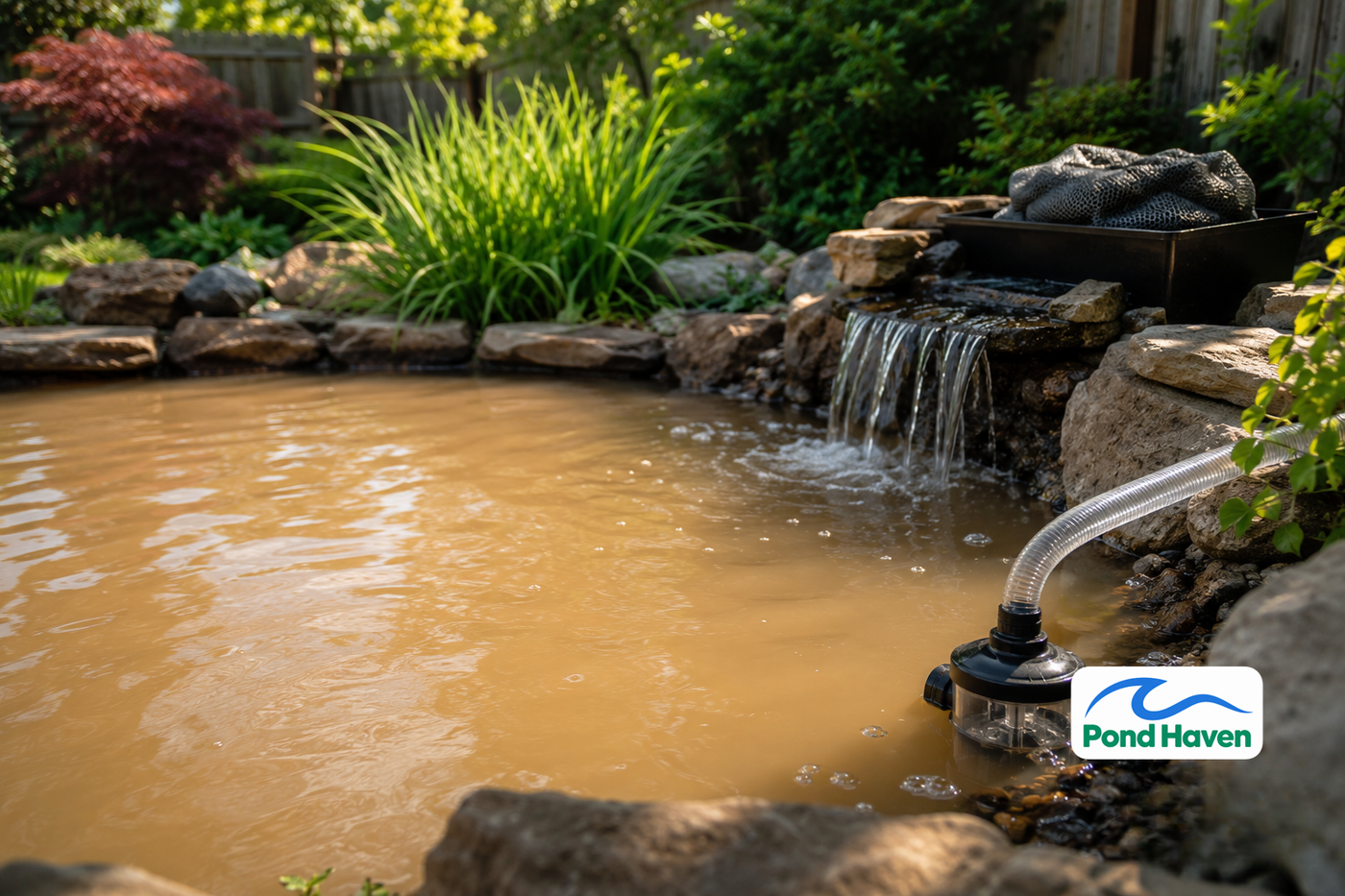

Brown water is the most common complaint we hear from pond owners. It's also the most misunderstood. The fix only works when you know the cause, because brown water comes in two very different forms: tea-colored water from dissolved tannins, and muddy, turbid water from suspended sediment. Treat the wrong one and you'll waste money and see zero results.
This guide walks you through diagnosis first, then routes you to the right treatment: skimmers and pumps for sediment, activated carbon for tannins, and diffused aeration for the biological issues underneath both. You'll get the numbers, the equipment names, and the seasonal timing to actually fix it.
- Run the Jar Test before buying anything: settled particles mean sediment, uniform brown color means tannins.
- Activated carbon removes dissolved tannins; flocculants and mechanical filtration remove suspended clay and silt.
- Diffused aeration (bottom bubblers) prevents the stratification and oxygen crashes that make brown water worse.
- Alum drops pH by about 1.0 unit; PAC is gentler and produces less sludge.
- Beneficial bacteria need water above 50°F and 4-8 weeks to show visible sludge reduction.
Root Causes of Brown Pond Water
Dissolved Organic Compounds (Tannins)
Tannins are dissolved organic acids that leach from decaying plant matter. Oak leaves, pine needles, cedar, and peat are the worst offenders. As they break down, they release humic and fulvic acids that stain water a clear amber or dark tea color.
The key word is dissolved. Tannins are in solution, not floating as particles. That's why no filter or flocculant will remove them. You can see through tannin-stained water, but it looks like weak iced tea.
This is more common in wooded areas, the southeastern US, and any pond with heavy leaf litter. It's harmless to fish, but it blocks light for submerged plants and looks terrible.
Suspended Sediment & Erosion
Turbid brown water is a different problem. It's caused by clay, silt, and sand particles suspended in the water column. Clay particles range from 0.2 to 2.0 microns, silt from 2.0 to 50 microns, and sand from 100 to 2,000 microns. The human eye can only see particles around 40 microns and larger, which is why fine clay makes water look like chocolate milk.
Clay stays suspended because of electrostatics. Clay particles carry a negative surface charge that makes them repel each other, so they never clump and settle on their own. Stormwater runoff, bank erosion, wind, and bottom-feeding fish all introduce or resuspend these particles.
Organic Sludge & Muck
Sludge is the layer of decomposed leaves, fish waste, and dead algae on your pond bottom. It doesn't directly color the water, but it fuels the problem. Sludge consumes oxygen as it decomposes, creating anaerobic zones that release hydrogen sulfide and ammonia. Fish and wind then stir these nutrients back into the water column, feeding algae and worsening turbidity.
Biological Factors
Algae blooms that die off release tannin-like compounds as they decompose. Bacterial imbalances and low dissolved oxygen slow the breakdown of organic matter, letting color compounds accumulate. Overstocked fish add waste and stir bottom sediment. These factors rarely cause brown water alone, but they amplify whatever else is happening.
Diagnosis: Identify Your Cause
The Jar Test (Step-by-Step)
This is the single most important diagnostic step. It takes 24 hours and costs nothing.
- Fill a clear glass jar with pond water.
- Set it on a flat surface, undisturbed, for 24 hours.
- Observe the results.
If particles settle to the bottom and the water above clears: you have suspended sediment. Treat with flocculants, mechanical filtration, or erosion control.
If the water stays uniformly brown with no settling: you have dissolved tannins. Treat with activated carbon or water changes.
If the water clears but turns green: algae is a secondary issue. Address nutrients and add biological treatment.
Professional Water Testing
If the Jar Test is inconclusive, or you have fish health concerns, test the water. A basic kit covers pH, ammonia, nitrite, and nitrate. For persistent issues, send a sample to a lab for dissolved oxygen, phosphate, and UV-254 absorbance, which measures dissolved organic matter.
Target ranges for a healthy pond: pH 6.5-8.5, dissolved oxygen above 5 mg/L for fish, ammonia and nitrite at zero. If dissolved iron or manganese is present, you'll see brown staining that requires oxidation (via aeration) before filtration can catch it.

Immediate & Short-Term Remedies
Partial Water Change
A 10-25% partial water change is the fastest way to dilute tannins. It's enough to meaningfully reduce color without shocking your fish or wiping out beneficial bacteria.
Use dechlorinated water matched to your pond's temperature. Replace 10-25% of the volume, wait a week, and repeat if needed. This is a temporary fix. If you don't remove the leaf litter or address the runoff, the color returns.
Skip the water change if the problem is sediment. You'll just stir up more particles. Also skip it during a fish stress event or heat wave.
Activated Carbon for Tannins
Activated carbon is the proven solution for dissolved tannins. It works by adsorption, not absorption. Molecules enter the carbon's pore structure and are held there by Van der Waals forces.
Carbon type matters:
| Carbon Type | Pore Structure | Best For |
|---|---|---|
| Coconut shell | Tight micropores | Small compounds, VOCs |
| Bituminous coal | Small, medium, large pores | General all-purpose |
| Wood | Large macropores | Color removal |
| Lignite | Large macropores | Color removal |
For tannin-stained ponds, wood or lignite carbon is your best bet. Coconut carbon's tight pores struggle with larger humic acid molecules.
Dosage: roughly 1 pound of carbon per 100-200 gallons for heavy tannin loads. Place it in a mesh bag in your filter housing, waterfall box, or near the pump intake.
Replacement: carbon exhausts in 2-4 weeks under heavy tannin loads. When the brown color returns, replace it. Reactivation requires heating to 1,700°F, which isn't practical for pond owners. Just buy fresh media.
Sludge Removal (Vacuuming)
If sludge is your issue, a pond vacuum is the direct fix. These units pull settled muck off the bottom without draining the pond. Vacuum in spring and fall, before adding bacteria. Long-settled muck and pollen mats need a vacuum and soft-tip brush; a net won't touch them.
For larger ponds, mechanical dredging is the option, but it's expensive and often requires permits. Vacuuming is the practical choice for most residential ponds.
Mechanical & Physical Solutions
Filtration Systems (Micron Ratings, Types)
Mechanical filtration catches suspended particles, but only if the filter is fine enough. Here's what each micron rating catches:
| Micron Rating | Catches | Notes |
|---|---|---|
| 50-60 micron | Sand, visible grit | Spin-down filters with flush valve |
| 20 micron | Fine sand, large silt | Standard pre-filtration |
| 5 micron | Fine silt, clay | Industry standard for turbidity |
| 1 micron | Ultra-fine particles, cysts | Pairs with UV disinfection |
Two ratings exist: nominal traps about 85% of particles at the rated size; absolute traps 99.9%. For clay, you need 5-micron or finer. Most standard pond filters are rated at 50-100 microns, which is why they fail on clay turbidity.
A 20-inch Big Blue cartridge housing with a 5-micron cartridge is a common upgrade for sediment problems. Replacement cartridges typically run $40-50 and last 3-6 months depending on load. That's the most cost-effective upgrade for a sediment problem.
The hard limit: filters catch particles, not dissolved tannins. If your Jar Test showed clear brown water, no filter will help.
Aeration Systems
Aeration doesn't directly clear brown water, but it's the foundation of every long-term fix. Dissolved oxygen drives the bacteria that break down sludge and organic matter. Without it, your pond is working against you.
- Bottom diffusers are the most efficient. An air compressor pushes air to the pond bottom, where rising bubbles circulate the entire water column and prevent stratification. These are self-cleaning and run year-round.
- Surface fountains look nice but only recirculate already-oxygenated surface water. They do little for deep-water circulation.
- Pumps can create currents but use more energy and clog with debris.
Target 5-8 mg/L dissolved oxygen. Aeration alone won't clear tannins or heavy sediment, but it's the prerequisite for bacteria to work. For more on sizing and placement, see our guide to pond aeration systems.
UV Clarifiers (Limitations)
UV clarifiers kill single-celled algae that cause green water. They do nothing for tannins or sediment. If your water is brown, not green, a UV clarifier is wasted money.
The trap is assuming UV fixes all clarity issues. It doesn't. Use UV only if your Jar Test showed a green tint after settling, indicating an algae component.
Chemical Treatments
How Coagulants & Flocculants Work
Flocculants neutralize the negative surface charge on clay particles, allowing them to clump into larger masses called flocs. These flocs settle to the bottom, where you vacuum them up.
Coagulation is the charge-neutralizing step. Flocculation is the clumping step. Both happen in one product for most pond treatments.
Flocculants only work on suspended solids. They will not touch dissolved tannins. If your Jar Test showed clear brown water, skip this section.
PAC vs. Alum Comparison
Two flocculants dominate the market: polyaluminum chloride (PAC) and alum (aluminum sulfate).
| Factor | PAC | Alum |
|---|---|---|
| Floc size/speed | Faster, larger, stronger flocs | Slower, smaller flocs |
| Dosage needed | Lower | Higher |
| Sludge produced | Significantly less | More |
| pH impact | Minimal (less than 0.5 units) | Drops pH by ~1.0 unit |
| Temperature range | Works across wider range | Less effective in cold water |
| Residual aluminum | Lower | Higher |
The key difference: alum at optimal doses lowers pH by about 1.0 unit. In low-alkalinity water, that can stress or kill fish. PAC's pH impact is minimal, making it the safer choice for most ponds.
Application Protocols & Warnings
- Dosage: 1 fluid ounce per 1,000 gallons for maintenance; 2 ounces per 1,000 gallons for problem ponds. Start low and re-dose after 24 hours if needed.
- Application: Dilute in a few gallons of pond water, then pour around the edges or spray over the surface.
- Agitation: Optimum flocculation requires 3-9 minutes of mixing. Turn on a pump or aerator during application, then shut it off so flocs can settle.
- Timing: Treat during cool weather to minimize fish stress. Flocculants can stress fish if overdosed.
- Aftermath: The settled floc must be vacuumed or removed. If left to decompose, nutrients return to the water column.

Biological & Natural Treatments
Beneficial Bacteria & Enzymes
Beneficial bacteria digest organic sludge at the molecular level. The key strains are Bacillus subtilis and Bacillus licheniformis, aerobic heterotrophs that consume nitrogen and phosphorus while producing enzymes that break down waste.
- α-amylase breaks down carbohydrates.
- Protease targets protein-based sludge.
- Lipase decomposes fats.
- Cellulase degrades plant fiber.
Dosage: follow label rates. A typical product calls for 2 ounces per 1,000 gallons weekly during the growing season. Problem ponds double the dose twice weekly.
Timeline: bacteria work slowly. Expect 4-8 weeks for visible sludge reduction. Using a high-dose bacterial regimen can effectively reduce sludge depth over time.
The catch: bacteria need water above 50°F to be active. Below that, microbial activity nearly stops. Start dosing in spring when water warms, and stop in late fall.
What bacteria won't do: clear tannins or suspended clay. They're a long-term sludge and nutrient tool, not a clarity fix.
Plants & Alternative Methods
Aquatic plants compete with algae for nutrients. Water lilies, pickerelweed, and arrowhead are good choices. Submerged vegetation also stabilizes bottom sediment.
Barley straw is a preventative algae tool, not a cure for existing brown water. It releases compounds that inhibit algal growth as it decomposes, but it takes weeks to work and does nothing for tannins or sediment.
Plants are a prevention tool, not a treatment. Use them to keep problems from returning, not to fix what's already wrong.
Long-Term Prevention & Control
Buffer Zones & Erosion Control
The best treatment is the one that keeps sediment out of your pond. A vegetated buffer zone is the most effective filter you can install.
- Inner zone: minimum 25 feet of native vegetation for bank stabilization.
- Middle zone: 50-100 feet of mature riparian forest where possible.
- Outer zone: 25 feet of turf or ornamentals to slow and filter runoff.
Native grasses, sedges, and shrubs hold soil far better than mowed lawn. For steep slopes, use riprap or stone revetment to stabilize the bank. Redirect downspouts and install French drains to keep sediment-laden stormwater away from the pond.
Federal regulations under the Clean Water Act require NPDES permits for construction sites disturbing 1 or more acres to maintain natural buffers. If you're planning earthwork near your pond, check local requirements first.
Pond Management & Maintenance
- Fish stocking: follow the rule of roughly 1 inch of fish per 10 gallons. Overstocking adds waste and stirs sediment.
- Feeding: stop feeding during poor water clarity. Uneaten food is pure nutrient loading.
- Leaf management: net the pond in fall, skim debris weekly, and use fine-mesh skimmers in spring and fall to prevent the "brown phase" entirely.
- Weed coverage: keep aquatic weeds below 20% of the pond surface. More than that impedes circulation and oxygen diffusion.
- Aeration: run diffused aeration year-round. It prevents the winter and summer stratification that causes oxygen crashes.
- Monitoring: run a Jar Test monthly and check water quality parameters quarterly.

Step-by-Step Treatment Plan (Week-by-Week)
Week 1: Diagnosis and Immediate Action
- Day 1: Run the Jar Test.
- Day 2-3: Confirm the cause. Order supplies.
- Day 4-7: If tannins, do a 10-25% partial water change. If sediment, start aeration and check your filter.
Week 2: Primary Treatment
- Tannin path: add activated carbon (1 lb per 100-200 gallons). Expect 2-4 weeks of effectiveness.
- Sediment path: apply flocculant at label rate. Mix for 3-9 minutes, then let settle. Vacuum flocs after 24 hours.
- Sludge path: vacuum the bottom, then start bacterial dosing.
Week 3-4: Follow-Up and Adjustment
- Re-test clarity.
- Replace exhausted carbon if brown color returned.
- Re-apply flocculant if needed (check label for re-treatment intervals).
- Begin weekly bacterial maintenance dosing.
Week 5-8: Biological and Long-Term Work
- Continue bacterial treatments.
- Plant buffer zones and erosion control.
- Adjust fish population if overstocked.
- Establish a maintenance schedule.
Ongoing: Prevention
- Monthly Jar Tests.
- Seasonal maintenance: net leaves in fall, vacuum in spring, skim pollen in spring.
- Monitor pH, dissolved oxygen, and nutrient levels quarterly.
Frequently Asked Questions
How long does it take to clear brown pond water?
Activated carbon shows tannin reduction within days and full effect in 1-2 weeks. Flocculants settle sediment within 24-48 hours. Bacteria take 4-8 weeks for sludge reduction. Expect 2-4 weeks for most ponds to reach acceptable clarity.
Is brown pond water harmful to fish?
Tannin-stained water is harmless. Sediment is a bigger concern: it can irritate gills, reduce oxygen, and carry contaminants. Low dissolved oxygen from decomposing organic matter is the real fish killer, not the color itself.
Can I swim in a pond with brown water?
Tannin-stained water is safe to swim in. Sediment-laden water from runoff may carry bacteria or contaminants, so test for E. coli before swimming. If the brown water follows a storm or agricultural runoff, wait until it clears.
Will a UV clarifier clear brown water?
No. UV clarifiers only kill single-celled algae that cause green water. They do nothing for tannins or sediment. If your water is brown, not green, skip the UV unit.
How much activated carbon do I need for my pond?
Use roughly 1 pound of carbon per 100-200 gallons for heavy tannin loads. A 1,000-gallon pond needs 5-10 pounds. Place it in mesh bags in your filter or waterfall box and replace every 2-4 weeks until the color clears.
Is alum safe for fish?
Alum is safe at label rates in water with adequate alkalinity, but it lowers pH by about 1.0 unit, which can stress fish. PAC is the safer choice: it has minimal pH impact, requires lower doses, and produces less sludge.