
Are Solar Pond Fountains Any Good?
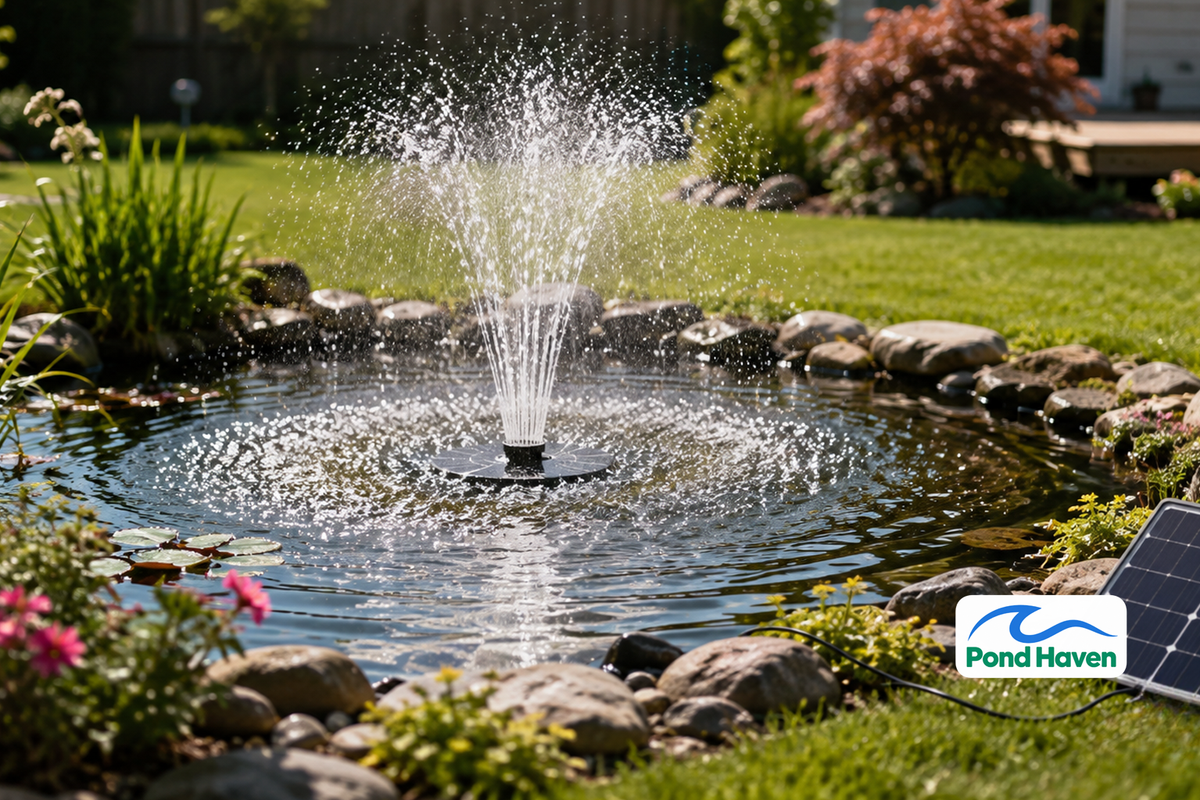

Yes, but only for the right pond. A solar fountain that sprays 33 inches in full July sun may barely break the surface on an overcast December afternoon. That performance swing is the single biggest thing to understand before you buy.
The technology has matured dramatically by 2025-2026. Standard consumer models now ship with 3.5W to 4W brushless DC (BLDC) pumps, 1,500mAh to 3,000mAh LiFePO4 batteries, and maximum power point tracking (MPPT) controllers. These are not the novelty gadgets of five years ago. But they still cannot match a plug-in electric fountain for raw power.
At Pond Haven, we sell both solar and electric fountain systems, and we maintain ponds year-round. This guide covers how solar fountains work, the honest pros and cons, the technical benchmarks that separate quality units from junk, and a direct solar vs. electric comparison so you can decide with real numbers.
- Solar fountains suit small to medium ponds (up to roughly 2,000 gallons) with 4-6+ hours of direct sun daily.
- Consumer models spray about 33 inches max and move 200-500 GPH, versus 1,000-3,000 GPH for AC pumps in the same price range.
- Buy a BLDC motor, LiFePO4 battery with a Battery Management System (BMS), and a stainless steel impeller. Anything less fails fast.
- Plan on weekly pump cleaning and indoor winter storage in freezing climates. Clogging is the #1 cause of failure.
- Battery backup delivers 2-6 hours of evening operation, not all night. Set your expectations accordingly.
How Do Solar Pond Fountains Work?
A solar fountain is a small DC pump powered by a photovoltaic panel, with an optional battery for cloudy periods and evening operation. Three components do the work.
The Three Core Components
PV panel. Monocrystalline silicon panels convert sunlight to DC electricity at 18-22% efficiency. Polycrystalline panels lag at 15-17%. For the same wattage, monocrystalline panels are smaller and perform better in low light. Panel life expectancy exceeds 30 years, with typical power warranties of 20-25 years.
Pump motor. Brushless DC (BLDC) motors now dominate quality units. They run at 85-90% efficiency, with premium models exceeding 90%. Older brushed motors waste 40-50% of their energy as heat and friction, and typically fail at 1,000-2,000 hours. A BLDC motor lasts 10,000+ hours.
Battery backup. Consumer units ship with 1,500mAh to 3,000mAh lithium batteries. A 2,600mAh battery runs a small pump for 3-10 hours depending on draw. LiFePO4 (lithium iron phosphate) chemistry is the benchmark: it delivers 2,000+ charge cycles versus 300-500 for lead-acid, and retains 80% capacity at 32°F where lead-acid drops to 50%.
The Role of MPPT Controllers
Maximum Power Point Tracking (MPPT) continuously adjusts the electrical operating point to deliver maximum wattage as sunlight intensity changes through the day. Top controllers achieve up to 99% tracking efficiency.
Without MPPT, a fountain can lose 20-30% of potential output during morning and late afternoon hours when the sun is low. Budget models often skip MPPT entirely. This is a key differentiator between an $80 unit and a $200+ unit.
Direct-Drive vs. Battery-Buffered Systems
Direct-drive: The pump runs only when the panel receives direct sunlight. A passing cloud cuts output by 50-80% within seconds, or stops the pump entirely. These systems cost less but frustrate owners in variable weather.
Battery-buffered: The system charges the battery first, then runs the pump. It provides 2-6 hours of operation after sunset depending on capacity. Battery-buffered systems cost 40-60% more but deliver consistent daily run times.
Pros of Solar Pond Fountains
Zero Operating Costs
A 20W solar fountain running 8 hours daily saves roughly $15-25 per year versus a comparable AC pump. No electricity bill, no wiring, no breaker, no electrician permit.
The federal solar tax credit does not apply to pond fountains (it covers grid-tied systems only). But the absence of ongoing utility cost remains the headline benefit. Over a 25-year system lifetime, energy costs on an electric fountain far exceed the initial purchase price.
Easy Installation
Set the panel, place the fountain, connect the hose. Complete in under 30 minutes with no tools. No trenching, no conduit, no GFCI outlet required. This makes solar fountains ideal for rental properties, temporary installations, or ponds far from any electrical source.
Electrical Safety
Low-voltage DC systems (12V or 24V) eliminate shock risk around water. No extension cords across the yard, no tripping hazards. This matters for ponds where children, pets, and wildlife come into contact with the water.
Environmental Benefits
Solar fountains draw zero grid electricity. Aeration improves dissolved oxygen (DO) levels; solar-powered floating fountains can significantly boost DO concentration, which benefits fish and water quality. Moving water also disrupts mosquito breeding, since Culex and Aedes species require still water for larvae.
Aesthetic Versatility
No power cord means the fountain can sit anywhere in the pond, not just near an outlet. Most consumer models offer multiple spray patterns (geyser, bell, tiered). Floating designs allow easy repositioning. Newer models add integrated LED lights that activate at dusk, providing 2-4 hours of illuminated display from stored battery power.

Cons & Limitations
Intermittent Operation
Output varies directly with sunlight. A cloud passing overhead can cut spray height by 50-80% within seconds. The "factor of ten" problem means a fountain that sprays 33 inches in full July sun may produce only 3-4 inches on an overcast December afternoon.
Battery backup helps but does not eliminate this. A 2,000mAh battery powers a 4W pump for roughly 4-5 hours, not all night.
Lower Power Than AC Fountains
Consumer solar fountains typically move 200-500 GPH. AC fountains in the same price range move 1,000-3,000 GPH. Spray height caps around 33 inches for most consumer solar models; AC units routinely reach 6-10 feet.
Solar fountains are not suitable for large ponds requiring serious aeration or tall water displays.
Panel Placement Constraints
Panels need 4-6 hours of direct, unobstructed sunlight daily for reliable operation. Shaded ponds (under trees, north-facing yards) will see severely degraded performance. Panel placement often requires 10-30 feet of cable between panel and fountain, which can be a tripping hazard or an eyesore.
Battery Cost and Replacement
LiFePO4 batteries last 3-5 years with proper care; replacement costs $25-60 depending on capacity. Lead-acid batteries (still found in budget models) lose 50% of their capacity at 32°F and fail within 1-2 seasons. A Battery Management System (BMS) is essential for overcharge and over-discharge protection; many cheap models omit it, shortening battery life.
Maintenance Requirements
Weekly pump cleaning is the industry consensus. Debris, algae, and mineral buildup can significantly reduce flow in a single week. Solar panels need periodic wiping; dust and pollen can cut output noticeably. Mineral buildup from hard water can clog nozzle jets and require descaling.
Winter Limitations
Solar fountains are not de-icers. They cannot keep a pond open in freezing temperatures, and ice formation will damage the pump if left in the water. Most units must be removed and stored indoors when water temperatures approach 40°F. In USDA zones 6 and colder, expect 3-5 months of zero fountain operation per year.
What Makes the Best Solar Pond Fountain? (Technical Benchmarks)
Motor Type: BLDC Is Non-Negotiable
Brushless DC motors achieve much higher efficiency than brushed motors. They last 10,000+ hours; brushed motors typically fail at 1,000-2,000 hours. Look for "brushless" or "BLDC" explicitly in the product description. The pump should carry an IP68 rating for complete submersion.
Battery Chemistry: LiFePO4 With BMS
LiFePO4 delivers 2,000+ charge cycles versus 300-500 for lead-acid. Cold-weather performance: LiFePO4 retains 80% capacity at 32°F; lead-acid drops to 50%. A Battery Management System prevents overcharging, deep discharge, and cell imbalance. Its absence is a dealbreaker.
Materials: Stainless Steel Impeller
Stainless steel (SS304 or SS316) impellers resist corrosion and mineral buildup. Stainless steel offers high tensile strength and hardness, making it superior for abrasive water with sand or silt.
Bronze impellers are acceptable but cost more. Plastic impellers wear out within 1-2 seasons and corrode in acidic or alkaline water. Check the pump housing material; ABS plastic is fine, but the impeller and shaft must be metal.
Panel Type: Monocrystalline
Monocrystalline panels hit 18-22% efficiency; polycrystalline panels lag at 15-17%. For the same wattage, monocrystalline panels are smaller and perform better in low light. Panel wattage should match pump draw; a 4W pump needs at least a 6W panel to charge the battery simultaneously.
Performance Specs to Compare
- Flow rate: Consumer models range 200-500 GPH; professional models reach 1,000+ GPH.
- Spray height: 24-33 inches is the realistic consumer range.
- Battery capacity: 1,500-3,000mAh is the 2025-2026 standard; anything below 1,000mAh is inadequate for evening operation.
A Battery Management System is the difference between a battery that lasts 3-5 years and one that fails in a single season. If the product page does not mention BMS, assume it is absent.
Solar vs. Electric Fountain: Direct Comparison
| Factor | Solar Fountain | Electric (AC) Fountain |
|---|---|---|
| Upfront cost | $60-$300 | $50-$400 |
| Operating cost | $0/year | $15-$40/year |
| 6-year total cost | $60-$300 + battery replacements | $90-$240 + electricity |
| Maximum spray height | ~33 inches | 6-10 feet |
| Flow rate | 200-500 GPH | 1,000-3,000 GPH |
| Run time | Sun-dependent + 2-6 hrs battery | 24/7 |
| Installation | 30 minutes, no tools | 1-3 hours, may need electrician |
| Electrical safety | Low-voltage DC | 120V AC near water |
| Winter operation | No (must be removed) | Yes, with de-icer |
| Maintenance | Weekly pump cleaning + panel wiping | Weekly pump cleaning |
| Best for | Small/medium ponds, remote locations | Large ponds, consistent displays |
Payback math: A $150 solar fountain with a 3-year battery life costs roughly $200 over 6 years including one battery replacement. A $100 AC fountain costs $90-240 in electricity over the same period. The solar unit breaks even or wins on cost, but only if it meets your performance needs.

Biological & Environmental Impact
Aeration Benefits
Solar fountains oxygenate the water column, supporting aerobic bacteria that break down organic waste. Target dissolved oxygen is 5-8 mg/L for healthy fish; below 3 mg/L stresses fish and can cause kills. A 300 GPH solar fountain can effectively aerate a pond up to 1,000-2,000 gallons. Larger ponds need multiple units or a dedicated aerator.
Aeration also assists destratification, preventing thermal layering and oxygen depletion at depth. This supports the biological filtration process and reduces how often you need to clean the pond.
Mosquito Prevention
Moving water disrupts mosquito breeding. Culex and Aedes species require still water for larvae. A fountain that runs even 8-10 hours daily significantly reduces mosquito habitat. Battery backup extends mosquito prevention into evening hours when mosquitoes are most active.
The Greenhouse Gas Trade-Off
Floating solar panels that cover a large portion of a pond's surface can increase methane and CO2 emissions compared to uncovered ponds. The mechanism is that significant shading reduces water temperature and oxygen production, altering microbial activity.
Mitigation: Use a floating fountain rather than a full-coverage floating solar array. A single fountain covers 1-5% of pond surface and does not meaningfully shade the water column. For full pond coverage with solar panels, incorporate aeration to offset the emission increase.
How to Choose the Right Solar Fountain for Your Pond
Match to Pond Size
- Under 500 gallons: Any 1.5-3W fountain works; prioritize spray aesthetics over flow rate.
- 500-2,000 gallons: Choose a 3.5-4W pump with 300+ GPH and a 2,000mAh+ battery.
- 2,000-5,000 gallons: Consider two solar fountains or a hybrid solar/electric system; single units will under-aerate.
- Over 5,000 gallons: Solar fountains are decorative only; invest in a dedicated AC aerator or windmill aerator.
Evaluate Sunlight Exposure
Track sunlight hours across your pond location for 3-5 days before buying.
- Less than 4 hours of direct sun: Skip solar; the fountain will disappoint.
- 4-6 hours: Workable with a quality battery-buffered system.
- 6+ hours: Ideal; most models will perform to spec.
Prioritize Features by Budget
- Under $100: Expect a direct-drive system, brushed motor, and no battery. Fine for decorative use in full sun.
- $100-$200: BLDC motor, LiFePO4 battery (1,500-2,000mAh), and better materials. This is the sweet spot for most pond owners.
- $200+: Commercial-grade pumps with stainless steel impellers, MPPT controllers, and larger batteries. Worth it for serious ponds or northern climates.
- BLDC motor rated IP68 for complete submersion
- LiFePO4 battery with BMS, 1,500mAh minimum
- Stainless steel impeller (SS304 or SS316)
- Monocrystalline panel, 6W minimum for a 4W pump
- MPPT controller for low-light performance
- Separated panel with at least 9.8 feet of cable for shaded ponds

Frequently Asked Questions
Will a solar fountain work at night?
Only with battery backup. A 2,000mAh battery powers a 4W pump for roughly 4-5 hours after sunset. Direct-drive systems without batteries stop entirely at night and during cloud cover.
How high can a solar fountain spray?
Consumer models reach about 33 inches in direct sunlight. Electric fountains in the same price range routinely reach 6-10 feet. If you want a tall display, buy electric.
Do solar fountains actually aerate a pond?
Yes. A 300 GPH solar fountain effectively aerates a pond up to 1,000-2,000 gallons and can significantly improve dissolved oxygen levels over time.
How long do solar fountain batteries last?
A 2,600mAh battery runs a small pump for 3-10 hours depending on draw. The battery itself lasts 3-5 years with proper care if it is LiFePO4 with a BMS. Lead-acid batteries fail within 1-2 seasons.
Can I leave a solar fountain out in winter?
No. Most consumer units must be stored indoors when water temperatures approach 40°F. Ice formation will crack the pump housing. Solar fountains are not de-icers and cannot keep a pond open in freezing temperatures.
Final Verdict
Solar pond fountains are genuinely good for small to medium ponds (up to roughly 2,000 gallons) with 4-6+ hours of direct sun daily. They cost nothing to run, install in 30 minutes, and carry no shock risk around water. The 2025-2026 generation with BLDC motors, LiFePO4 batteries, and MPPT controllers is reliable enough for daily use.
They are not a substitute for electric fountains in large ponds, shaded locations, or anywhere you need a tall water display or serious aeration. If your pond exceeds 2,000 gallons or sits under heavy tree cover, invest in a dedicated AC aerator instead.
Match the technology to your pond, and a solar fountain will deliver years of zero-cost, low-maintenance service. Mismatch it, and you will watch a weak trickle on cloudy days while wondering what went wrong. The technology works. The application is everything.