
Red Worms in Water
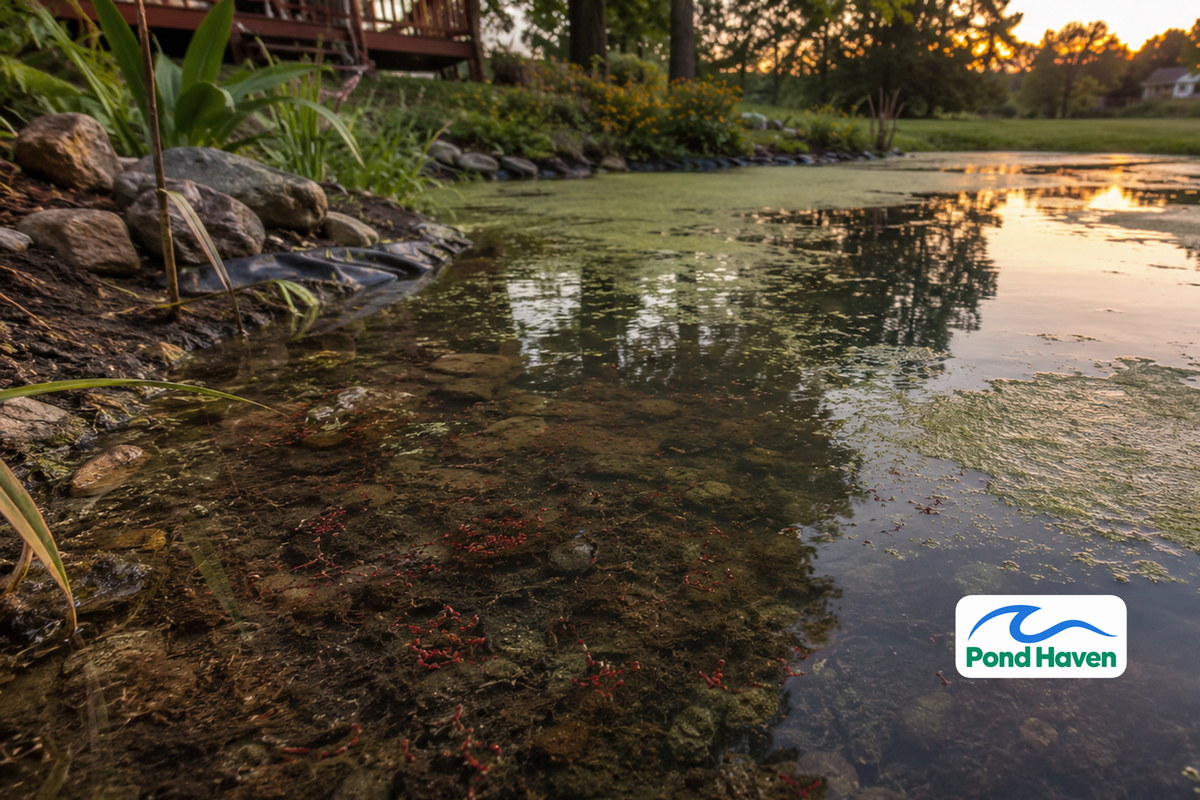

You spot them one morning: a cluster of tiny red worms wriggling near the edge of your pond, or maybe clinging to the filter pad. Your first thought is probably "what are these, and are they going to hurt my fish?"
Here is the short answer: those little red worms are almost certainly midge fly larvae, commonly called bloodworms. They are not parasitic, they do not bite, and your fish will likely treat them as a snack. The real issue is what their presence says about your pond's water quality.
- Tiny red worms in pond water are almost always non-biting midge larvae (Chironomidae family), not parasites.
- They are harmless to humans and fish, and are actually a nutritious natural food source for koi and goldfish.
- A large population signals excess organic muck and low dissolved oxygen levels.
- The permanent fix is environmental: add aeration, remove debris, and cut back on feeding, not chemical treatments.
- With proper aeration and cleanup, populations drop noticeably within 1 to 2 weeks.
What Are the Tiny Red Worms in My Water?
The worms you are seeing are the aquatic larval stage of the non-biting midge fly, a member of the Chironomidae family. Despite the common name "bloodworms," they are not the same as the bloodworms sold as fish food in frozen cubes, though they are related. The name comes from their bright red color, which is caused by hemoglobin in their bodies.
Key Characteristics
- Size: Slender and segmented, ranging from about 1/4 inch to 1 inch long.
- Color: Bright red to pinkish, thanks to that hemoglobin.
- Movement: They wiggle in an S-shaped motion, often in clusters.
- Location: Muddy pond bottoms, decaying leaf litter, inside filter pads, and on pond liners.
That hemoglobin is the clever part. It lets midge larvae survive in water with very low dissolved oxygen, levels that would kill most other aquatic organisms. Midge larvae can tolerate dissolved oxygen concentrations below 2 mg/L, conditions that would stress or kill most fish. This is why you often find them in the muck at the bottom of a pond, where oxygen is scarce.
The Lifecycle Connection
Midge flies go through four stages: egg, larva, pupa, and adult. The worm you see is the larval stage, which is entirely aquatic. After a few weeks, larvae pupate and emerge as adult midges, which look like small mosquitoes but do not bite. The adults live only a few days, long enough to mate and lay eggs back on the water surface, starting the cycle again.
In warm water above 70°F (21°C), that lifecycle speeds up considerably. A pond in July can cycle through multiple generations of midges in a single season, which is why infestations often peak in late summer.
Are These Red Worms Harmful?
No, not directly. Here is the breakdown:
To humans: Midge larvae do not bite, sting, or parasitize people. They are a nuisance, not a health threat. You can handle them safely, though washing your hands afterward is still common sense.
To fish: They are a natural, highly nutritious food source. Koi, goldfish, and most pond fish will actively hunt and eat them. If you have fish, they are doing you a favor by helping control the population.
The real problem: A large population of midge larvae is a symptom, not the disease. It tells you that your pond has an excess of organic matter and likely low dissolved oxygen. The worms are thriving because other organisms cannot survive in those conditions. Fix the water quality, and the worms will naturally decline.

What Causes Red Worm Infestations in Ponds?
Midge larvae do not appear out of nowhere. They show up in force when the pond environment favors them. Four factors drive most infestations.
1. Excess Organic Debris
This is the primary cause. Decaying leaves, grass clippings blown into the pond, uneaten fish food, and fish waste all accumulate on the bottom as muck. That muck is a food-rich habitat for midge larvae, which feed on decaying organic matter and the microorganisms living in it.
A pond with a thick layer of sludge on the bottom is essentially a midge nursery.
2. Low Dissolved Oxygen
As organic matter decomposes, the bacteria doing the work consume oxygen. In a mucky pond, dissolved oxygen levels can drop well below the 5 mg/L target that most healthy ponds maintain. Midge larvae, with their hemoglobin, thrive in these low-oxygen conditions where fish, beneficial bacteria, and other invertebrates struggle.
3. Stagnant Water and Poor Circulation
Without water movement, debris settles to the bottom and stays there. Oxygen exchange at the surface slows. A pond with no aeration or fountain develops a stratified water column where the bottom layer becomes oxygen-depleted. That is exactly the environment midge larvae prefer.
4. Warm Water Temperatures
Heat accelerates everything. Bacterial decomposition speeds up, consuming more oxygen. The midge lifecycle shortens. Ponds in USDA climate zones 7 and warmer, or any pond that sees sustained water temperatures above 70°F (21°C) in summer, are more prone to outbreaks.
How to Get Rid of and Prevent Red Worms
The goal is not to nuke the worms. It is to change the pond environment so they no longer thrive. Here is the sequence that works.
1. Improve Pond Aeration and Circulation
This is the single most effective step. Aeration raises dissolved oxygen above the 5 mg/L threshold, which disrupts the low-oxygen habitat midge larvae need. It also keeps water moving, suspending fine debris so your filter can capture it instead of letting it settle into muck.
What to use:
- Bottom diffused aeration: A compressor pushing air through a diffuser on the pond floor is the most effective option for ponds deeper than 3 feet. It oxygenates the entire water column, including the bottom where larvae live.
- Surface aerators and fountains: These work well for shallower ponds and add visual appeal. A fountain circulates surface water and promotes gas exchange.
- Pond pumps: A properly sized pump keeps water moving through your filtration system. Aim for a pump that turns over your total pond volume at least once per hour.
Sizing: Choose an aeration system rated for your pond's total gallonage. For a 1,500-gallon pond, you need a system rated for at least that volume. For a 1/4-acre pond, you need a much larger unit, typically a 1/4 HP or larger compressor with multiple diffusers. When in doubt, size up slightly; you cannot really over-aerate a pond.
In winter, aeration keeps an open hole in the ice and prevents toxic gas buildup under the surface. It also keeps oxygen levels stable so fish survive the cold months.
2. Reduce Organic Muck and Debris
Aeration prevents new muck from accumulating, but it does not remove what is already there. You need to physically remove the existing organic load.
Manual removal: Use a pond vacuum to suck sludge off the bottom, or rake out heavy debris with a net. For a heavily mucked pond, you may need to do this in stages over a few weekends, removing no more than a third of the bottom at a time to avoid stirring up too much nutrient-rich sediment at once.
Prevent debris from entering: Install pond netting in autumn before leaves start falling. A fine mesh net over the pond surface catches leaves before they sink and decompose. Remove and clean the net regularly through fall.
Use beneficial bacteria: Monthly pond bacteria treatments break down organic waste, uneaten food, and fish waste before they can settle into muck. These are live bacteria that digest sludge at the bottom. Start treatments in early spring when water temperatures rise above 50°F (10°C), and continue monthly through the growing season.
Clean your filter: Midge larvae commonly colonize filter pads, which are warm, dark, and full of organic matter. Clean mechanical filter pads weekly during peak season (June through September) to remove larvae and eggs before they mature.
- Vacuum or rake out bottom sludge in spring and again in late summer.
- Install pond netting before autumn leaf drop.
- Apply beneficial bacteria monthly from spring through fall.
- Clean mechanical filter pads weekly during peak season.
- Remove floating debris with a skimmer net at least twice a week.
3. Introduce Natural Predators
Fish are the most effective biological control. Koi, goldfish, and sunfish will actively hunt midge larvae in the muck and on surfaces. A healthy fish population can noticeably reduce larvae numbers.
Note: Only add fish if your pond is appropriately sized and established. A general rule from the Koi and Water Garden Society is one inch of fish per 10 gallons of water for koi, and one inch per 20 gallons for goldfish. Overstocking creates more waste, which feeds the muck problem you are trying to solve.
4. Physical and Chemical Controls (Last Resort)
If you need immediate relief while you fix the underlying conditions:
Manual skimming: Use a fine mesh net to skim larvae from the surface, especially at dawn and dusk when they are most active. This removes adults and pupae before they can lay more eggs.
Bacillus thuringiensis israelensis (Bti): This is a bacterial larvicide that specifically targets fly larvae like midges and mosquitoes. According to the EPA, Bti is safe for fish, plants, and beneficial insects when used as directed. Bti comes in dunks or granules and is most effective when applied to shallow, still water where larvae are concentrated.
General insecticides: Do not use these in a pond. Broad-spectrum insecticides kill beneficial insects, disrupt the food web, and can harm fish. They are not worth the risk.

Tiny Red Worms vs. Other Aquatic Worms
Not every worm in your pond is a midge larva. Here is a quick reference to help you identify what you are actually seeing.
| Worm Type | Color | Size | Habitat | Concern |
|---|---|---|---|---|
| Midge Larvae | Bright red/pink | 1/4 - 1 inch | Mud, filters, liners | Nuisance indicator of low oxygen |
| Tubifex Worms | Reddish, thinner | 1 - 2 inches | Buried in mud, tail waving | Indicator of high organic pollution |
| Planaria | White, gray, brown | Under 1/2 inch | On glass, rocks, plants | Can harm shrimp and snail eggs |
| Detritus Worms | White, translucent | Tiny, thread-like | Floating in water column | Indicator of overfeeding |
Tubifex worms are the ones most often confused with midge larvae. They are thinner, longer, and typically burrow in mud with their tails waving in the water. They tolerate even worse water quality than midge larvae and indicate heavy organic pollution.
Planaria are flatworms, not round like midge larvae. They are usually white or gray and glide across surfaces. They are mostly harmless but can prey on shrimp and snail eggs.
Detritus worms are tiny, white, and thread-like, often seen floating in the water column. They feed on uneaten food and waste, so a sudden bloom usually means you are overfeeding your fish.
What About Red Worms in Tap Water or Toilets?
You may occasionally spot tiny red worms in a toilet bowl or in water that has sat in a pipe for a while. These are usually the same midge larvae, breeding in the thin layer of biofilm inside drains and sewer lines. They are not a sign of contaminated drinking water and are not a health hazard.
Flush them, clean the bowl, and if they keep returning, check for a slow leak or a drain that stays damp. The fix is eliminating the moist biofilm they breed in, not treating your water supply.
For pond owners, this is a side note. The real action is in the pond itself.

Frequently Asked Questions
Are red worms in my toilet the same thing?
Yes, often they are midge larvae breeding in the biofilm inside drains or sewer lines. They are not a health hazard. Clean the bowl, eliminate standing moisture, and they should stop returning.
Will they hurt my koi?
No. Koi and goldfish actively eat midge larvae, which are a natural and nutritious food source. If anything, your fish are helping you control the population.
How quickly can I get rid of them?
With aeration running and a good cleanup of bottom muck, populations typically drop noticeably within 1 to 2 weeks. Full elimination takes longer because new midges will keep laying eggs until the habitat stops favoring them.
Can they live in my filter?
Yes, filter pads are a common hiding spot because they are dark, warm, and full of organic matter. Clean mechanical filter pads weekly during peak season to remove larvae and eggs.
The Bottom Line
Tiny red worms in your pond are not a crisis. They are a clear signal that your pond has too much organic muck and not enough oxygen. The worms themselves are harmless, even beneficial as fish food, but the conditions that produce them will eventually cause bigger problems like algae blooms and fish stress.
The permanent fix is proactive maintenance: run a properly sized aerator, remove bottom sludge, cut back on feeding, and keep your filter clean. Do that, and midge larvae become a minor, occasional presence instead of a seasonal swarm. Your pond stays healthier, your fish stay happier, and you stop worrying about what is wriggling in the water.