
Pond Aeration for Algae Control

Algae is the #1 water quality complaint among pond owners, and for good reason. A single bloom can turn a clear pond into a pea-soup mess in days, stress your fish, and even pose health risks to pets and family.
Most owners only react when they see green water in July. That is the wrong approach. Algae blooms are seeded months earlier by nutrients that build up in your pond bottom and water column. If you only treat in summer, you are fighting a problem you already lost to in spring.
The key nutrient is phosphorus. It is the primary limiting nutrient for algae growth in freshwater, which means controlling phosphorus inputs year-round controls algae year-round. This guide lays out a layered defense: biological prevention first, mechanical support second, and chemical treatment only as a last resort.
- Algae is driven by phosphorus; keep total phosphorus low to starve blooms.
- Run aeration year-round, including under ice, to prevent nutrient release from bottom sediment.
- Apply barley straw in late fall or early spring before blooms start.
- Treat no more than one-third of your pond with algaecides at a time, and only when water is 65–80°F.
- No single product works. A year-round plan combining bacteria, plants, aeration, and filtration wins.
Understanding Algae: Know Your Enemy
Before you can control algae, you need to identify what you are dealing with. The three primary forms behave differently and require different control strategies.
The Three Primary Forms
Planktonic algae are single-celled, microscopic plants suspended in the water column. They turn water pea-soup green, though they can also appear yellow, gray, brown, or red. A brownish tint indicates diatoms; reddish means Euglena. These algae form the base of the aquatic food chain, but uncontrolled blooms deplete oxygen at night and can kill fish. If you cannot see more than 12 inches into the water, you have a problem bloom.
Filamentous algae — string algae, pond scum, or moss — are single cells linked into long strands. They start on rocks and pond bottoms in shallow water, then form floating wool-like mats by mid-summer. Spirogyra and Cladophora are the common genera.
Macrophytic algae, like Chara (musk grass or stonewort), look like true plants with stem-like and leaf-like structures. Chara feels coarse and gritty due to calcium carbonate deposits and has a musky odor. It thrives in alkaline water.
Cyanobacteria: The Dangerous "Blue-Green Algae"
Cyanobacteria are not true algae. They are photosynthetic bacteria that regulate their buoyancy with internal gas vesicles, moving between the surface for light and the bottom for nutrients. They cause Harmful Algal Blooms (HABs) and produce potent toxins: microcystins, anatoxins, and cylindrospermopsin.
These toxins cause liver and kidney damage, dermatitis, and in the case of anatoxin-a, neurological effects. A well-known example occurred in 2014 when a Microcystis bloom in Lake Erie contaminated the municipal water supply for Toledo, Ohio, forcing a temporary halt to water withdrawals.
You cannot identify toxic strains visually. Dangerous blooms can look like pea soup or latex paint, colored light blue-green, bright green, green-brown, or even chocolate. Earthy or musty odors are common but do not confirm toxicity. If you suspect a bloom, submit a sample for laboratory testing through your state's extension service.
Why Algae Blooms Happen: Seasonal Drivers
Algae growth follows a predictable seasonal cycle. Understanding it tells you when to act.
Spring Turnover and Nutrient Resuspension
When ice melts in spring, the pond "turns over." Water layers mix, bringing nutrient-rich bottom water to the surface. This happens when surface water reaches about 39°F (4°C), the temperature at which water is densest. The nutrient spike fuels the first algae growth of the year.
Summer Stratification and Peak Growth
By summer, warm surface water (the epilimnion) sits above cold bottom water (the hypolimnion), separated by a thermocline. The bottom layer goes anoxic, and chemical reactions release "legacy phosphorus" trapped in the sediment. Algae growth peaks when water temperatures hit 68–86°F (20–30°C).
Autumn Leaf Fall and Nutrient Loading
Falling leaves decompose in the water, releasing phosphorus and nitrogen through the winter. A second turnover in fall mixes these nutrients through the pond, creating a second bloom window. This is why autumn cleanup matters as much as spring treatment.
Winter Dormancy, Ice, and "Winter Kill"
Ice cover blocks light and gas exchange. Toxic gases like hydrogen sulfide and methane build up under the ice, and oxygen cannot enter. This causes "winter kill" — fish mortality from oxygen depletion and toxic gas accumulation. Winter algae die-off also spikes ammonia levels.
Climate change is extending the problem. Warmer winters mean shorter ice cover and a longer bloom season. In some regions, cyanobacteria blooms now persist into winter.

Water Chemistry: The Nutrient Foundation
Algae cannot grow without nutrients. Control the nutrients, and you control the algae.
Phosphorus and Nitrogen: The Critical Thresholds
To prevent algae blooms, aim to keep nutrient levels low. General targets for a healthy pond include:
| Parameter | Target Level |
|---|---|
| Total Nitrogen | Below 0.55 mg/L |
| Total Phosphorus | 0.057–0.064 mg/L |
| Chlorophyll a | Below 30 μg/L |
| Secchi disk visibility | Above 12 inches |
The Redfield ratio of 16:1 nitrogen to phosphorus matters. When the ratio shifts, cyanobacteria gain an advantage. Dual nutrient control — managing both nitrogen and phosphorus — is more effective than focusing on one.
Where Algae "Food" Comes From
Nutrients enter your pond from several sources:
- Fertilizer runoff from lawns in the drainage area
- Livestock waste from animals with pond access
- Failing septic systems, which produce high-phosphorus plumes
- Leaf litter decomposing in the water
- Waterfowl waste — a single goose produces about 1 lb of waste daily
- Legacy phosphorus in bottom sediment, released when the sediment-water interface goes anoxic
Sediment Control and Silt Settling Agents
If your pond is shallow and mucky, sediment is feeding the algae. Amendments can bind phosphorus in the water column and sediment:
| Amendment | Rate per Surface Acre | Notes |
|---|---|---|
| Agricultural lime | 1,000 lbs | Raises pH, flocculates |
| Hydrated lime | 1,000 lbs | Same as above |
| Aluminum sulfate (alum) | 250 lbs | Binds phosphorus in water column |
| Agricultural gypsum | 300–500 lbs | Flocculation, pH adjustment |
Monitoring Parameters
Test your water regularly. The core parameters are pH, ammonia, nitrites, and phosphates. Fluctuating readings are the primary indicator of an impending algae spike.
- Secchi disk: Target 2–4 ft visibility; below 12 inches means a problem bloom
- pH: Ideal range 6.5–8.5
- Ammonia: Below 0.5 mg/L
- Nitrites: Below 0.1 mg/L
- Dissolved oxygen: Above 5 mg/L for fish health
Biological Control: The Sustainable Foundation
Biological methods are your first line of defense. They are the lowest cost, lowest risk, and most sustainable approach.
Beneficial Bacteria
Beneficial bacteria consume the nutrients algae need. Different strains do different jobs:
- Aerobic bacteria break down surface debris and fish waste into water and carbon dioxide
- Anaerobic bacteria digest complex waste in low-oxygen sludge layers
- Nitrifying bacteria convert toxic ammonia into nitrates
- Denitrifying bacteria convert nitrates into nitrogen gas, which exits the water
Consistent bacterial treatment can significantly reduce sediment phosphorus. Start applications 2–4 weeks before bloom season and reapply every 2–4 weeks. Products like PondPerfect handle ponds from 50 to 100,000 gallons; FarmPond Treatment doses at one box per quarter-acre per month.
Aquatic Plant Competition
Plants outcompete algae for phosphorus and nitrogen. Aim for 10–20% surface coverage of your pond bottom with beneficial plants.
Good choices include water lilies (Nymphaea spp.), pickerelweed (Pontederia cordata), and arrowhead (Sagittaria spp.). A bog filtration area equal to at least 10% of your pond's surface area effectively removes nitrates.
Herbivorous Fish
Grass carp (Ctenopharyngodon idella) eat algae when small but shift to other aquatic plants as they age. They are generally ineffective for long-term algae control. Triploid sterile fish are legal in most states but illegal in Maryland. Stocking rates run 5–15 per surface acre.
Tilapia are aggressive filamentous algae grazers but die below 55°F, requiring annual restocking. Some states require permits in conservation zones.
Mechanical and Physical Control
Mechanical methods support the biological foundation. They are moderate cost but require ongoing maintenance.
Aeration Systems
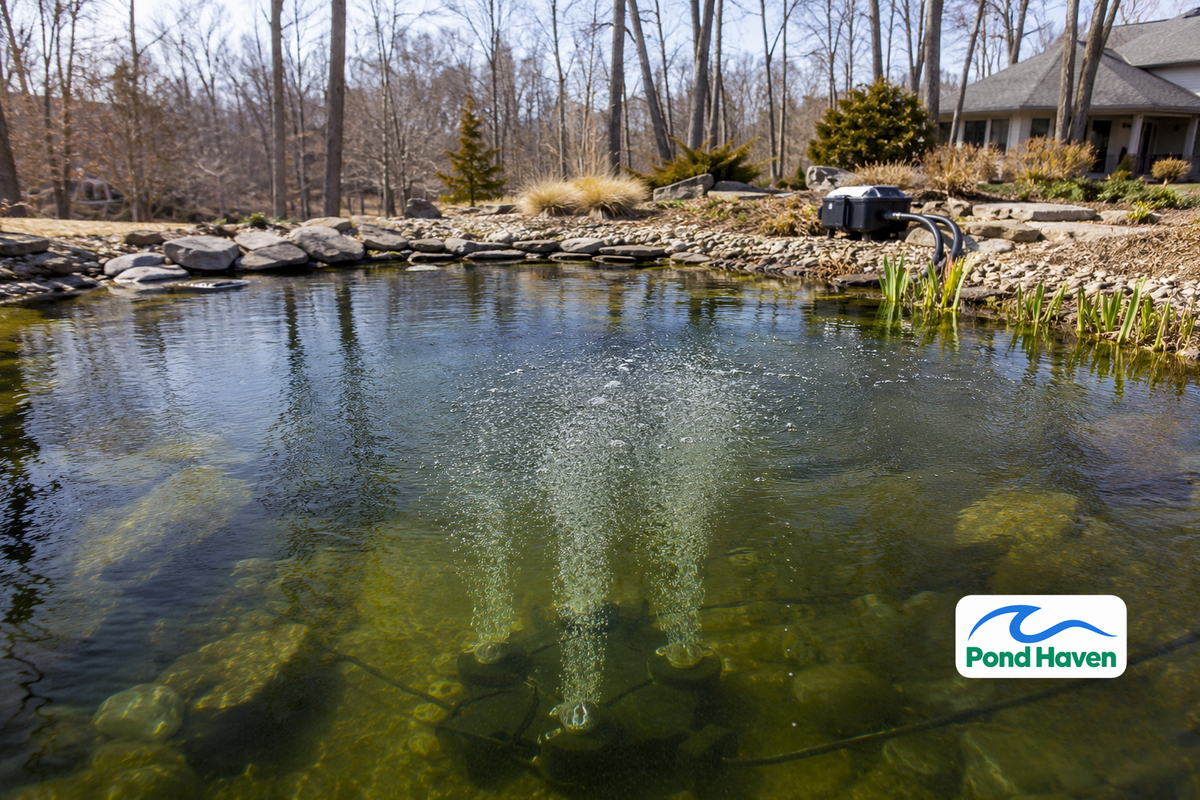
Aeration is the single most important mechanical tool for algae control. It prevents thermal stratification, maintains oxygen at the sediment-water interface to inhibit phosphorus release, and shifts species composition from blue-green to green algae.
Diffused air systems work best for ponds over 6 feet deep. A shore-mounted compressor pushes air through hoses to diffuser plates at the deepest point. Oxygen transfer efficiency increases noticeably with depth, so a diffuser at 10 feet is significantly more efficient than one at 2 feet. Budget $800–$2,500 for a complete system.
Surface aerators suit ponds under 6 feet deep. They draw water from the top and spray it into the air for rapid oxygen transfer.
Nanobubble technology is the emerging option. These generators produce microscopic bubbles (100–200 nm) that remain suspended for months, providing sustained dissolved oxygen that reduces excess nutrients before blooms start.
Common mistakes: undersizing the system, placing diffusers too shallow, and shutting down aeration in winter. Run aeration year-round.
UV Clarification and Sterilization
UV systems use 254 nm electromagnetic radiation to destroy algal cells and pathogens at the DNA level. They are highly effective for green water (planktonic algae).
| Pond Volume | Clarification Wattage | Sterilization Wattage |
|---|---|---|
| Up to 1,000 gal | 10–15W | 30W |
| 1,000–2,500 gal | 15–25W | 40–75W |
| 2,500–5,000 gal | 25–55W | 75–150W |
| 5,000–10,000 gal | 55–100W | 150–300W |
| 10,000–20,000 gal | 100–200W | 300–400W |
| 20,000+ gal | 200W+ | 400W+ |
The rule of thumb: 10 watts per 1,000 gallons for clarification, 30 watts per 1,000 gallons for sterilization. Increase wattage by 50% if treating water before filtration.
UV only works at rated flow rates. Clarifiers need 0.5x hourly turnover; sterilizers need 1–1.5x. Clean the quartz sleeve every 2–4 weeks with distilled white vinegar — a dirty sleeve can significantly reduce UV transmission. Replace bulbs annually; UV output drops even if the bulb still lights.
UV eliminates green water within 3–7 days. It is most critical in spring and fall when plants are not growing fast enough to consume nitrates.
Filtration Systems
Mechanical filtration removes leaves, dirt, and fish waste. Skimmers are the best option for average to large ponds. Biological filtration uses nitrifying bacteria to convert ammonia to nitrite, then to nitrate, which plants consume.
Run filtration pumps 24/7. Size the pump to circulate the total pond volume at least once every two hours; every hour is preferred.
Manual Removal and Physical Interventions
Raking and netting remove filamentous algae mats, though the effect is temporary. Compost removed algae away from the pond edge so nutrients do not wash back in.
Deepen shallow areas to at least 3–4 feet to prevent sunlight reaching the bottom. Floating shade covers block sunlight in small ponds. For lined, non-fish ponds, partial winter draining kills shoreline weeds through freezing and drying.
Chemical Control: Last-Resort Algaecides
Chemicals are the final tier. Use them only after biological and mechanical methods have failed.
Application Rules
Follow these rules strictly:
- Water temperature: 65–80°F (18–27°C) for most algaecides
- Volume: Treat no more than one-third of the pond at a time
- Interval: Wait 10–14 days between partial treatments
- Oxygen risk: Dead algae decomposition consumes dissolved oxygen and can kill fish
Permits are required for algaecide applications in New York, New Jersey, and Ontario.
Effectiveness Ratings by Algae Type
| Algaecide | Planktonic | Filamentous | Macrophytic | Notes |
|---|---|---|---|---|
| Copper complexes | Excellent | Excellent | Excellent | Broad-spectrum; toxic to fish at high doses |
| Diquat | Good | Good | Good | Contact herbicide; fast-acting |
| Endothall | Good | Good | Good | Systemic; effective on Chara |
| Flumioxazin | — | Good | Good | Works in cooler water (50°F+) |
| Sodium carbonate peroxyhydrate | — | Good | — | Peroxide-based; low fish toxicity; spot treatment |
Sodium carbonate peroxyhydrate is the modern choice. It is a granular hydrogen peroxide-based oxidizer that kills algae on contact and breaks down into water and oxygen, leaving no heavy metal residues. Copper-based treatments remain common but accumulate in sediment over time.
Barley Straw: The Chemical-Free Preventative
Barley straw is an algistat — it inhibits algae growth without killing it. It does not affect higher vascular plants.
- Dosage: 225 lbs per surface acre (2–6 bales); small ponds use 1 lb per 2,000 gallons
- Maximum safety limit: Never exceed 450 lbs per acre; higher doses cause deoxygenation
- Timing: Apply late fall through early spring, before algae appears
- Activation: 6–8 weeks in cold water (below 50°F); 1–2 weeks in warm water (above 70°F)
- Duration: About 6 months
Use only dry straw. Fluff it and place it in woven sacks (onion sacks or bird netting), anchored but buoyant within a few feet of the surface. Decaying straw produces compounds that prevent algal cell reproduction.
Barley straw is not effective once a bloom is established. It is a preventative, not a cure.

The Seasonal Algae Control Calendar
Here is the month-by-month plan that ties everything together.
Spring (March–May): Reset and Prepare
- March: Test water for pH, ammonia, nitrites, phosphates. Apply barley straw before blooms start. Start aeration before turnover.
- April: Service equipment. Start UV systems — plants are not yet consuming nitrates. Clean filters.
- May: Add beneficial bacteria as water warms above 50°F. Begin algaecides only if water hits 65–80°F, treating one-third volume at a time.
Summer (June–August): Peak Vigilance
- June: Continue bacteria dosing. Remove filamentous algae mats manually. Keep aeration running 24/7.
- July: Check Secchi disk weekly — below 12 inches means a problem. Test phosphorus monthly.
- August: Watch for cyanobacteria blooms (pea soup or latex paint appearance). Submit suspicious blooms for lab testing.
Autumn (September–November): Contain the Leaf Load
- September: Clean leaves, twigs, and sludge thoroughly. Trim hardy plants as foliage yellows. Stop fertilizing.
- October: Install leaf netting or skimmer covers before peak leaf fall. Remove leaves weekly — do not let them sink.
- November: Apply nutrient binders (alum) and high-potency sludge-fighting bacteria. Keep aeration running through turnover.
Winter (December–February): Protect and Plan
- December: Install a de-icer (750–1,500 watts for ponds up to 1/2 acre) to maintain open water for gas exchange. Switch fish to wheat-germ food.
- January: Monitor dissolved oxygen under ice. Test pH, ammonia, nitrites, phosphates even in winter.
- February: Consider partial draining for lined, non-fish ponds. Order bacteria and barley straw for spring.
The Treatment Hierarchy: From Sustainable to Last-Resort
Tier 1: Biological & Preventative. Beneficial bacteria, aquatic plant competition, barley straw, and watershed management. Lowest cost, lowest risk, most sustainable.
Tier 2: Mechanical & Physical. Aeration, UV clarification, filtration, manual removal. Moderate cost, ongoing maintenance required.
Tier 3: Chemical. Algaecides only after Tiers 1 and 2 fail. Follow label rates, treat one-third volume, monitor oxygen. Permits required in New York, New Jersey, and Ontario.
Watershed Management: The Big Picture
Your pond is a sink for everything in its drainage area. Long-term algae control requires managing the watershed.
- Buffer strips: A wide vegetated buffer of at least 50 feet traps a significant amount of phosphorus from lawn runoff. A 100-foot strip of grass and trees is even better.
- Livestock fencing: Keep cattle and horses out of the pond. Direct manure away from drainage areas.
- Septic maintenance: Inspect every 3–5 years. Failing systems are major nutrient sources.
- Waterfowl control: Discourage geese with habitat modification. One goose produces about 1 lb of waste daily.
- Fertilizer rules: No phosphorus fertilizers within 50 feet of the pond. Use phosphorus-free blends.

Frequently Asked Questions
How long does it take to clear a green pond?
UV clarification typically clears green water within 3–7 days. Beneficial bacteria take 2–4 weeks to establish. Barley straw needs 6–8 weeks in cold water. A full season of layered treatment is realistic for a heavily nutrient-loaded pond.
Is it safe to swim in a pond with algae?
Not if cyanobacteria are present. Toxins like microcystins and anatoxins cause skin irritation, liver and kidney damage, and neurological effects. You cannot identify toxic strains visually. If the water looks like pea soup or latex paint, keep people and pets out and submit a sample for testing.
Can I use copper sulfate to kill algae?
Yes, but it is a last resort. Copper is toxic to fish at high doses and accumulates in sediment over time. Apply only when water is 65–80°F, treat one-third of the pond at a time, and wait 10–14 days between treatments. Modern peroxide-based options like sodium carbonate peroxyhydrate are safer for fish.
Should I run my aerator in winter?
Yes. Running aeration under ice maintains dissolved oxygen and vents toxic gases like hydrogen sulfide and methane. If you cannot run aeration, install a de-icer rated at 750–1,500 watts for ponds up to 1/2 acre to keep an area of open water for gas exchange.
How much barley straw do I need?
Apply 225 lbs per surface acre, or 1 lb per 2,000 gallons for small ponds. Never exceed 450 lbs per acre. Apply in late fall or early spring before blooms start, and replace every 4–6 months.
The Bottom Line
No single product eliminates algae permanently. The ponds that stay clear year-round use a layered defense: biological competition and nutrient starvation as the foundation, aeration and filtration as mechanical support, and chemicals only as a last resort.
Start with a water test and an aeration audit this season. Know your phosphorus and nitrogen levels, confirm your aeration is sized and placed correctly, and run it year-round. Then build the biological layer with bacteria, plants, and barley straw timed to the seasonal calendar.
Year-round commitment beats any summer rescue. Your pond will thank you.