
How to Remove Cattails from a Pond
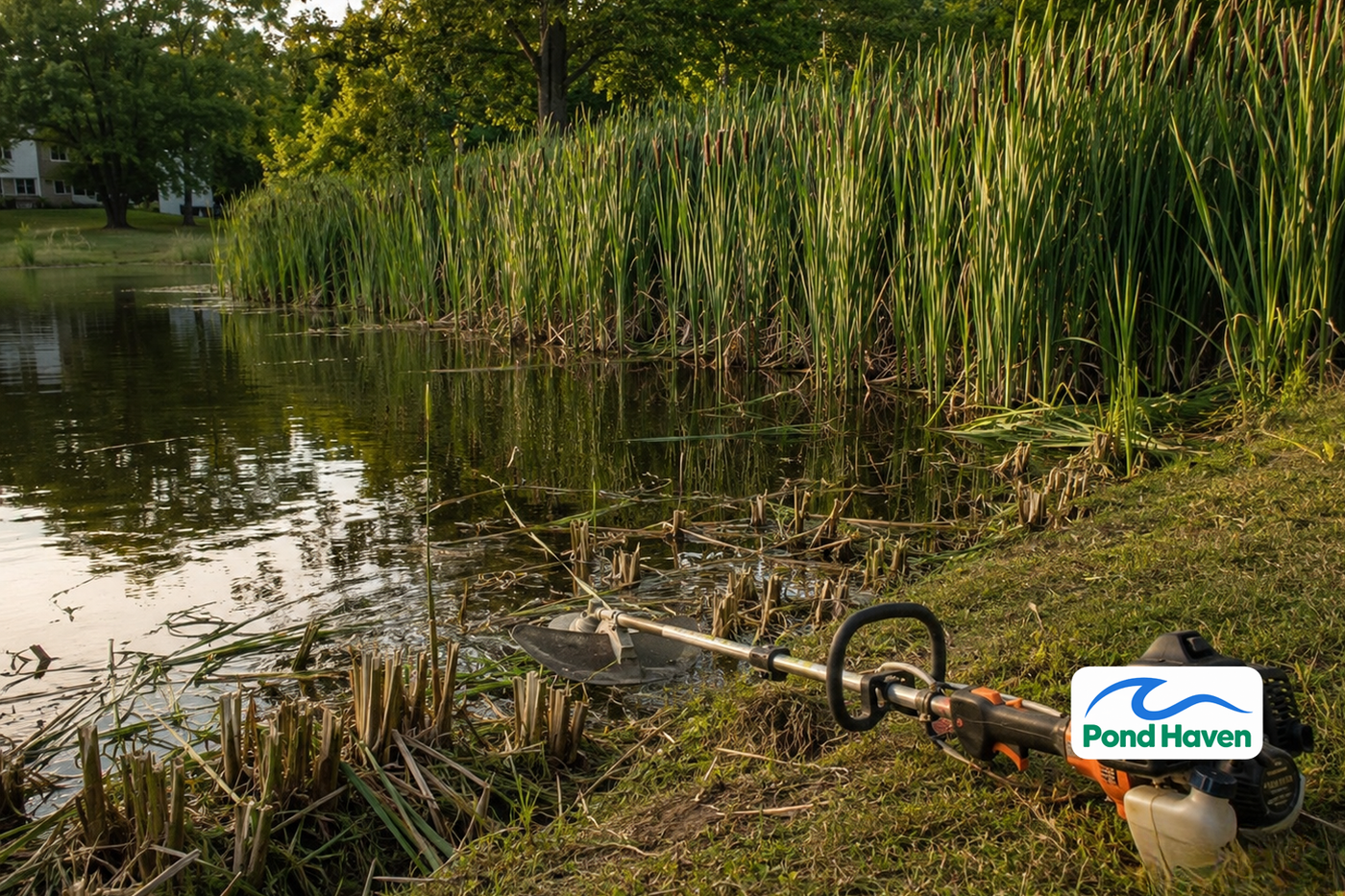

Cattails (Typha latifolia and Typha angustifolia) are among the most aggressive emergent plants in North America. A single plant can colonize an entire shallow pond within a few years, spreading through thick underground rhizomes that extend from the shoreline and float over deeper water.
Here's the thing most guides get wrong: cattails aren't bad plants. They're unmanaged plants. A healthy pond should have 10% to 20% aquatic vegetation coverage. Beyond that, management is needed to protect access, fish health, and the pond's overall balance.
This guide covers five removal methods, the exact timing that determines success, real cost benchmarks, and a realistic multi-year plan. No one-season fixes here.
- Cut cattails in June when rhizome energy reserves are lowest; spray herbicides in September or October when plants move nutrients to their roots.
- Never treat more than 25% of your pond's surface at once with herbicide. Decaying vegetation depletes dissolved oxygen and can kill fish.
- Hand-pulling prevents regrowth for 2-3+ years but only works for small stands under 100 square feet.
- Mechanical cutting alone won't kill rhizomes. You need repeated cuts through the season or a combined cut-and-herbicide approach.
- Expect a major reduction by year three of an integrated management plan. One-time treatments fail.
Rule #1: Timing is Everything: The Best (and Worst) Times to Act
When you act matters more than how you act. Cattails store energy in their rhizomes, and that energy cycle dictates which method works and when.
Never cut cattails in the spring. In May, the plant is drawing on stored rhizome energy to fuel top growth. Cutting during this window stimulates regrowth and actually strengthens the root system. You're doing the plant a favor.
June is the optimal cutting window. By early summer, the plant has spent its energy reserves on foliage and the seed head. Rhizome energy is at its lowest point of the year. Cutting now causes maximum stress to the root system and minimizes regrowth.
September through October is the herbicide window. During late summer and fall, cattails actively transport nutrients downward to their rhizomes for winter storage. Systemic herbicides applied now are carried deep into the root system, killing the plant from the inside.
Winter cutting is ineffective. By the time the plant goes dormant, food reserves have already been transported to the roots. The plant survives on stored energy, and cutting the dead top growth does nothing to the rhizome.
Regional timing notes: In Minnesota, the DNR permits cattail removal in public waters between August 15th and October 31st to protect nesting wildlife. In warmer climates (zones 7-9), shift the herbicide window later, into October and November, since plants stay green longer.
Method 1: Mechanical Removal (Hand-Pulling, Cutting, Dredging)
Hand-Pulling
Hand-pulling is the ultimate low-cost method for small infestations, and it offers the longest regrowth prevention of any DIY option: 2 to 3+ years.
When to pull: Act when plants are roughly 6 inches above the pond's surface. Young plants release from the sediment easily. Established stands are a different story.
Technique: Grasp the base of the plant and pull the white rhizome out of the soil. Reach down to the base of the pond and extract as much of the root system as possible. Pulling just the stalk guarantees regrowth within weeks.
Effort benchmark: Expect 1-2 hours per 50 square feet for established stands. This method works best in sandy or mucky sediment where roots release easily. In heavy clay, you'll be fighting the substrate.
Tools: Gloved hands work for small patches. A weed wrench gives you leverage for thicker stands. Turbidity from pulling typically settles within a few days.
When it doesn't work: Once cattails form dense, matted rhizome networks, hand-pulling becomes impractical. If you're pulling for more than an hour and barely making a dent, switch methods.
Cutting and Mowing
Cutting is faster than pulling but requires a multi-cut strategy to be effective.
The drowning method: Cut stems 2-4 inches below the waterline. This prevents the rhizome from receiving oxygen, effectively drowning the root system. Use a gas-powered weed trimmer with a blade, a scythe for small areas, or a specialized aquatic weed cutter.
June timing is critical. One cut in June, then repeat every 3-4 weeks through the season. Each cut forces the plant to expend energy on regrowth, depleting rhizome reserves. Two to three cuts below the waterline in a single season can prevent regrowth the following year.
The cut-and-flood technique: Cut at water level, then hold the water high to drown regrowth. This works best when you control the water level and can maintain consistent depth.
Limitations: Cutting alone never removes the roots. If you cut once and walk away, the cattails return within 1-2 seasons. This method requires commitment.
Safety rules: Never use electrical tools near water. Never operate tractors or brush hogs on dikes; the rollover risk is extreme. Wear gloves, eye protection, and sturdy boots.
Dredging and Excavation
For large stands with established rhizome mats, equipment is the only realistic option.
What to use: A skid-steer with a bucket or a long-reach excavator. Hydro-raking is increasingly recommended for dense infestations because it removes the entire plant structure, including thick underground rhizome mats.
Depth matters: Remove at least 12-18 inches of substrate to get the full rhizome layer. Cattail roots can extend several feet deep. Top-cutting with equipment is a common shortcut, and it guarantees regrowth.
Real-world example: For a small to medium-sized pond fringe, mechanical removal can cost between $700 and $2,000 or more, depending on the contractor's approach and hours worked. Be aware that some operators may only cut the tops rather than extracting root systems, which leads to rapid regrowth. These services often bill by the hour, not a flat project fee.
Cost range: $1,500-$5,000+ depending on pond size and access. Full bog removal runs $1,500-$3,000+ but prevents regrowth for 3-5+ years.
One more option: Deepening the pond edge to 18-24 inches makes the habitat unsuitable for cattails, which establish in water 1 to 1.5 feet deep or less. This is the permanent fix, but it's also the most expensive.
Ask specifically how deep they dig and whether they remove the rhizome layer. Top-cutting with a skid-steer is the most common shortcut, and it guarantees regrowth within a season.

Method 2: Chemical Control (Herbicides, Safety, The 25% Rule)
Herbicides are the most effective option for large infestations, and when timed correctly, they're the easiest method for ponds over 1/4 acre.
Approved Herbicides for Aquatic Use
Only a handful of herbicide active ingredients are EPA-approved for aquatic sites. For cattails specifically, these are your options:
| Active Ingredient | Brand Examples | Notes |
|---|---|---|
| Glyphosate | Rodeo, AquaPro | Highly effective on wet/aquatic sites; no residual activity |
| Imazapyr | Habitat, Polaris | Top recommendation for tough stands |
| Diquat | Reward | Works when plants are actively growing and green |
| 2,4-D | Various | Selective; controls cattails while sparing other plants |
| Fluridone | Sonar | Best the year after mechanical removal for widespread regrowth |
| Imazamox | Various | Effective for cattail control |
You cannot use Roundup. The label is a legal document. Using a product not labeled for aquatic use in a pond is a federal offense. Every aquatic herbicide must have an EPA registration number on the label.
Surfactants matter. Cattail leaves have a waxy cuticle that repels water. You need a non-ionic aquatic surfactant to help the herbicide adhere and penetrate.
Application Rules and Technique
Timing: Spray foliage in September or October when plants are translocating nutrients to their roots. This carries the systemic herbicide deep into the rhizome system.
Conditions: Air temperature above 60°F, no rain forecast for 24 hours, and calm winds to prevent drift. Spray only actively growing, non-stressed plants.
Equipment: A backpack sprayer or hand sprayer works for spot treatment. Wet the foliage thoroughly but not to runoff.
Results: Expect browning in 2-3 weeks and full die-back in 4-6 weeks.
The expert benchmark: Expect to treat multiple times over two summers for near-total eradication; a single application is often not enough.
The 25% Rule: Protecting Your Fish
This is the most important safety rule in aquatic herbicide use.
Never treat more than 25% of your pond's surface area at one time. When treated vegetation dies and decays, the decomposition process consumes dissolved oxygen (DO). Treating the whole pond at once can drop DO to lethal levels within days.
The numbers: Fish need at least 5 mg/L dissolved oxygen for optimal health. Warmwater fish become stressed below 3 mg/L. Mortality typically occurs below 2 mg/L. At 90°F, water can only hold about 7.4 mg/L DO at saturation. At 45°F, it holds about 11.9 mg/L. Hot water holds less oxygen, which is why summer treatments are riskier.
The protocol:
- Treat 25% or less of the pond surface.
- Wait 10-14 days for decomposition to complete.
- Treat the next section.
- Run an aerator during and after treatment to maintain DO levels.
How to test: Use a dissolved oxygen meter or test kit. If Secchi disk visibility is less than 12 inches, there's a high danger of oxygen depletion.
Method 3: Physical & Cultural Methods (Drawdown, Barriers, Dye)
Pond Drawdown
Draining the pond in fall exposes rhizomes to freezing temperatures, killing them over winter.
How it works: Draw the pond down in October and keep the exposed sediment frozen for 4-6 weeks. Refill in spring. Repeat for 2-3 years for full control.
Best in northern climates (zones 3-6) where winter temperatures drop below 20°F. In warmer regions, drying alone rarely kills cattail rhizomes.
Limitations: Not practical for ponds with fish unless you relocate them. Dropping water levels too low in winter can deplete oxygen for fish or kill animals buried in the mud. You also need a functioning drain valve.
Benthic Barriers
Benthic barriers are heavy-duty fabric panels (polypropylene or PVC) laid over the sediment to block plant growth.
How to install: Cover the affected area, weigh down with gravel or sandbags, and overlap edges by 12 inches. Rhizome death typically occurs within a few months of installation.
Best for: Small, contained areas around docks, swim areas, and shorelines. They provide immediate open water and work in depths too deep for mechanical harvesting.
Cost: $0.50-$1.50 per square foot for material.
The trade-offs: Barriers kill all rooted vegetation underneath, including desirable natives. At sediment depths of 4-5 cm, invasive plants can root on top of the barrier, so you must clean accumulated sediment once it reaches 4 cm.
Advantages
- Immediate open water in targeted areas.
- Works in depths too deep for mechanical harvesting.
- Low ongoing maintenance once installed.
Disadvantages
- Kills all rooted vegetation, including desirable natives.
- Requires sediment cleanup when it accumulates to 4 cm.
- Not practical for large shoreline areas.
Pond Dye
Pond dye blocks sunlight penetration, limiting photosynthesis and preventing seed germination.
Best used as a preventive measure, not a cure for established cattails. Apply in early spring before growth starts and reapply every 4-6 weeks as the dye degrades.
Limitation: Cattails can survive in shallow water where light still reaches the sediment. Dye alone won't eliminate an established stand.
Method 4: Biological Control (Why Grass Carp Don't Work)
Grass carp (Ctenopharyngodon idella) are frequently suggested for pond weed control. They don't work for cattails.
The reality: Grass carp prefer submerged vegetation. Cattails are emergent plants, rooted in the sediment with foliage above the waterline. Carp will ignore cattails when other plants are available, and they won't touch shoreline grasses.
Stocking rates for submerged weeds (where they do work): 5-10 per acre for light infestations, 15 per acre for moderate, 20-30 per acre for heavy coverage. But even at these rates, they won't touch your cattails.
Permit requirements: Most states require a permit for grass carp stocking. In South Carolina, only sterile triploid fish are legal, and you need a permit from the SC DNR.
Bottom line: Skip biological control for cattails. It wastes money and time. No biological option is effective for this plant.

Method 5: Integrated Management (The Multi-Year Plan for Lasting Control)
One-time treatments fail. Cattail rhizomes persist, and any surviving fragment regrows. The only approach that works is a multi-year integrated plan.
The 3-year cycle:
Year 1: Cut cattails below the waterline in June to stress the rhizomes. Spray with an aquatic glyphosate or imazapyr product in September or October. Remove dead biomass after die-back.
Year 2: Spot-treat regrowth with herbicide in the fall. Install benthic barriers or deepen edges in problem areas. Cut any new shoots in June.
Year 3: Monitor and maintain. Expect a major reduction by this point. Continue annual June cutting of new shoots and fall spot treatments.
Ongoing maintenance: Keep cattail coverage under 20% of the pond surface. Cut seed heads while they're still brown, before they go to seed. A single seed head disperses thousands of seeds.
How Pond Haven products fit: Run an aerator during and after herbicide treatments to maintain dissolved oxygen levels. Use a de-icer to keep a hole open during winter drawdowns if you have fish. A fountain or circulation pump keeps water moving and prevents stagnation in treated areas.
Most people treat once, see die-back, and stop. The surviving rhizomes regrow within a season, and they're back to square one. The 3-year plan is what actually works.
What to Do With Removed Cattails: Safe Disposal & Repurposing
Seed heads must be bagged and removed from the property. Cattail seeds remain viable for decades. Do not compost them, do not leave them on the shoreline, do not toss them in the woods.
Safe disposal options:
- Municipal green waste collection
- Burning, where permitted
- Landfill
Composting the green biomass (leaves and stalks only, no seed heads) is safe if the pile reaches 140°F. Mix with brown materials like wood chips to balance the carbon-to-nitrogen ratio.
Repurposing options: Cattail leaves are durable and work well for chair caning, mats, and other crafts. Dried stalks make excellent kindling. The entire plant, from roots to seed heads, has traditional weaving applications.
Don't let cut material re-root. Rake or pile cut leaves away from the pond. If the pond freezes over, removal is easily done on the ice.

Hiring a Pro: What to Expect, Costs, and Key Questions
When to Hire a Professional
- Large infestations (over 1/4 acre of coverage)
- Ponds with restricted access for equipment
- When state permits are required and you don't want to navigate the process
Cost Benchmarks
| Service | Cost Range | Regrowth Prevention |
|---|---|---|
| Underwater cutting | $400-$800 | 1-2 seasons |
| Hand plucking | $800-$1,500 | 2-3+ years |
| Herbicide application (1-acre pond) | $500-$1,500 per treatment | Requires repeat treatments |
| Bog removal | $1,500-$3,000+ | 3-5+ years |
| Mechanical removal with excavator | $150-$250/hour + mobilization | Depends on depth of extraction |
| Full-scale restoration (dredging, replanting) | $5,000-$15,000+ | Long-term |
The skid-steer cautionary tale: Skid-steer jobs can be unpredictable; quotes can be low and final bills much higher. Some operators cut tops rather than extracting roots, and the cattails return. These services bill actual hours, so ask for a written scope of work that specifies root extraction.
Key Questions to Ask
- Are you licensed for aquatic herbicide application in my state?
- What is your experience with cattail control specifically?
- Will you handle permit applications?
- What is your guarantee or follow-up policy?
- Can you provide references from similar ponds?
Frequently Asked Questions
Will herbicides kill my fish?
Only if you violate the 25% rule and deplete dissolved oxygen. Treat no more than 25% of the pond surface at once, wait 10-14 days between treatments, and run an aerator during and after application. Fish need at least 5 mg/L dissolved oxygen; mortality occurs below 2 mg/L.
Do I need a permit to remove cattails?
Some states require permits for herbicide application in waterways. Minnesota requires an Aquatic Plant Management permit for emergent vegetation removal in public waters, with a removal window of August 15 to October 31. South Carolina and Florida have similar requirements. Check with your state's Department of Natural Resources or environmental agency before working in public waterways.
How fast do cattails grow back?
From seed, within one season. From rhizomes, within 2-4 weeks after cutting. Full regrowth from untreated roots takes 1-2 years. This is why the 3-year integrated plan matters: one-time treatments don't address the rhizome system.
Can I just mow them down?
Mowing alone won't kill the rhizomes. You must combine cutting with herbicide application or commit to repeated cuts below the waterline every 3-4 weeks through the season. A single top-cut is a temporary aesthetic fix.
Is it legal to remove cattails from public waters?
Rules vary by state and water body type. Minnesota restricts removal to August 15 through October 31. Some states require permits for any vegetation removal in public waterways. Always check local regulations before working in public waters.