How to Get Rid of Algae in a Pond

A green, murky pond or stringy mats choking the surface is one of the most frustrating problems you can face as a pond owner. Left unchecked, algae blooms can kill fish, create noxious odors, and drag down the look and value of your property. But here's the truth: no single method fixes algae for good. Effective control requires a tiered approach that combines identification, removal, nutrient management, and the right equipment.
This guide walks you through every option, from manual raking to chemical algaecides to aeration and beneficial bacteria. You'll get specific numbers, dosing guidelines, and practical advice throughout, so you can match the right solution to your specific algae problem.
- Identify your algae type first: filamentous (string mats), planktonic (green water), or cyanobacteria (blue-green scum) each need different treatments.
- Test alkalinity before any copper-based algaecide; values below 40 ppm can make copper toxic to fish.
- Treat chemical algaecides in sections (25-33% of the pond at a time) and run aeration to prevent oxygen crashes.
- Barley straw and beneficial bacteria prevent algae but won't knock down an active bloom; apply them in early spring.
- UV clarifiers clear green water in 5-7 days but do nothing for string algae; aeration helps both.
Understanding the Types of Pond Algae
Treatment differs dramatically by algae type. What kills string algae may do nothing for green water, and some treatments for one can harm fish if misapplied to another. Here's your quick reference:
| Algae Type | Appearance | Primary Risk | Best First Response |
|---|---|---|---|
| Filamentous (string algae) | Green threads, slimy mats on surface or rocks | Oxygen swings, habitat disruption | Manual removal, aeration |
| Planktonic (green water) | Pea-soup green, visibility under 12 inches | Severe oxygen depletion at night | UV clarifier, aeration |
| Cyanobacteria (blue-green) | Paint-like scum, often blue-green | Toxins harmful to pets and people | Aeration, targeted algaecide |
Filamentous Algae (String Algae, Mats)
Filamentous algae are single cells that join into long, hairlike strands. Common genera include Spirogyra, Cladophora, and Pithophora. They start on the pond bottom in shallow, sunlit areas and float to the surface by mid-summer as they accumulate photosynthetic gases.
These mats expand fast. For example, Pithophora mats can rapidly cover a significant portion of a pond's surface in a matter of days. That's why early intervention matters.
The mats wind around submerged plants, block light, and when they die and decompose, they consume oxygen. A natural die-off can drop dissolved oxygen to dangerously low levels, killing fish.
Planktonic Algae (Green Water)
Planktonic algae are free-floating, microscopic cells. High concentrations turn water into "pea soup." Common genera include Chlorella and Scenedesmus.
The standard field tool for measuring planktonic algae is a Secchi disk, an 8-inch disk lowered until it disappears. Readings under 12 inches indicate a problem bloom. Ideal nutrient-rich ponds run 18-24 inches in summer.
Planktonic algae are highly susceptible to UV clarification because they pass through UV chambers in the water flow. You cannot rake them out.
Cyanobacteria (Blue-Green Algae)
Despite the common name, cyanobacteria are photosynthetic bacteria, not true algae. They form surface films that look like spilled green paint. Common genera include Microcystis, Anabaena, and Planktothrix.
These are the dangerous ones. They produce microcystins and anatoxins that can harm pets, livestock, and humans. They also produce 2-methylisoborneol (MIB) and geosmin, compounds that give fish fillets a muddy, earthy flavor. This off-flavor problem is a significant economic concern for aquaculture.
Cyanobacteria thrive in warm water above 75°F, with high phosphorus and calm conditions.
Step 1: Diagnose with Water Testing and Monitoring
You cannot manage what you do not measure. Before you spend money on treatments, test your water. This determines which chemicals are safe and which problems you're actually solving.
Key parameters and target ranges:
- Alkalinity: 50-150 mg/L. Critical for safe copper dosing.
- Total phosphorus: Below 0.05 mg/L to limit algae growth.
- Total nitrogen: Below 1.0 mg/L.
- Dissolved oxygen: Above 5 mg/L for fish health, ideally 6-8 mg/L.
- pH: 6.5-9.0.
Test monthly during the growing season (April-October in most US climates) and weekly during active blooms. Many university extension services offer low-cost testing. Frequent monitoring, such as every couple of weeks, can be necessary to prevent out-of-control blooms.

Mechanical and Physical Removal Methods
Mechanical removal is best for filamentous algae mats and immediate relief. It physically takes nutrients out of the pond system. But it removes the symptom, not the cause. Pair it with nutrient management or the algae will regrow.
Manual Raking and Netting
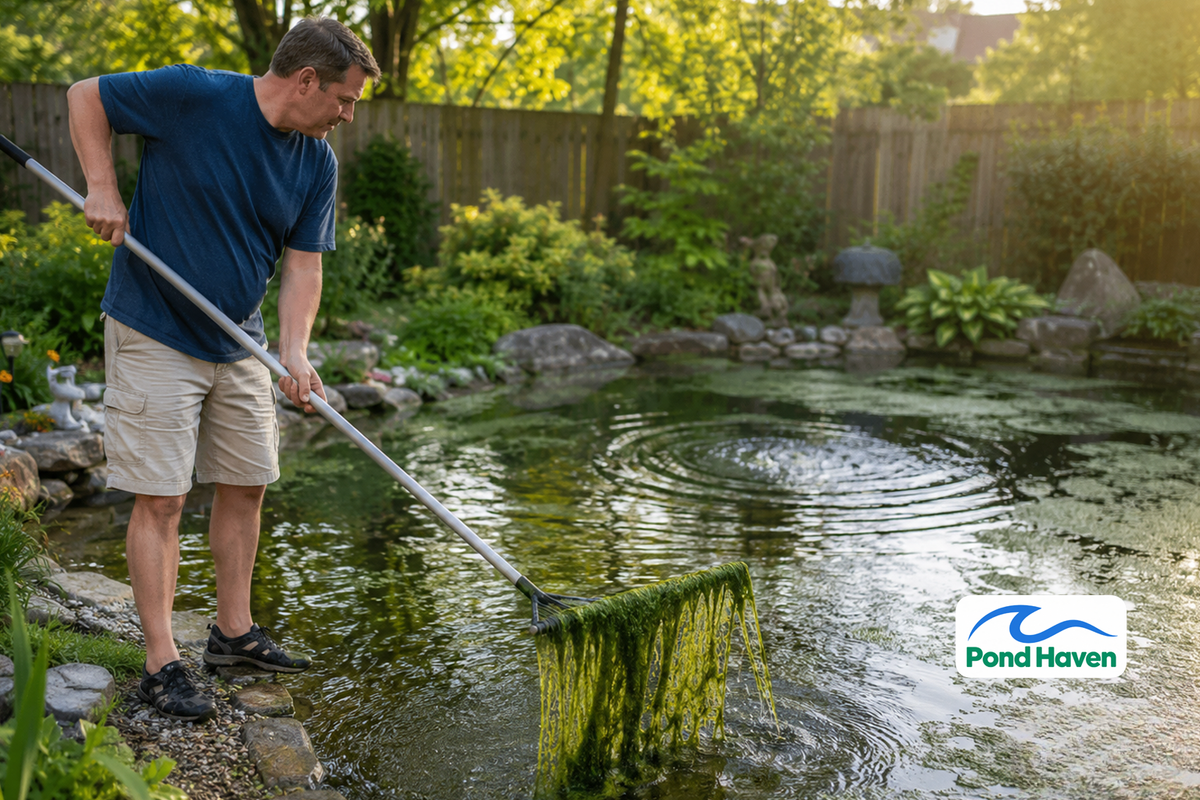
Use leaf rakes, specialized algae rakes, or seine nets to pull mats from the edges. Remove algae before it dies and decomposes naturally to avoid an oxygen crash. Dispose of pulled algae away from the pond edge; if it decomposes at the shoreline, those nutrients re-enter the water.
Labor estimate: 1,000 square feet of mat can take 2-4 hours with a rake. This works best in early growth stages before mats reach the surface.
Pond Vacuums and Suction Dredges
Handheld pond vacuums work for small ponds and bottom sludge. Gas-powered suction dredges handle larger water bodies. Consumer vacuums typically run $200-$500; professional dredging services are priced per project and can run into the thousands. Vacuum annually or as needed based on sediment depth.
Bottom sediment often contains decades of accumulated phosphorus and nitrogen. Removing it eliminates a major internal nutrient source that fuels future blooms.
Mechanical Cutters and Harvesters
For large ponds and lakes, aquatic weed harvesters are the standard approach. Named devices include the Jenson Lake Mower, Weed Razeer, and Weed Roller. Commercial harvester rentals are priced per day and vary by region and equipment size.
Harvesting can remove a significant amount of algae and the nutrients it contains. But harvesting alone isn't enough. The algae will regrow within weeks unless you also manage nutrients.
When Mechanical Removal Is Not Enough
Planktonic algae cannot be raked. Green water requires filtration, UV treatment, or chemical algaecides. Cyanobacteria mats are often too toxic to handle without gloves, and breaking them apart can release toxins into the water.
Chemical Algaecides: Fast-Action with Caution
Chemical algaecides provide rapid knockdown but are not a long-term solution. All algaecides sold in the US must be registered with the EPA under FIFRA (Federal Insecticide, Fungicide, and Rodenticide Act).
The golden rule: treat sectionally, 25-33% of the pond at a time, to avoid oxygen depletion. Dying algae consume large volumes of oxygen during decomposition.
Copper-Based Treatments (Sulfate & Chelated)
Copper ions disrupt photosynthesis and cell membranes. Copper sulfate is an efficient and cost-effective option for reducing total phytoplankton biomass and is effective against filamentous algae. It's one of only two algaecides fully EPA-approved for food-fish aquaculture.
But copper dosing depends entirely on alkalinity:
- Low alkalinity (below 50 mg/L): Use 0.5 mg/L or less to avoid fish toxicity. Below 40 ppm, copper can be toxic to fish.
- Moderate alkalinity (50-150 mg/L): Standard dose of 1.0 mg/L.
- High alkalinity (above 150 mg/L): Copper binds with carbonate and becomes ineffective. Above 250-300 ppm, use chelated forms.
The dosing formula is: [Total Alkalinity (ppm) / 100] x Recommended Dose (ppm) x Volume (acre-feet) x 2.72.
Chelated copper products like Cutrine Plus and Cutrine Ultra stay in solution longer and work better in hard water, but cost more. Copper is toxic to fish at 0.1-0.2 mg/L free copper in soft water, so always test alkalinity first.
One more warning: copper accumulates in sediment. Repeated use creates long-term toxicity. Algae often return within a few weeks after most copper treatments, so you'll be tempted to reapply. Resist.
Hydrogen Peroxide & Sodium Carbonate Peroxyhydrate
These release oxygen and oxidize algae cells. Brand examples include GreenClean and PAK 27. Typical dosing is 1-2 lbs per acre-foot for filamentous algae and 2-4 lbs per acre-foot for planktonic.
The advantage: they break down into water and oxygen with no long-term residue, and they're safer for fish at labeled rates. This makes them the better choice for smaller ponds, spot treatment, and ponds with low alkalinity where copper is risky.
Algae often return within a few weeks after hydrogen peroxide treatment, similar to copper.
Other EPA-Approved Options
- Diquat: A fast-acting contact herbicide. The EPA drinking water standard is 0.02 mg/L, so it's not for use in potable water sources. Product names include Reward and Tsunami DQ.
- Flumioxazin: Broad-spectrum, works in cooler water above 60°F, breaks down in 2-7 days. Product: Flumigard SC.
- Peracetic acid: A strong oxidizer effective against cyanobacteria with only marginal effects on beneficial algae and zooplankton. It can provide longer suppression than some other options. Products: VigorOx SP-15, Peraclean.
| Active Ingredient | Target Algae | Fish Safety | Notes |
|---|---|---|---|
| Copper sulfate | Filamentous, planktonic | Risk in low alkalinity | Cheapest, fast, accumulates in sediment |
| Hydrogen peroxide/SCP | Filamentous, some planktonic | Safer at labeled rates | No residue, good for low alkalinity |
| Diquat | Filamentous | Moderate | Not for potable water |
| Flumioxazin | Broad-spectrum | Moderate | Works in cooler water |
| Peracetic acid | Cyanobacteria | Good | Targeted, longer suppression |
Critical Application & Safety Practices
- Treat 25-33% of the pond at a time; wait 7-14 days between treatments.
- Run aeration during and after treatment to maintain dissolved oxygen.
- Apply in the morning on calm days; avoid treatment when water temperature exceeds 85°F.
- Do not treat when fish are stressed (spawning, low oxygen).
- Wear protective gear: gloves, goggles, long sleeves.
- Check restrictions: some states require permits for algaecide application in waterways connected to public waters.
Biological Controls and Natural Solutions
Biological controls work with the pond's ecosystem rather than against it. They're slower than chemicals but more sustainable.
Barley Straw and Barley Straw Extract
As barley straw decomposes, lignins are released and oxidized into humic substances. In sunlight and oxygen, these form hydrogen peroxide, which inhibits algae growth.
Application rate: 225 lbs per acre (about 3-5 bales per surface acre). Apply in early spring before blooms appear; it takes 4-6 weeks to become effective.
Barley straw is algistatic, not algicidal. It prevents new growth but won't kill existing algae. Results can be inconsistent in practice. It is generally ineffective against certain types of algae like golden alga (Prymnesium parvum). Liquid extracts work faster but cost more per treatment.
Beneficial Bacteria Additives
Beneficial bacteria compete with algae for nutrients and break down organic sludge. Common genera include Bacillus, Pseudomonas, and Nitrobacter. Products like LLMO (Liquid Live Micro-Organisms System) contain these plus Nitrosomonas and Cellulomonas.
Apply liquid or granular forms every 2-4 weeks during the growing season. Cost runs $30-$100 per month for a 1-acre pond. One application rate is 1 liter per 56,718 liters of pond water biweekly.
Bacteria are best for prevention and maintenance, not for knocking down an active bloom. They're aerobic, so they need adequate dissolved oxygen. Pair them with aeration for best results.
Beneficial bacteria are aerobic organisms. Without adequate dissolved oxygen, they die off and do nothing. A bottom diffuser aeration system keeps oxygen levels high enough for bacteria to work and directly competes with algae for nutrients.
Tilapia Stocking
Tilapia consume filamentous algae aggressively. Nile tilapia (Oreochromis niloticus) and Mozambique tilapia (Oreochromis mossambicus) are the common choices.
Stocking rate: 15-20 lbs of mixed-sex adult fish per surface acre. Stock when water temperature is consistently above 65°F; tilapia are tropical and die below 55°F. In most US climates, that means stocking mid-April or May and expecting them to die in November or December. You must restock annually.
Cost: $50-$150 per pound of fish depending on region. Tilapia are ineffective in ponds with large largemouth bass populations due to predation. In Texas, stocking requires Texas Parks and Wildlife Department approval if the pond is in a "conservation zone."
Competitive Aquatic Plants
Submerged plants compete directly with algae for nitrogen and phosphorus. Some species are particularly effective at nutrient uptake.
| Species | Total Nitrogen Removal | Total Phosphorus Removal |
|---|---|---|
| Elodea canadensis | 68.70% | 58.60% |
| Hydrilla verticillata | 64.38% | 47.94% |
| Ceratophyllum demersum (coontail) | 67.84% | 36.59% |
| Vallisneria natans | 69.13% | 43.70% |
Coontail (Ceratophyllum demersum) has a high affinity for phosphorus uptake. It's recommended as a pioneer species for recovering vegetation in eutrophic lakes.
Target 20-40% plant coverage of the pond surface for shading. Floating plants like water lilies (Nymphaea spp.) shade 30-50% of the surface when established.

Technological Systems for Control and Clarity
Technology is best for planktonic algae (green water) and ongoing prevention.
UV Clarifiers and Sterilizers
UV-C light at 254 nm damages algae DNA, causing cells to clump and settle or be filtered out. Match UV wattage to pond volume:
- Up to 1,000 gallons: 9-18 watts
- 1,000-3,000 gallons: 25-40 watts
- 3,000-10,000 gallons: 55-80 watts
- 10,000+ gallons: 110 watts or multiple units
A UV clarifier typically takes 5-7 days to fully clear a green pond. Flow rate matters: water must pass slowly enough for exposure, typically 1,000-3,000 GPH for residential units. Exceeding the rated flow rate reduces exposure time and can downgrade a sterilizer to a clarifier.
Maintenance: replace the UV bulb annually (output degrades after about 9,000 hours even if it still lights). Clean the quartz sleeve monthly; a dirty sleeve can reduce efficiency from 100% to 40%. Stainless steel housings reflect UV light back into the water, increasing efficiency by up to 30% compared to plastic.
Cost of ownership: $150-$400 initial purchase, $30-$80 per year for bulbs. A 40-watt unit at $250 plus $50/year bulbs totals about $750 over a decade.
The limitation: UV does not remove nutrients. It clears the symptom but doesn't address the cause.
Aeration and Circulation Systems
Aeration increases dissolved oxygen, aids nutrient removal, and encourages phosphorus to bind to sediments rather than staying in the water column. Ponds with active inlets and outlets typically have fewer algae problems and higher dissolved oxygen.
Aerator types:
- Fountains (surface aerators): Draw surface water and spray it into the air.
- Bubblers (diffusers/bottom aerators): Release air from the pond floor.
- Paddlewheel aerators: Standard for aquaculture, achieving 1.1-1.3 kg O₂ per kilowatt-hour.
Proper aeration can significantly boost fish production by maintaining much higher dissolved oxygen levels.
For algae control, bottom diffused aeration is the better choice. It circulates the entire water column, breaks up thermal stratification, and keeps nutrients suspended rather than letting them settle where algae can use them.
Long-Term Prevention: Nutrient Management
Algae need nutrients to grow. Cut off the nutrients and you cut off the algae. This is the most important long-term strategy.
Control External Nutrient Sources
Excess nitrogen and phosphorus are the primary drivers of algae blooms. Common sources include barnyard runoff, crop fields, septic systems, lawn fertilizers, golf courses, and pet waste.
- Use zero-phosphorus fertilizers (like 18-0-5) around pond areas.
- Prevent livestock from entering the pond.
- Redirect nutrient-rich runoff away from the pond.
Install Buffer Strips
Vegetated transition zones trap soil and nutrients before they enter the pond. Minimum recommended width is 35 feet, though ranges of 15-50 feet are suggested depending on land use. High phosphate levels can often be traced to organic nutrients from fallen trees and leaves entering the pond through eroded banks.
Manage Internal Nutrient Load
Bottom sediment often contains decades of accumulated phosphorus and nitrogen. Even after you control external sources, this internal load can fuel blooms.
Options include:
- Alum (aluminum sulfate): Binds phosphorus in sediment. Requires precise calculations based on pH, hardness, and volume.
- Phoslock: A modified clay that binds phosphorus. Apply before or alongside other treatments; it doesn't control current growth.
- Dredging: Physically removes sediment and eliminates internal nutrient storage.
- Aeration: Increases dissolved oxygen, encouraging phosphorus to bind to sediments.
Pond Design and Dyes
A 3:1 slope (1-foot drop for every 3 feet from shore) minimizes shallow areas where algae start. Ponds should be at least 3 feet deep to reduce bottom-growing algae, and 6-7 feet deep if fish need to overwinter.
Non-toxic pond dyes like Aquashade block sunlight to reduce growth. Apply early in the growing season before algae reach the surface. Dyes require EPA registration if they claim to control plants or algae. Caveat: dyes can suppress the natural food chain, limiting zooplankton and the broader pond ecosystem.
A Tiered Action Plan for Algae Removal
Here's the complete sequence, from identification to ongoing maintenance:
- Identify the algae type. Distinguish between filamentous mats, green water, and cyanobacteria films using a Secchi disk and visual inspection.
- Test water quality. Measure alkalinity, pH, dissolved oxygen, nitrogen, and phosphorus. This determines safe chemical options.
- Reduce nutrient inputs. Redirect runoff, install buffer strips at least 35 feet wide, use zero-phosphorus fertilizers, exclude livestock.
- Physically remove existing biomass. Rake, net, or vacuum filamentous algae. Dispose away from the pond edge.
- Apply biological controls early. Add barley straw (3-5 bales per surface acre) or beneficial bacteria in late winter or early spring. Stock tilapia (15-20 lbs per surface acre) after water temperatures exceed 65°F.
- Add nutrient-competing plants. Introduce submerged plants like coontail or Elodea canadensis.
- Install or optimize technology. Add a properly sized UV clarifier (10 watts per 1,000 gallons) for planktonic algae. Run aeration 24/7, especially at night.
- Treat chemically only if needed. Use EPA-approved algaecides, treat in sections, monitor dissolved oxygen, and run night aeration.
- Monitor twice a month. Preventive monitoring prevents out-of-control blooms.
- Accept a healthy baseline. Small amounts of algae are natural and beneficial. The goal is balance, not total eradication.

Safety, Regulations, and Ecological Balance
Protecting Fish and Wildlife
The biggest risk in algae treatment is oxygen depletion. Dying algae consume high volumes of oxygen during decomposition. This causes fish kills in late summer and fall, and after chemical treatments.
For example, a natural algae die-off can drop dissolved oxygen below safe levels, killing fish. That's why sectional treatment and night aeration are non-negotiable.
Regulatory Standards
All algaecides sold in the US must be EPA-approved for aquatic use under FIFRA. Some states require additional approval from their Department of Pesticide Regulation.
Drinking water standards matter if your pond connects to a water supply. For diquat, the US EPA maximum contaminant level is 0.02 mg/L. The WHO guideline is 0.03 mg/L.
In the UK, no chemical treatments or weedkillers are approved for home garden ponds. Residential owners there must rely on manual removal and nutrient management.
Accept the Healthy Baseline
Small amounts of algae are natural and beneficial. They provide oxygen, shelter for wildlife, and form the base of the aquatic food chain. The goal of algae management is balance, not total eradication. Chasing a perfectly clear, sterile pond often creates more problems than it solves.
Frequently Asked Questions
Will algaecides kill my fish?
They can, if misapplied. The main risk is oxygen depletion as dying algae decompose. Treat only 25-33% of the pond at a time, wait 7-14 days between treatments, and run aeration during and after application. Copper-based products are also directly toxic to fish in low-alkalinity water, so test alkalinity first.
How long does a UV clarifier take to work?
A properly sized UV clarifier typically clears green water in 5-7 days. Match the wattage to your pond volume (about 10 watts per 1,000 gallons for clarification) and replace the bulb annually. UV only works on planktonic algae, not string algae.
Is barley straw effective for algae control?
Sometimes. Results can be inconsistent. Barley straw is algistatic, meaning it prevents new growth rather than killing existing algae. Apply it in early spring before blooms appear, at a typical rate of a few bales per acre. It takes several weeks to become effective and won't help with an active bloom.
What causes green water in ponds?
Green water is a planktonic algae bloom, driven by excess nutrients (nitrogen and phosphorus) combined with warm water and sunlight. Common nutrient sources include lawn fertilizer runoff, livestock waste, septic systems, and decomposing organic matter. A UV clarifier clears the water, but you must address the nutrient source to prevent recurrence.
What's the difference between string algae and green water treatment?
String algae (filamentous) forms visible mats you can rake out; green water (planktonic) is microscopic and requires UV, filtration, or chemical treatment. Aeration and beneficial bacteria help with both by competing for nutrients and maintaining oxygen. Match your treatment to the algae type you actually have.