
Are Pond Pumps Expensive to Run?
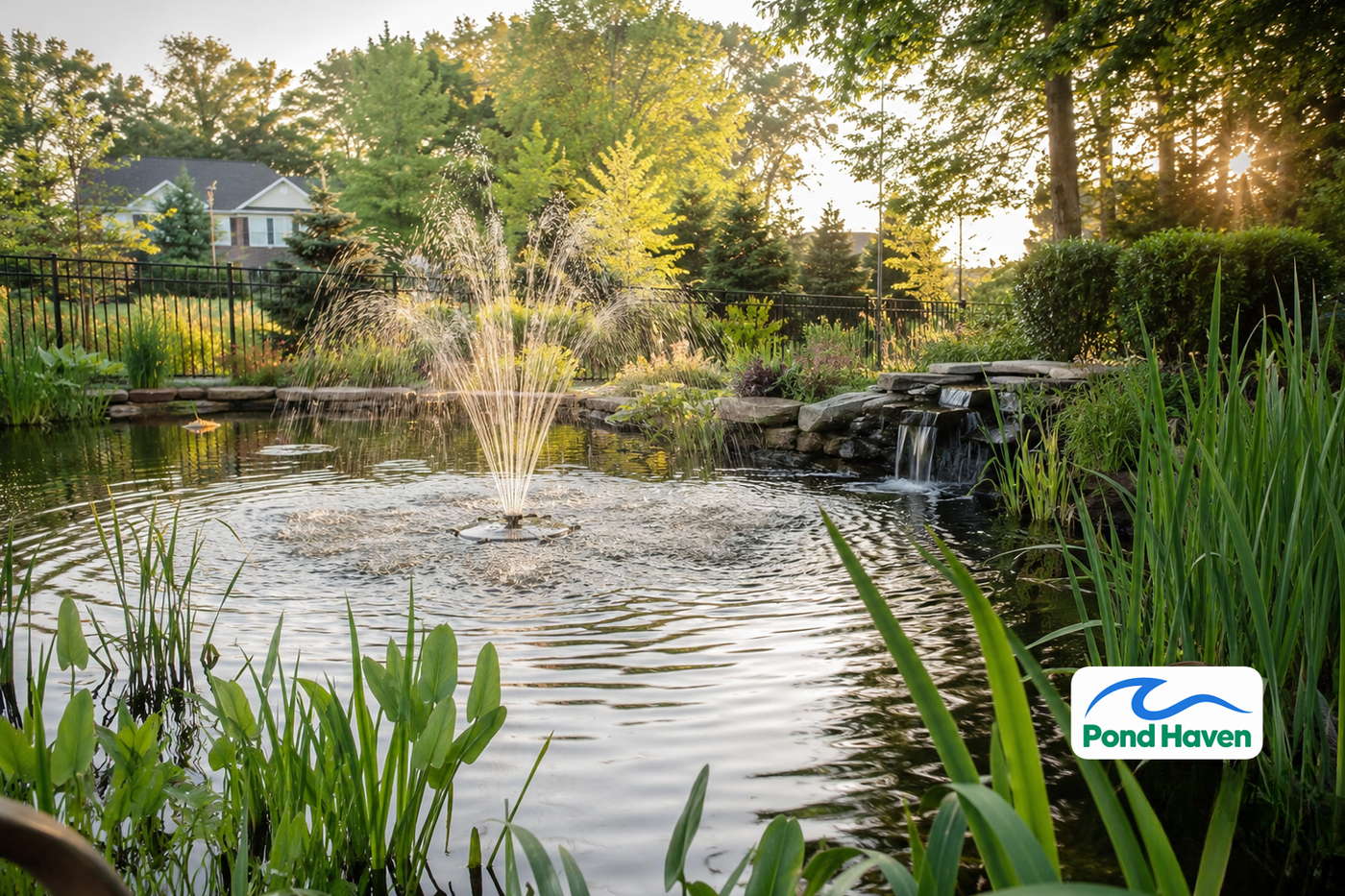

The short answer: no, not for most pond owners. A typical backyard fountain costs between $16 and $38 per month to run 24/7 during warm weather. That's roughly the price of a streaming subscription or a couple of pizzas.
But your exact bill depends on three things: your pump's wattage, your local electricity rate, and how many hours per day you run it. Here's exactly how to figure out what your fountain will cost, plus how to cut that number in half without hurting your pond.
- A 1/4 HP fountain pump (250–350 watts) costs about $27–$38 per month running 24/7 at the national average electricity rate.
- Your monthly cost is simple math: (pump wattage ÷ 1000) × hours run × your electricity rate.
- Running a fountain on a timer for 12 hours a day instead of 24 cuts energy costs by roughly half.
- Magnetic-drive (mag-drive) pumps use significantly less energy than direct-drive pumps for the same water flow.
- If your main goal is fish health and oxygenation, a diffused-air aerator is usually cheaper to run than a fountain.
What Determines Your Pond Fountain's Operating Cost?
Three variables control your monthly bill. Change any one of them and your cost shifts noticeably.
Pump Wattage and Horsepower (HP)
Fountain pumps for residential ponds range from 1/8 HP up to 2 HP for large display features. The horsepower rating tells you roughly how much energy the pump draws, but wattage is the number that matters for your electric bill.
Here are typical wattage ranges for common residential fountain pump sizes:
| Pump Size | Typical Wattage Draw |
|---|---|
| 1/8 HP | 150–200 watts |
| 1/4 HP | 250–350 watts |
| 1/2 HP | 450–550 watts |
| 3/4 HP | 600–750 watts |
| 1 HP | 900–1,100 watts |
Higher horsepower moves more water and throws a taller spray, but it also draws more power. A 1/2 HP pump uses roughly twice the electricity of a 1/4 HP pump. Match the pump to your pond's size and the spray effect you want, not to the biggest option on the shelf.
Your Local Electricity Rate
Electricity is billed in kilowatt-hours (kWh). One kWh is 1,000 watts running for one hour. The national average residential rate hovers around $0.15 to $0.17 per kWh, but your rate depends heavily on your state and utility.
Some states pay far less. Louisiana and Washington often sit near $0.10 to $0.12 per kWh. California and Hawaii frequently exceed $0.25 to $0.40 per kWh. That same fountain can cost two to three times more to run in San Diego than in Baton Rouge.
To find your exact rate, check your latest electric bill. Look for the line labeled "energy charge" or "delivery charge" and divide the total by your kWh usage. Or search your utility's website for their current residential rate per kWh.
Daily Run Time
How many hours per day you run the fountain is the biggest lever you control. Most owners run fountains 24/7 during warm months for continuous aeration and surface movement. That's fine, but it's also the most expensive option.
Seasonal operation matters too. A fountain run only from May through October costs about half of one run year-round. In freezing climates, you should pull the pump and store it indoors for winter anyway, which naturally limits your annual run time.

Calculating Your Fountain's Operating Cost: A Step-by-Step Guide
The math is straightforward. Use this formula:
(Pump Wattage ÷ 1000) × Hours Run Per Day × Electricity Rate = Daily Cost
Multiply that by 30 for a monthly estimate, or by the number of days in your operating season for an annual figure.
Example Cost Calculation
Let's walk through two real-world scenarios.
Example 1: A 1/4 HP fountain in Ohio, run 24/7 for 6 months
- Pump wattage: 300 watts
- Electricity rate: $0.15/kWh
- Daily run time: 24 hours
Daily cost: (300 ÷ 1000) × 24 × $0.15 = $1.08 per day
Monthly cost: $1.08 × 30 = $32.40 per month
Seasonal cost (May through October, about 183 days): $1.08 × 183 = $197.64 for the season
Example 2: A 1/2 HP fountain in California, run 12 hours/day year-round
- Pump wattage: 500 watts
- Electricity rate: $0.25/kWh
- Daily run time: 12 hours
Daily cost: (500 ÷ 1000) × 12 × $0.25 = $1.50 per day
Monthly cost: $1.50 × 30 = $45.00 per month
Annual cost: $1.50 × 365 = $547.50 for the year
Notice the difference. The smaller pump in a cheaper-rate state costs less than half of the larger pump in an expensive-rate state, even before you factor in run time.
Comparison Table: Estimated Monthly Operating Costs
This table assumes the national average rate of $0.15/kWh. Adjust the numbers up or down based on your local rate.
| Fountain Pump Size | Typical Wattage | Monthly Cost (24/7) | Monthly Cost (12 hrs/day) |
|---|---|---|---|
| 1/8 HP | 150–200W | $16 – $22 | $8 – $11 |
| 1/4 HP | 250–350W | $27 – $38 | $14 – $19 |
| 1/2 HP | 450–550W | $49 – $60 | $24 – $30 |
| 3/4 HP | 600–750W | $65 – $81 | $33 – $41 |
How to Reduce Your Pond Fountain's Energy Costs
You don't have to sacrifice pond health or the visual appeal of your fountain to save money. These four strategies cut operating costs without compromising water quality.
Choose an Energy-Efficient Pump
The biggest single decision is pump type. Magnetic-drive (mag-drive) pumps use a sealed magnetic coupling between the motor and impeller. They run cooler, quieter, and use significantly less energy than traditional direct-drive pumps moving the same volume of water.
Direct-drive pumps have a shaft that passes through a seal into the water. They're often cheaper upfront and can handle higher head pressure, but they draw more wattage for equivalent flow. For a decorative fountain in a backyard pond, a mag-drive pump is almost always the better energy choice.
Optimize Your Run Schedule
A simple timer is the cheapest energy-saving device you can buy. Run the fountain only during daylight hours when you can see and enjoy it, or set it for intermittent cycles like 6 hours on, 2 hours off.
Cutting from 24 hours to 12 hours per day reduces your energy cost by half. In cooler weather, when water holds dissolved oxygen more readily, intermittent operation is perfectly safe for fish. During hot summer months, you'll want more consistent aeration, but even then, running the fountain during the hottest part of the day provides the most benefit.
Right-Size Your Fountain for Your Pond
A fountain that's too powerful for a small pond wastes money and can actually stress fish with excessive water movement. A good rule of thumb: your fountain pump should turn over the pond's total volume roughly once every 1 to 2 hours.
For a 1,500-gallon pond, that means a pump rated around 750 to 1,500 GPH. For a 5,000-gallon pond, look for 2,500 to 5,000 GPH. Check the pump's GPH rating at the head height you need, not just the maximum flow at zero lift. A pump rated 3,000 GPH at 0 feet may only deliver 1,800 GPH at a 4-foot spray height.
Buy the smallest pump that delivers the spray height and flow you want. A 1/4 HP pump costs less per month to run than a 1/2 HP pump at the same schedule, and most backyard ponds under 3,000 gallons don't need more than 1/4 HP.
Perform Regular Maintenance
A clean pump is an efficient pump. Debris clogging the intake or nozzle forces the motor to work harder, drawing more wattage and moving less water.
Once a month during the operating season, do these checks:
- Remove and rinse the pump intake screen to clear leaves, algae, and debris.
- Check the fountain nozzle for clogs and clean with a soft brush.
- Inspect the impeller for wrapped debris like hair or fishing line.
- Verify the pump is fully submerged; running dry damages the motor and wastes energy.
These checks take about 10 minutes and keep your pump running at its rated efficiency.

Pond Fountain vs. Pond Aerator: Operating Cost Comparison
If your primary goal is water quality and fish health, a diffused-air aerator is worth comparing against a fountain. They oxygenate water differently, and the cost difference can be significant.
A fountain pulls water from the surface and sprays it into the air, creating surface agitation and oxygen exchange. A diffused-air aerator sits on the bank and pushes air through a hose to a diffuser on the pond bottom, releasing fine bubbles that rise and circulate the entire water column.
For equivalent oxygenation, aerators typically use less energy. A 1/4 HP fountain pump draws 250–350 watts. A small aerator for a similar-size pond might draw 100–200 watts, depending on the compressor and pond depth. In deeper ponds, aerators are more effective because they oxygenate the bottom layers where fish actually live, while a fountain only affects the surface.
When a Fountain is the Right Choice
Choose a fountain when aesthetics matter. The spray pattern, the sound of falling water, and the visual centerpiece are the whole point. A fountain also provides decent surface aeration, which helps in ponds under 6 feet deep where the entire water column stays mixed.
The slightly higher operating cost is the price of the visual feature. For most owners, $25–$40 per month is a reasonable trade for a backyard centerpiece that runs all summer.
When an Aerator Might Be More Cost-Effective
Choose an aerator when fish health is your top priority, especially in ponds deeper than 6 feet. A fountain only oxygenates the top few feet of water. In a deep pond, the bottom layers can go anoxic even while the surface looks fine, which stresses fish and fuels algae growth.
Aerators also run year-round in many climates. In winter, they maintain an open hole in the ice for gas exchange, something a fountain can't do because you've stored the pump for the season.
Fountain Advantages
- Visual centerpiece with spray patterns and water sound.
- Provides surface aeration for ponds under 6 feet deep.
- Simple to install and operate.
Fountain Disadvantages
- Higher wattage draw than an aerator for equivalent oxygenation.
- Only oxygenates the surface layer, not deep water.
- Must be removed and stored in freezing climates.
Many pond owners run both: a fountain for looks during the day and an aerator for year-round water quality. If you're on a budget, start with the aerator for fish health and add the fountain when you want the visual upgrade.

Frequently Asked Questions
Does a pond fountain use a lot of electricity?
No, not for most setups. A typical 1/4 HP fountain pump draws 250–350 watts and costs about $27–$38 per month running 24/7 at the national average rate of $0.15/kWh. Running it 12 hours a day on a timer cuts that roughly in half.
Can I run my pond fountain 24 hours a day?
Yes. Many owners run fountains 24/7 during warm months for consistent aeration and surface movement. It's not necessary for aesthetics alone, and a timer can save you 50% or more on energy costs while still providing good water circulation.
Is it cheaper to run a fountain or a waterfall?
It depends on the pump size and head height. A waterfall pump pushing water vertically to the top of a rock feature works against more head pressure, so it often draws more wattage than a surface fountain pump for the same pond. Every setup is unique, so compare the wattage ratings on the specific pumps you're considering.
Should I turn my pond fountain off in the winter?
Yes, in freezing climates. Remove and store the fountain pump indoors to prevent ice damage to the motor and housing. Use a pond de-icer or a diffused-air aerator to maintain an open hole in the ice for gas exchange so fish survive the winter.