
Why Pond Fountains Are Expensive
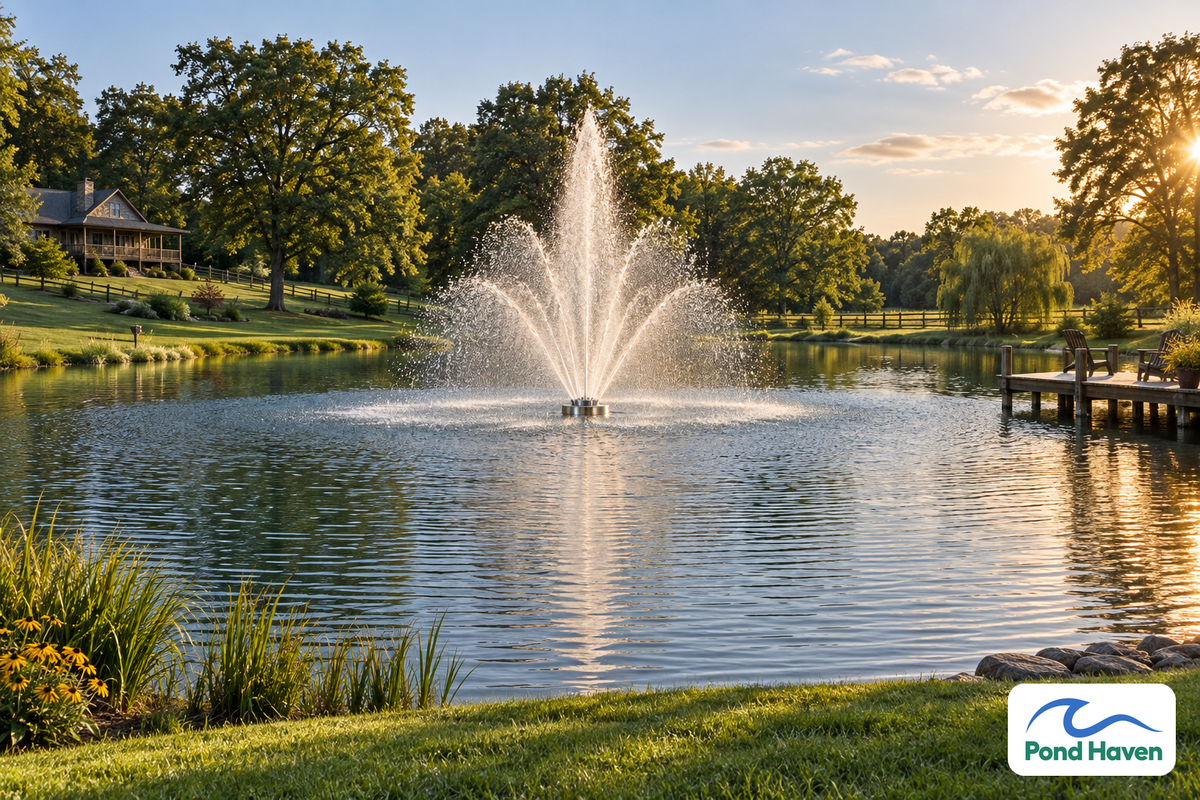

You've seen the $200 floating fountain on Amazon. You've also seen the $2,000 unit from a specialty dealer. Same job, right? Both shoot water into the air. Both sit in your pond. Why the tenfold price gap?
The short answer: a $200 fountain is a decoration. A $2,000 fountain is a piece of water management equipment that happens to look beautiful. The difference shows up in the motor, the seals, the materials, and the engineering that keeps it running for years instead of months.
Here's where the money actually goes.
- A quality pond fountain is a continuous-duty aeration system with a decorative spray, not a garden ornament. That dual role drives most of the cost.
- Marine-grade 316L stainless steel and silicon carbide seals last 15–25 years underwater; consumer plastics and rubber gaskets fail in 3–5 years.
- Hidden manufacturer costs — UL 778 certification, product liability insurance, and R&D — are baked into every certified unit you buy.
- Run the math on cost-per-year, not sticker price. A $2,000 fountain that lasts 15 years often beats two $500 units that fail in 4.
- For a small decorative pond with no fish, a cheaper fountain is genuinely the right call. For a stocked pond, it's a false economy.
The Motor Is the Difference Between a Toy and a Tool
Open up a $200 fountain and you'll find a motor designed for intermittent use. It might run happily for a few hours on a summer weekend. Run it 24/7 for a season and the windings overheat, the bearings wear, and the unit dies. That's by design — consumer pumps are built to a price point, not a duty cycle.
A professional floating fountain runs a submersible motor engineered for continuous immersion. These motors are rated for 3,400 RPM operation around the clock, through heat, cold, and storm debris. The housing is marine-grade stainless steel or fiber-reinforced resin, not thin plastic that becomes brittle after two winters of UV exposure.
Here's what that costs at the component level:
| Component | Consumer Grade | Professional Grade |
|---|---|---|
| Pump motor | $100–$500 | $1,000–$2,500+ |
| Housing material | ABS plastic, 304 steel | 316L stainless steel, reinforced resin |
| Seal type | Rubber gasket | Silicon carbide mechanical face seal |
| Expected service life | 3–5 years | 15–25 years |
| Warranty | 30–90 days | 1–3 years |
The motor alone accounts for roughly half the price difference between tiers. That's not markup. That's copper windings, sealed bearings, thermal overload protection, and a housing thick enough to survive decades of constant submersion.
Seals: The Part That Fails First (and Costs the Most to Fix)
Ask any pond professional what kills fountains and they'll give you the same answer: seals. Water finds its way past a degraded seal, reaches the motor, and the unit is done.
Cheap fountains use rubber gaskets or simple O-rings. They work fine for a year or two, then harden, crack, and leak. The result is a dead motor and a fountain that costs more to repair than replace.
Professional fountains use silicon carbide mechanical face seals. These are precision-ground surfaces that run against each other with a thin film of water as lubricant. They're the same technology used in industrial pumps handling chemicals and wastewater. They're expensive to manufacture — each seal face must be flat to within fractions of a micron — but they survive years of continuous rotation.
When a seal does eventually wear out on a quality unit, it's serviceable. Replacement seals run $50–$200 for parts, or $200–$500 with labor. That's the difference between a $200 repair and a $2,000 replacement.
Materials: Why 316L Stainless Steel Costs What It Does
The grade of stainless steel matters more than most buyers realize. There are two grades you'll see in pond equipment:
304 stainless steel is the standard grade. It's fine for freshwater applications with no chemical treatments. But it's susceptible to pitting and corrosion in chlorinated water, brackish conditions, or water with aggressive pH levels.
316L stainless steel is marine grade. The addition of molybdenum makes it dramatically more resistant to corrosion. It's the same material used in saltwater boat fittings and chemical processing equipment. A 316L fountain nozzle is expected to last 15–25 years. The same nozzle in 304, placed in challenging water, can corrode within 3 years.
That material upgrade alone roughly triples the cost of the raw metal. When you multiply it across the housing, the impeller, the nozzle assembly, and the mounting hardware, you're looking at a significant chunk of the price difference.
Stainless steel also offers a roughly 5x longer service life than cast iron in corrosive environments. For a component that sits underwater 365 days a year, that longevity is worth paying for.

The Engineering Nobody Sees: CFD and Nozzle Design
Here's a cost most buyers never consider: the research and development that goes into making water spray in a controlled pattern.
Fountain manufacturers use computational fluid dynamics (CFD) software to simulate how water behaves as it leaves the nozzle, travels through the air, and lands back on the pond surface. This isn't decorative engineering — it's physics. Getting a spray pattern that holds its shape in wind, doesn't collapse under its own weight, and distributes oxygen efficiently requires serious simulation work.
That engineering doesn't come cheap:
- A qualified CFD analyst costs roughly $190,000 per year in loaded salary
- Commercial CFD software licensing runs $15,000–$50,000+ annually
- A manufacturer running 8 simulation projects per year carries a $210,000–$260,000 annual CFD budget
Then there's the nozzle itself. Quality nozzles maintain a bore tolerance of ±0.05mm. That's about half the width of a human hair. At that precision, every nozzle in an array produces an identical jet. Cheap injection-molded plastic nozzles can't hold that tolerance, which is why budget fountains produce uneven, wavering, collapsing spray patterns.
Precision-machined brass and stainless nozzles cost far more than molded plastic. They also produce a display that looks professional rather than amateur.
Safety Certification: The Regulatory Price Tag You Never See
Every fountain sold in the US with a UL listing has been through a certification process that costs real money. The UL 778 standard — which covers motor-operated water pumps — is the primary safety standard for fountain equipment.
Here's what compliance actually costs:
- The UL 778 standard document itself: $642–$1,567 depending on format
- Third-party testing lab fees: thousands of dollars per unit design
- Ongoing certification maintenance: a recurring cost, not a one-time expense
Testing covers motor overload protection, locked rotor protection, short circuit protection, dry operation protection, and burnout testing. Every one of those tests exists because a failure underwater with electricity nearby can be lethal.
The cost of that certification is baked into every unit the manufacturer sells. A manufacturer selling 1,000 certified units per year might carry $50,000+ in testing and compliance costs annually. That's $50 per unit before a single component is assembled.
You're Buying Aeration, Not Just a Pretty Spray
Here's the part most buyers miss: a fountain is also an aerator. The spray pattern that looks beautiful is simultaneously pulling oxygen-depleted water from the pond surface and exposing it to the atmosphere.
That dual function is why fountains cost more than purely decorative water features. The pump must be sized not just to lift water for display, but to circulate enough volume to meaningfully oxygenate the pond.
The science matters. Dissolved oxygen (DO) levels below 2 ppm are lethal to fish if prolonged. Between 2–5 ppm, fish survive but grow slowly and become susceptible to disease. Above 5 ppm is the desirable range for most species.
A stocked pond represents a real investment. Largemouth bass, bream, and grass carp populations can be valued at more than $3,000 per acre. An oxygen depletion event — triggered by a few days of cloudy weather, a sudden algae die-off, or wind mixing that brings low-oxygen deep water to the surface — can kill that investment in hours.
A quality fountain is insurance against that loss. A cheap one that fails mid-summer, when oxygen demand is highest, leaves your fish exposed.
Floating fountains only circulate the upper few feet of water. If your pond is deeper than 7 feet, pair the fountain with a bottom aerator to oxygenate the full water column. Many serious pond owners run both.
The Hidden Costs Manufacturers Carry
Beyond components and engineering, every fountain manufacturer carries overhead that directly inflates the retail price:
Product liability insurance. Fountains combine high-voltage electricity with public-access water. Insurers classify that as high-risk manufacturing. Product liability coverage runs $700–$5,000+ per year for a small manufacturer, and general liability adds another $1,200–$3,000+. Total insurance for a small-to-mid-sized manufacturer lands between $9,000 and $28,000+ annually. That's 0.5–1.5% of revenue, passed directly to buyers.
Warranty obligations. A 2-year warranty on a premium fountain means the manufacturer is betting the unit will survive. When it doesn't, they eat the replacement cost. That risk is priced into every unit. Cheap fountains offer 30–90 day warranties because the manufacturer knows the failure curve — and doesn't want to be on the hook when it arrives.
Warranty length is a confidence signal. A manufacturer willing to back a product for 2–3 years has engineered it to survive. One offering 90 days is telling you what they expect.
Installation: The 30–50% You Can't Skip
If you're comparing fountain prices, remember that the unit itself is only part of the cost. Professional installation typically adds 30–50% on top of equipment.
Licensed electricians charge $75–$150 per hour. A fountain installation needs a dedicated GFCI-protected circuit, often a sub-panel if the pond is far from the house. Permits run $50–$300 depending on your jurisdiction. Trenching for electrical lines, deck-cutting, and long cable runs all add up.
Can you DIY it? Sometimes. But most manufacturers require professional installation to honor the warranty, and for good reason. An improperly grounded fountain is a lethal hazard. The electrical work isn't the place to save money.

The Real Cost of "Cheap": A Life-Cycle Analysis
Here's the math that matters. Let's compare two paths over 15 years:
The cheap path: Buy a $500 consumer fountain. It lasts 3–4 years before the seals fail and the motor dies. Replace it. Repeat. Over 15 years, that's 4 units at $500 each — $2,000 total, plus the hassle of repeated installation and the risk of a mid-summer failure when your fish need aeration most.
The quality path: Buy a $2,000 professional fountain with 316L stainless steel and silicon carbide seals. It lasts 15–25 years. Total cost: $2,000, plus one seal replacement around year 10.
The quality unit costs the same or less over its service life — and it never leaves your fish unprotected during a July heat wave.
Advantages of Premium Fountains
- 15–25 year service life vs. 3–5 years for consumer grade
- Serviceable seals and components — repair instead of replace
- Continuous-duty motor rated for 24/7 operation
- UL certified for electrical safety underwater
- Meaningful aeration for stocked ponds
Disadvantages
- High upfront cost ($1,000–$5,000+)
- Professional installation often required for warranty
- Overkill for small decorative ponds with no fish
Operating Costs: What It Costs to Run a Fountain
The purchase price isn't the only number to consider. Running a fountain 24/7 consumes electricity, and the cost varies significantly by pump size.
A 1/2 HP pump running continuously draws about 960 watts. Over a 30-day month (720 hours), that's roughly 691 kilowatt-hours. At the US average of 12 cents per kWh, that's about $83 per month.
A 3/4 HP aerator costs roughly $0.05 per hour to operate — about $36 per month at continuous duty. Larger units cost more. A 2 HP paddlewheel aerator runs about $0.16 per hour, or roughly $115 per month.
Newer motor technologies improve efficiency by up to 25% compared to older models. If you're comparing units, check the wattage rating rather than just the horsepower. A more efficient motor can save you hundreds of dollars per year in operating costs — enough to justify a higher purchase price within a few seasons.
What You're Actually Paying For: Price Tier Breakdown
| Tier | Price Range | Materials | Lifespan | Warranty | Best For |
|---|---|---|---|---|---|
| Entry-level | $200–$500 | Plastic, 304 steel | 3–5 years | 30–90 days | Decorative ponds, no fish |
| Mid-range | $800–$2,000 | 316L stainless, quality seals | 8–15 years | 1–2 years | Stocked ponds, serious hobbyists |
| Commercial | $2,000–$5,000+ | Full marine-grade, precision nozzles | 15–25 years | 2–3 years | Large ponds, acreage lakes |
| Custom | $5,000–$100,000+ | Bespoke engineering | 20+ years | Custom | High-end landscapes, HOAs |
For most residential pond owners with fish, the mid-range tier is the sweet spot. You get marine-grade materials, a real warranty, and serviceable components without paying for commercial-scale capacity you don't need.
When a Cheaper Fountain Is the Right Call
Not every pond needs a $2,000 fountain. Here's when a budget unit makes sense:
- Small decorative ponds under 1,000 gallons with no fish. Aeration isn't critical, and the fountain is purely aesthetic.
- Temporary installations where you're testing whether you'll use a fountain before committing.
- Rental properties or situations where you won't own the pond long-term.
- Budget-constrained first-time pond owners who need to start somewhere.
The key question: what are you protecting? If the answer is "nothing but aesthetics," buy cheap. If the answer is "several thousand dollars of fish and years of pond investment," buy quality.

Is a Premium Pond Fountain Worth It?
Run the cost-per-year math before you decide.
A $500 fountain that lasts 4 years costs $125 per year — plus the risk of failure at the worst possible moment.
A $2,000 fountain that lasts 15 years costs $133 per year — with continuous-duty reliability, serviceable parts, and genuine aeration capacity.
The premium unit costs roughly the same per year of service. It just asks you to pay upfront instead of every few years.
For a stocked pond, the calculation is even clearer. A single fish kill from a failed aerator can cost you more than the fountain itself. Protecting a $3,000+ per acre fish population with reliable equipment isn't an expense — it's insurance.
Divide the total price by the expected service life. A $2,000 fountain over 15 years costs less per year than a $500 fountain over 4 years — and it never leaves your pond unprotected.
Frequently Asked Questions
Are solar-powered fountains more cost-effective?
Solar fountains eliminate operating costs but can't run 24/7 and produce far less flow than AC-powered units. They're fine for small decorative ponds but can't provide meaningful aeration for a stocked pond. For a fish pond, a mains-powered unit with a timer is the reliable choice.
How much does it cost to run a pond fountain monthly?
A 1/2 HP pump running 24/7 costs roughly $83 per month at average US electricity rates of 12 cents per kWh. A 3/4 HP aerator runs about $36 per month. Energy-efficient motors can cut those figures by up to 25%.
Do LED lights significantly increase the price?
Yes, but less than you might think. LED lighting adds $200–$800 to a fountain's price depending on the number of lights and control features. The lights themselves are energy-efficient and long-lasting, so the main cost is upfront rather than ongoing.
What's the average lifespan of a quality pond fountain?
A fountain built with 316L stainless steel and silicon carbide seals typically lasts 15–25 years. Consumer-grade units with plastic housings and rubber gaskets usually fail within 3–5 years. The difference is almost entirely in materials and seal quality.
Can I install a fountain myself to save money?
You can, but most manufacturers require professional electrical installation to honor the warranty. A licensed electrician costs $75–$150 per hour, and the work involves GFCI protection and often a dedicated circuit. Improper installation of underwater electrical equipment is a genuine safety hazard, not just a warranty issue.
Are floating fountains cheaper than in-ground models?
Generally yes. Floating fountains are self-contained units that sit on the pond surface, requiring only an electrical supply. In-ground models need plumbing, a dedicated pump house or vault, and more complex installation. For most residential ponds, a floating fountain is the more cost-effective choice.
The Bottom Line
A premium pond fountain is expensive because it's a precision-engineered piece of water management equipment. The motor is built for continuous duty. The seals are industrial-grade. The materials are specified to survive decades underwater. The certification ensures it won't kill you or your fish. And the engineering behind the spray pattern is closer to aerospace than to garden decor.
When you buy a $2,000 fountain, you're not paying for a prettier spray. You're paying for 15 years of reliable service, genuine aeration for your fish, and the peace of mind that comes from equipment that won't fail on the hottest day of July.
When you buy a $200 fountain, you're paying for a decoration with a short lifespan and no safety certification. For a small pond with no fish, that might be the right call. For anything you care about, it's a false economy.
Before you compare prices, browse our pond fountains and pond aerators to see what fits your pond's size and your goals. Match the equipment to the job, then compare costs per year of service. That's the math that tells you what a fountain is really worth.