
Pond Spring Startup
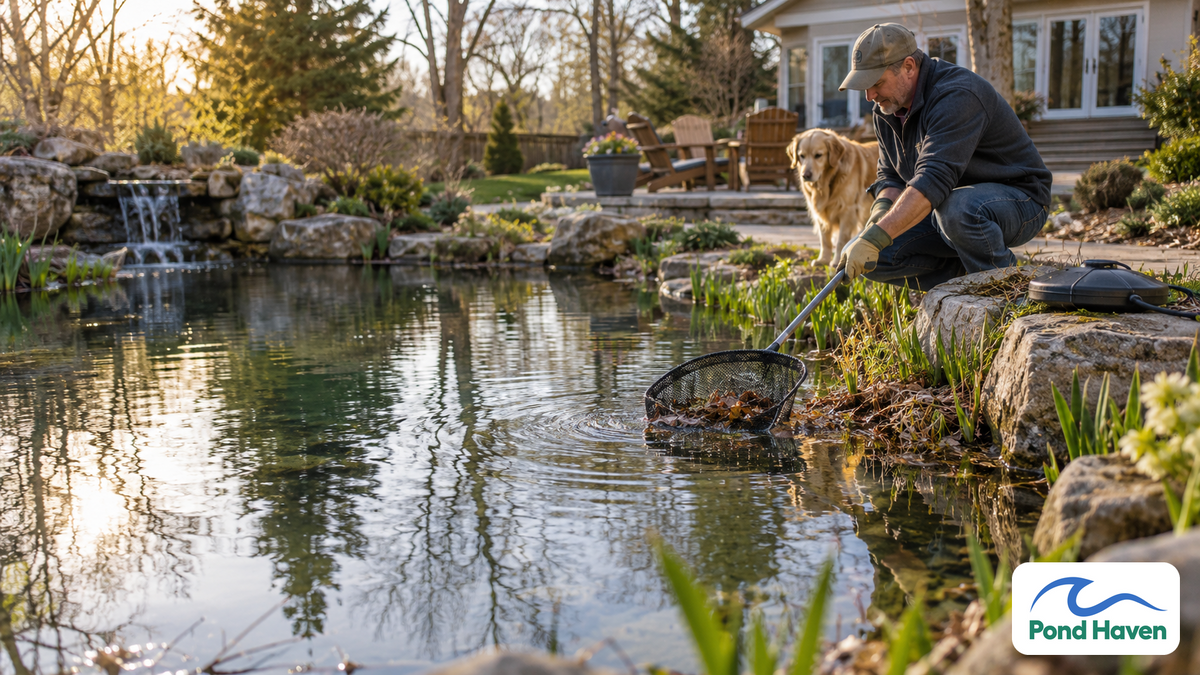

Spring startup is not a cleaning task. It is a biological reactivation.
Your pond's filter bacteria spent the winter dormant. Your fish survived on stored energy with suppressed immune systems. The debris that settled in fall is about to decay as water warms. Rush this transition and you will spike ammonia, stress your fish, and trigger the algae bloom that defines a bad spring.
The principle that should guide every step: stability over sterility. A gentle, phased approach spread over several weekends beats a single intensive clean-out day every time. Draining the pond and pressure-washing the liner destroys the very bacteria colony you need to process the spring ammonia load.
This guide walks you through startup in order, gated by water temperature. Work through it over two to four weekends as your climate allows.
- Water temperature drives everything: do not feed fish or add standard bacteria below 50°F (10°C).
- Clean equipment without sterilizing it. Rinse filter media in pond water, never tap water or bleach.
- Test ammonia, nitrite, pH, and KH before you add anything to the water.
- Start fish on low-protein wheat-germ food only after temperatures hold above 50°F.
- Spread tasks across weekends. A one-day overhaul removes beneficial bacteria and shocks fish.
The Spring Startup Trigger: It's All About Temperature
Every decision in spring startup traces back to one number: 50°F (10°C).
Below 50°F, your fish's metabolism is nearly zero. They are not digesting food properly, and their immune systems are suppressed. Your nitrifying bacteria (Nitrosomonas and Nitrobacter) are largely dormant. The nitrogen cycle has effectively paused.
Above 50°F, everything wakes up at once. Fish metabolism rises and ammonia production begins. But the bacteria that process that ammonia lag behind because they multiply slowly in cool water. This creates the spring ammonia window: a period where waste accumulates faster than your biofilter can handle it.
Worse, the pathogens wake up before your fish do. Between roughly 40°F and 65°F, opportunistic bacteria like Aeromonas and Pseudomonas multiply faster than the fish immune system can respond. Koi keepers call this stretch "Aeromonas Alley." Fish immune function only reaches about 50% efficiency at 65°F, and full strength near 73-74°F.
This is why gradual temperature management matters. A sudden warm spell that swings water temperature more than 5°F in 24 hours stresses fish precisely when they are most vulnerable.
Temperature Milestone Chart
| Water Temperature | Fish Metabolism | Bacterial Activity | Recommended Action |
|---|---|---|---|
| Below 40°F | Dormant | Dormant | Leave fish alone; keep de-icer running |
| 40-50°F | Very low | Minimal | Inspect equipment; begin debris removal |
| 50-60°F | Rising | Activating | Start wheat-germ feeding; add cold-water bacteria |
| Above 60°F | Normal | Fully active | Resume regular feeding and maintenance |
Phase 1: Initial Inspection and Clean-Up (When Ice Melts)
Your first weekend of spring work happens as soon as the ice clears, regardless of temperature. This phase is about removing the raw material of spring ammonia spikes before it decays.
Inspect the structure. Walk the pond perimeter and check the liner, edging, and rocks for frost heave damage. Look for exposed liner edges, shifted boulders, or collapsed plant shelves. If you ran a de-icer through winter, check the cord for damage and store it once ice risk passes.
Remove debris by hand. Leaves, twigs, and dead plant material that fell in over winter will decompose and release ammonia as the water warms. Net out what you can reach. Do not climb into the pond yet; the water is still cold and the liner is brittle.
Check for leaks. If the water level dropped noticeably over winter, you have a leak. Mark the level, top up, and monitor over a few days before you commit to a repair. Small liner tears can often be patched with a butyl repair kit.
Do a small partial water change. Replace 10-20% of the volume to dilute the toxins that accumulated under ice. Add a dechlorinator if you are using tap water. Do not drain the pond. Your filter media, rocks, and liner surfaces hold the bacteria colony you will need in three weeks.

Phase 2: Mechanical System Revival
Once debris is cleared and temperatures are trending above 40°F, pull your equipment for inspection. This is weekend two.
Pump. Remove the pump from the pond and inspect the housing for cracks from freezing. Take apart the intake and clean the impeller. Debris that froze inside the impeller chamber is the most common cause of a pump that hums but does not push water. Replace any worn gaskets before reassembly.
Filter media. This is where most people make the spring mistake. Rinse mechanical filter pads and foams in a bucket of pond water to remove sludge. Do not use tap water, and do not scrub them clean. Tap water chlorine kills bacteria, and a sterile pad is useless. The goal is to remove the gunk while preserving the colony. Bio-media (balls, blocks, lava rock) should only need a light rinse; deep-clean it just 2-3 times per year.
Skimmer. Clean out the basket and check the weir door moves freely. If leaves packed in over winter, clear the throat where water enters.
UV clarifier. Pull the quartz sleeve and inspect it for mineral scaling. Clean it with citric acid, not a scraper. Replace the UV bulb if it is more than 12 months old; UV output fades well before the bulb burns out. A fresh bulb is your best defense against the spring green-water bloom.
Hoses and fittings. Check every hose, clamp, and seal for cracks before you restart. A pinhole leak in a return line can waste a surprising amount of water over a season.
Restart gradually. Reinstall the pump and start water flowing. Do not blast the system to full capacity immediately. A sudden strong current stresses fish that have been in still water for months. Run the pump, confirm flow through the filter, and check every fitting for leaks over the next hour.
Clean filter pads in a bucket of pond water, not tap water. Chlorine kills the bacteria colony you spent last season building, and a sterile filter cannot process the spring ammonia load.
Phase 3: Biological System Boost
Your filter media holds bacteria, but the colony is small and cold-stunned. Your job now is to feed it and help it rebuild before the ammonia spike arrives.
Test your water first. Before you add anything, you need a baseline. Test ammonia, nitrite, pH, and KH. Do not add bacteria to water with a pH crash or an existing ammonia spike; fix the chemistry first.
Add cold-water bacteria. Standard beneficial bacteria products go dormant below roughly 50-60°F. If you add them in cold water, you are pouring money into an inactive product. Cold-water formulations use strains selected to work at lower temperatures. Follow the label dosing, typically twice weekly for two weeks, then weekly until water passes 50°F.
Dose dechlorinator. If you topped up with tap water during your partial change, the chlorine and chloramine need neutralization before bacteria can colonize. Dose the full pond volume, not just the added water.
Monitor daily. Test ammonia and nitrite every day for the first two weeks after the water passes 50°F. This is the spring ammonia window, and it is the period when most ponds spike. Catching a rise on day two is far easier to fix than discovering it on day ten.
Phase 4: Fish and Plant Care
Fish care is the phase most people rush, and the one where patience pays.
Do not feed below 50°F. Fish cannot digest food properly in cold water. Uneaten food decays into ammonia, and partially digested food ferments in the fish's gut. Wait until water temperature holds consistently above 50°F, meaning several days in a row, not one sunny afternoon.
Start with wheat-germ food. Low-protein, wheat-germ-based diets are formulated for the fish's slowed metabolism. A 40% protein diet produces measurably more ammonia than a 30% protein wheat-germ diet, and your biofilter is not ready for that load. Feed sparingly at first, once a day, only what the fish consume in a couple of minutes. Switch to higher-protein food once temperatures exceed 60°F.
Inspect your fish daily. Look for the signs of winter damage and spring disease:
- Flashing (scratching against liner or rocks), which indicates parasite irritation
- Clamped fins or lethargy
- Red streaks in the fins or red sores on the body, which suggest Aeromonas or Pseudomonas
- Gasping at the surface, which can mean low oxygen or nitrite toxicity
- White spots, which indicate Ich
If you see flashing or sores, test the water first. Many "disease" symptoms are actually ammonia or nitrite toxicity. Treat the water quality issue before you treat the fish.
Plants. Trim dead foliage from hardy marginals and water lilies before new growth emerges. Divide and repot overcrowded plants now, while they are still dormant and less likely to shock. Wait until all frost danger passes before moving tropical plants outdoors. If you overwintered plants indoors, start acclimating them to outdoor light gradually over a week.

Spring Water Chemistry: What to Test and Why
Spring water chemistry is unforgiving because the system is out of balance. Your fish are producing waste, your bacteria are rebuilding, and decaying debris is adding to the load. Here is what matters most.
| Parameter | Ideal Range | Spring Danger Sign | Quick Fix |
|---|---|---|---|
| Ammonia | 0 ppm | Any detectable level during warm-up | Partial water change, cold-water bacteria, stop feeding |
| Nitrite | 0 ppm | Above 0.5 ppm | Add salt at 1-3 lbs per 100 gallons, boost bacteria |
| Nitrate | Below 40 ppm | Above 80 ppm | Water changes, add plants |
| pH | 6.8-8.0 | Below 6.5 or above 8.5 | Gradual adjustment with pH buffer |
| KH (Alkalinity) | 80-120 ppm | Below 80 ppm | Add baking soda or potassium bicarbonate |
Why KH matters most in spring. Carbonate hardness (KH) buffers your pH against swings. As organic matter decays, it produces acids. If your KH is low, those acids crash the pH. A pH crash below 6.5 stops nitrification entirely, which means ammonia rises while your bacteria shut down. This is the cascade that kills fish in spring.
If you only test one parameter, test KH. In regions with naturally soft water, like the Pacific Northwest, low KH is a chronic problem that demands attention every spring.
Test frequency. Once water passes 50°F, test at least weekly. During the active warm-up period, test ammonia and nitrite daily for the first two weeks. This is the single best investment you can make in your fish's health.
Troubleshooting Common Spring Problems
Green Water (Algae Bloom)
The classic spring plague. Cause: excess nutrients from winter debris plus increasing light and temperature. Your plants have not leafed out yet, so nothing is competing with the algae for nutrients.
Solution: Run your UV clarifier continuously once the pump is running. Reduce feeding. Add barley straw or a phosphate-binding treatment if the bloom persists. Expect some algae during the transition; it typically clears as plants establish and the biofilter matures.
Fish Flashing or Gasping
Flashing indicates parasite irritation. Gasping at the surface indicates low oxygen or nitrite toxicity. Test the water immediately before treating anything.
Action: If ammonia or nitrite is elevated, do a 10-20% partial water change, stop feeding, and add cold-water bacteria. Increase aeration with an air pump or by running a waterfall. If water quality is fine and flashing continues for more than a few days, treat for parasites. Many parasite treatments are only safe above 50°F, so check labels.
Ammonia Spike
Cause: accumulated fish waste plus warming water plus a dormant bacteria colony. The bacteria cannot catch up because they multiply slowly in cool water.
Action: Stop feeding until levels drop. Add cold-water bacteria. Increase aeration, since nitrifying bacteria need oxygen. Do small daily water changes of 5-10% to dilute the ammonia without shocking fish. Prevention is the real answer: start bacteria additions at 50°F, before the spike appears.
Low KH (Alkalinity Crash)
Cause: acidic spring runoff and decomposition of organic matter consuming your carbonate buffer.
Action: Add potassium bicarbonate or baking soda in small doses. Target raising KH to 80-120 ppm over 24-48 hours. Do not dump it all at once; a rapid pH swing is itself a stressor. Retest after 24 hours and redose as needed.
Setting Your Aeration Schedule
Aeration deserves its own step because it is the most overlooked element of spring startup.
Do not restart a bottom diffuser abruptly in a stratified pond. Through winter, your pond may have developed temperature layers. The bottom water is colder and holds less oxygen. Firing up a bottom aerator at full capacity suddenly mixes those layers and can bring oxygen-poor water to the surface while shocking fish with a rapid temperature change.
Start the aerator gradually. Run it at reduced output for a few days, or run it on a timer for short intervals, allowing the water column to mix slowly. As temperatures stabilize above 50°F, run it continuously.
Match aeration to the season. Through spring and summer, your goal is maintaining dissolved oxygen above 6 mg/L at all times. Warm water holds less oxygen than cold; at 77°F, freshwater holds roughly half the oxygen it does at 32°F. If you have a heavy fish load or a pond that gets afternoon sun, run aeration continuously through the warm months.
Fountains serve double duty. A fountain provides surface agitation for oxygen exchange and keeps the water moving, which discourages mosquitoes and prevents stagnation. Set your fountain schedule for the season once ice risk passes, running it during daylight hours when photosynthesis is active.

The Weekend-by-Weekend Plan
If you prefer a calendar to a checklist, here is the same process laid out by weekend.
Weekend 1 (ice melts, water 40-50°F): Inspect liner and structure. Remove debris by hand. Do a 10-20% partial water change with dechlorinator. Check for leaks.
Weekend 2 (water trending above 40°F): Pull and clean the pump. Rinse filter media in pond water. Clean the skimmer. Inspect and clean the UV clarifier; replace the bulb if over 12 months old. Restart the pump and check for leaks.
Weekend 3 (water approaching 50°F): Test water chemistry. Correct pH and KH if needed. Add cold-water beneficial bacteria. Begin daily ammonia and nitrite testing.
Weekend 4 (water consistently above 50°F): Start feeding wheat-germ food sparingly. Inspect fish daily for signs of stress or disease. Trim and divide plants. Start your aerator or fountain gradually.
Every intervention you make in spring carries risk. A smaller water change, a lighter feeding, a gentler cleaning all beat the aggressive version. Stability beats intervention every time.
Frequently Asked Questions
When should I start my pond spring startup?
Start when ice melts and water temperatures begin rising above 40°F. The full process typically spans 2-4 weeks depending on your climate zone. In the southern US, this may be February; in the northern states, it can be April or even May.
Can I clean my pond all at once in spring?
For established ponds, no. A one-day deep clean removes beneficial bacteria and stresses fish. Spread tasks across phases over several weekends. Reserve a full drain and clean-out for severely neglected ponds or major structural repairs.
Do I need to replace my pond water in spring?
No. A 10-20% partial water change is sufficient for most ponds. Only drain fully if you have a severe water quality crisis or major structural repair. Your filter media, rocks, and liner surfaces hold the bacteria colony your pond needs.
When should I start feeding my fish after winter?
Start only when water temperature is consistently above 50°F, meaning several days in a row. Begin with low-protein wheat-germ food and transition to higher-protein diets above 60°F. Feed sparingly at first; your fish's digestive systems are still waking up.
Why is my pond water green every spring?
Green water is a nutrient problem. Winter debris decays and releases nutrients as water warms, while your plants have not leafed out to compete with algae. Run your UV clarifier, reduce feeding, and expect it to clear as the ecosystem rebalances over several weeks.