
How to Test Pond Water
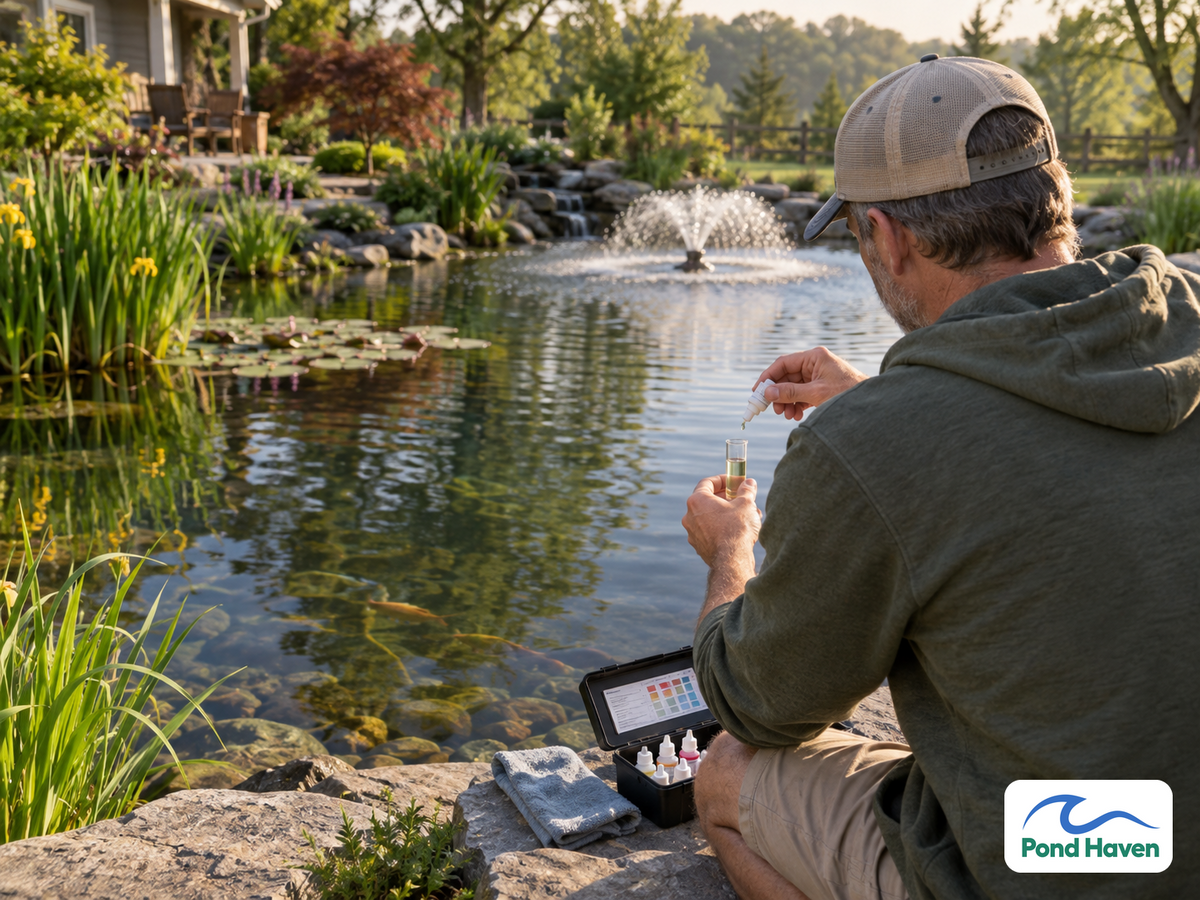

Testing your pond water is the single most reliable way to see what's happening beneath the surface. It lets you diagnose murky water, stressed fish, and algae blooms before they become full-blown crises. This guide covers what to test, how to do it, and exactly what your results mean so you can act with confidence.
- Test pH, ammonia, nitrite, and alkalinity (KH) weekly during the active season; these four catch most problems before fish show stress.
- Test strips are fine for trend-watching but too imprecise for a fish emergency. Use a liquid drop kit when a reading matters.
- Always test before you dose anything. Adding treatments blind can make a bad water chemistry situation worse.
- Dissolved oxygen below 4 mg/L is an emergency. Aerate immediately, don't wait for a test kit to confirm.
Why You Must Test Your Pond Water
Water quality dictates everything in your pond. Fish health, algae growth, and water clarity are all controlled by chemical balance. You can't manage what you don't measure. Testing is the only way to move from guessing to knowing. It tells you if your aeration is sufficient, if you're overfeeding, or if your filtration is working.
A stocked pond is a closed system. Every handful of fish food adds nutrients. Every fallen leaf decomposes and consumes oxygen. Rain runoff carries fertilizers and sediment. Without regular testing, these inputs accumulate silently until fish die or algae takes over.
According to the Penn State Extension, routine water testing is the foundation of pond management because it reveals problems while they're still correctable, not after fish losses occur.
What to Test For: Key Water Quality Parameters Explained
Focus on these core parameters. They tell the complete story of your pond's health. For a backyard water garden or a farm pond stocked with fish, these seven matter most.
The Nitrogen Cycle: Ammonia, Nitrite, Nitrate
This is the most critical group for fish survival. Fish waste and decomposing organic matter produce toxic ammonia (NH₃). Beneficial bacteria in your filter and pond substrate convert ammonia to nitrite (NO₂⁻), which is also highly toxic. A second group of bacteria then converts nitrite to nitrate (NO₃⁻), which is less harmful but fuels algae.
- Ammonia: Ideal is 0 mg/L. Any reading above 0.25 mg/L is cause for concern and stressful to fish. The toxic fraction rises as pH climbs, so high ammonia plus high pH is a dangerous combination.
- Nitrite: Ideal is 0 mg/L. Levels above 0.5 mg/L can block oxygen transport in fish blood, a condition sometimes called brown blood disease.
- Nitrate: Ideal is below 40 mg/L. Levels above 80 mg/L promote heavy algae and plant growth.
pH and Alkalinity: The Stability Duo
pH measures how acidic or basic your water is on a 0 to 14 scale. Alkalinity (KH, or carbonate hardness) measures the water's buffering capacity, its ability to resist pH swings. You need both readings to understand either one.
- pH: Ideal range for most pond fish (koi, goldfish, bluegill, bass) is 6.5 to 8.5. Sudden swings outside this range are more dangerous than a steady, slightly high or low reading.
- Alkalinity: Target 80 to 120 mg/L as calcium carbonate (CaCO₃). This stabilizes pH against daily fluctuations caused by plant respiration. Below 50 mg/L, your pH can crash overnight.
Dissolved Oxygen (DO)
Oxygen is non-negotiable for fish and beneficial bacteria. Warm water physically holds less oxygen than cold water, which is why summer is the highest-risk season for fish kills.
- Target: 5 mg/L minimum for warm-water fish like bass, bluegill, and koi. Cold-water species like trout need at least 6.5 mg/L. Levels below 4 mg/L cause stress; below 3 mg/L, fish gasp at the surface.
Phosphates and General Hardness
Phosphates (PO₄) are a primary nutrient for algae. They enter via fish food, runoff, and tap water. If you battle chronic algae blooms, this test matters. General Hardness (GH) measures dissolved calcium and magnesium, important for fish health and biological processes.
- Phosphates: Keep below 0.05 mg/L to limit algae fuel. Above 0.1 mg/L, expect algae problems.
- General Hardness: Aim for 50 to 150 mg/L as CaCO₃.
Temperature
Temperature drives everything else. It controls how much oxygen water can hold, how fast fish metabolize food, and how quickly bacteria process waste. Test it alongside your chemical parameters, not instead of them.
Visual Clarity: The Jar Test
Before any chemical test, do a simple jar test. Fill a clear glass jar with pond water, let it sit for 24 hours, and observe.
- Green tint settling to the bottom: Suspended algae.
- Brown or tea-colored tint: Tannins from leaves or driftwood.
- Sediment on the bottom: Soil erosion or stirred-up muck.
- Cloudy water that doesn't settle: Suspended clay or silt.

How to Test: A Comparison of Methods and Tools
Choose your method based on accuracy needs, budget, and how you'll use the data. Here's the honest comparison.
| Method | Best For | Pros | Cons | Approx. Cost |
|---|---|---|---|---|
| Test Strips | Quick, routine trend-watching | Fast (60 seconds), easy, inexpensive, tests multiple parameters at once | Least accurate. Useless for a fish emergency. Can be affected by humidity and age | $15 to $40 for 50 to 100 tests |
| Liquid Drop Kits | Accurate diagnosis, problem-solving | More precise than strips. Reliable for pH, ammonia, nitrite, and KH | More steps, takes 5 to 10 minutes per parameter. Reagents expire | $25 to $70 per kit |
| Digital Meters | Continuous monitoring, high precision | Very accurate for pH, DO, temperature. Instant digital readout | High upfront cost. Requires calibration and probe maintenance | $50 to $300+ per meter |
| Professional Lab | Baseline data, severe or unexplained issues, toxin screening | Most comprehensive and accurate. Identifies metals, pesticides, specific bacteria | Turnaround time (days to weeks). Highest cost | $100 to $300+ per sample |
Test Strips: Fine for Trends, Useless in an Emergency
Test strips are the fastest way to check multiple parameters. Dip, wait 60 seconds, compare colors. They're perfect for weekly trend-watching in a stable pond.
But understand their limits. Strips are the least accurate method available. Color matching is subjective, and the pads degrade with humidity and age. If your fish are gasping or dying, a strip reading of "0.25 ppm ammonia" doesn't tell you whether the real value is 0.1 or 1.0. That margin is the difference between a minor issue and an emergency.
Liquid Drop Kits: The Accuracy Standard for Home Use
Liquid drop (titration) kits add reagent drop by drop until the sample changes color. The number of drops tells you the concentration. They take longer and require more care, but they're dramatically more accurate than strips.
For ammonia, nitrite, pH, and KH, a liquid kit is the right tool. These are the parameters where precision matters most because they directly affect fish survival. A good master kit covers all four and costs $25 to $70.
Digital Meters: Precision for Specific Problems
Digital meters shine for two parameters: pH and dissolved oxygen. A digital pH meter removes the guesswork of color matching and is worth it if you battle constant pH swings. A DO meter is the only practical home option for measuring oxygen directly.
The catch is maintenance. Probes need calibration with buffer solutions and regular cleaning. A cheap meter that drifts out of calibration is worse than no meter at all. Buy a reputable brand and follow the calibration schedule.
Professional Lab Testing: When to Call in the Experts
Home kits can't test for everything. Heavy metals, pesticides, and specific bacterial pathogens require laboratory analysis. Send a sample to a lab when:
- You experience a sudden, unexplained fish kill.
- Problems persist despite corrective action.
- You're setting up a new pond and want a baseline.
- You suspect contamination from runoff, septic systems, or agricultural chemicals.
Use test strips for routine weekly checks in a stable pond. Switch to a liquid drop kit the moment a reading looks off or fish show stress. Reserve lab tests for unexplained losses or suspected contamination.
Step-by-Step: How to Collect a Water Sample and Run Tests
Accurate results start with a proper sample. A sloppy sample produces misleading numbers, no matter how good your kit is.
- Gather your tools. Use a clean container. A plastic cup dedicated to pond testing is fine. Rinse it with pond water before collecting.
- Collect the sample. Submerge the container elbow-deep (about 12 to 18 inches), away from waterfalls, fountains, and the pond edge. This gets a representative sample of the main water column. Avoid surface scum and areas with visible debris or algae.
- Test immediately. Especially for dissolved oxygen and pH, test within 15 minutes of collection. Temperature changes and exposure to air can alter readings.
- Follow kit instructions exactly. For liquid kits, hold droppers vertically and count drops carefully. Cap and shake reagent bottles firmly before use. Match colors in natural daylight, not under artificial light. For strips, dip briefly and shake off excess water, don't let them sit in the sample.
- Record everything. Note the date, time, water temperature, weather, and all results. A logbook reveals trends that a single test cannot. A one-time reading of pH 8.0 means little; a steady climb from 7.2 to 8.0 over three weeks tells you something is changing.
Interpreting Your Results and What to Do Next
Here's what your numbers mean and your immediate action plan.
| Parameter | Ideal Range | Caution Level | Immediate Action |
|---|---|---|---|
| Ammonia | 0 mg/L | > 0.25 mg/L | 1. Stop feeding. 2. Perform a 25% water change. 3. Check and clean the filter. 4. Add beneficial bacteria booster. |
| Nitrite | 0 mg/L | > 0.5 mg/L | 1. Add pond salt (0.1 to 0.3%) to protect fish. 2. Ensure strong aeration. 3. Review filter bio-capacity. |
| Nitrate | < 40 mg/L | > 80 mg/L | 1. Increase water changes. 2. Add fast-growing plants (water hyacinth, water lettuce). 3. Reduce feeding. |
| pH | 6.5 to 8.5 | < 6.5 or > 9.0 | If low: Add crushed oyster shell or limestone. If high: Partial water change. Never adjust more than 0.5 per day. |
| Alkalinity (KH) | 80 to 120 mg/L | < 50 mg/L | Add a commercial KH buffer or crushed coral to the filter to stabilize pH. |
| Dissolved Oxygen | 5+ mg/L | < 4 mg/L | 1. Turn on all aerators and fountains. 2. Perform a water change. 3. Reduce organic load (clean debris). |
| Phosphate | < 0.05 mg/L | > 0.1 mg/L | 1. Reduce feeding. 2. Increase water changes. 3. Add phosphate-binding media or plants. |
Connecting Symptoms to Causes
- Fish gasping at the surface, especially at dawn: Low dissolved oxygen. Dawn readings are the lowest of the day because plants consume oxygen all night. Check your aeration.
- Green, murky water: High phosphates or nitrates. Test nutrients, reduce feeding, and consider a UV clarifier.
- Sudden fish illness or death: Test for ammonia and nitrite spikes first. These are the most common killers.
- pH crashes overnight: Low alkalinity. The daily pH swing from photosynthesis and respiration overwhelms a weak buffer. Test and boost KH.
- Fish hovering near a waterfall or fountain: They're seeking oxygen. Your aeration may be undersized for your fish load.

What to Test After a Fish Loss or a Treatment
Fish losses and chemical treatments both demand immediate testing. Here's what to check and why.
After a Fish Loss
When fish die unexpectedly, test in this order:
- Ammonia and nitrite. These are the most common acute killers. A spike from overfeeding, filter failure, or a new fish addition can kill within hours.
- Dissolved oxygen. If you don't have a DO meter, look for the signs: fish gasping at the surface, especially in the early morning. Low oxygen kills the largest fish first because they need more oxygen.
- pH. A crash below 6.0 or a spike above 9.5 can be lethal. Test at dawn and again in late afternoon to catch a daily swing.
- Temperature. A rapid temperature change of more than 5°F in 24 hours can stress fish, especially in shallow ponds. Check for sudden swings after storms or large water changes.
If ammonia, nitrite, DO, and pH all look normal, suspect something home kits can't detect. Send a sample to a professional lab for heavy metals, pesticides, or bacterial pathogens.
After a Treatment
Any chemical treatment, whether for algae control, parasites, or pH adjustment, stresses the pond's biology. Test 24 hours after dosing to confirm the treatment worked and didn't cause collateral damage.
- After an algaecide: Expect a dissolved oxygen drop as dead algae decompose. Run your aerator continuously for several days after treatment.
- After a pH adjuster: Confirm the new pH is stable and that alkalinity is adequate to hold it there.
- After any treatment: Check ammonia and nitrite 48 to 72 hours later. Dead organic matter from the treatment can spike the nitrogen cycle.
If you're repeatedly dosing treatments for the same problem, the treatment isn't the fix. Test to find the underlying imbalance, then correct that. You'll spend less money and stress your fish less.
How Often Should You Test Your Pond Water?
Your testing schedule should match your pond's life cycle and the seasons. A new pond needs daily checks; an established pond needs weekly ones.
Testing Cadence by Season
| Season | Water Temp | Frequency | Priority Tests |
|---|---|---|---|
| Spring | Rising above 55°F | Weekly | pH, ammonia, nitrite, KH. Full test at startup as the filter reactivates. |
| Summer | Above 70°F | Weekly, more if stocked heavily | pH, ammonia, nitrite, DO. High temps increase feeding and lower oxygen. |
| Fall | Falling below 60°F | Bi-weekly | pH, ammonia, KH. Test before winter; ammonia can build under ice. |
| Winter | Below 45°F | Monthly if fish are active | Ammonia. Ensure a de-icer keeps an opening for gas exchange. |
Test Immediately When:
- You add new fish.
- After heavy rain or runoff.
- Fish show signs of stress (gasping, clamped fins, flashing).
- After treating the water with any chemical.
- You notice a sudden algae bloom or water clarity change.
- A fish dies unexpectedly.

Your Recommended Testing Path
Start simple and scale up based on your needs.
- For every pond owner: Perform the jar test monthly and anytime water clarity changes. Purchase a master liquid test kit for ammonia, nitrite, pH, and KH. Test weekly in summer. This covers the four parameters that catch 90% of problems before fish die.
- For problem-solving: If you have chronic algae, add a phosphate test. If fish gasp despite good ammonia and nitrite readings, invest in a dissolved oxygen test kit or meter. Accurate data is cheaper than replacing fish.
- For serious or unexplained issues: If problems persist despite corrective actions, or you experience a sudden fish kill, submit a sample to a professional water lab. They can test for heavy metals, pesticides, and specific bacterial pathogens that home kits cannot.
Testing transforms pond keeping from reactive to proactive. It removes the mystery and gives you control. Consistent checks with the right tools are the foundation of a clear, healthy, and thriving pond.
When your tests reveal a problem, address it with the right tools. Water chemistry issues respond to targeted pond treatments like bacteria boosters, KH buffers, and phosphate removers. Low dissolved oxygen is an equipment problem, not a chemical one. Browse pond aerators to keep oxygen levels safe through the hottest months. For seasonal guidance, check our pond maintenance calendar to time your testing and treatments correctly.
Frequently Asked Questions
How often should I test my pond water?
Test pH, ammonia, and nitrite weekly during the active season when water temperatures are above 55°F. Check nitrates, phosphates, and alkalinity monthly. Test immediately after adding fish, after heavy rain, or when fish show signs of stress.
Are test strips accurate enough for pond water?
Test strips are accurate enough for routine trend-watching in a stable pond, but not precise enough for diagnosing a fish emergency. When a reading matters, confirm it with a liquid drop kit. Strips flag problems; liquid kits confirm them.
What is the most important water quality test for fish?
Ammonia is the most critical test because it's the most common acute killer. It's produced by fish waste and decomposing organic matter, and any reading above 0.25 mg/L is stressful to fish. Dissolved oxygen is equally important but harder to test at home without a meter.
Why does my pond water test differently in the morning than the afternoon?
Photosynthesis drives daily swings. Plants and algae consume carbon dioxide during the day, which raises pH, and produce oxygen. At night, respiration reverses this: pH falls and oxygen drops. Dawn readings are typically the lowest oxygen and pH of the day. Test at the same time each week for comparable results.
When should I send a water sample to a professional lab?
Send a sample when you experience a sudden, unexplained fish kill, when problems persist despite corrective action, or when you suspect contamination from runoff, septic systems, or agricultural chemicals. Labs can test for heavy metals, pesticides, and pathogens that home kits cannot detect.