
How Much Bentonite to Seal a Pond
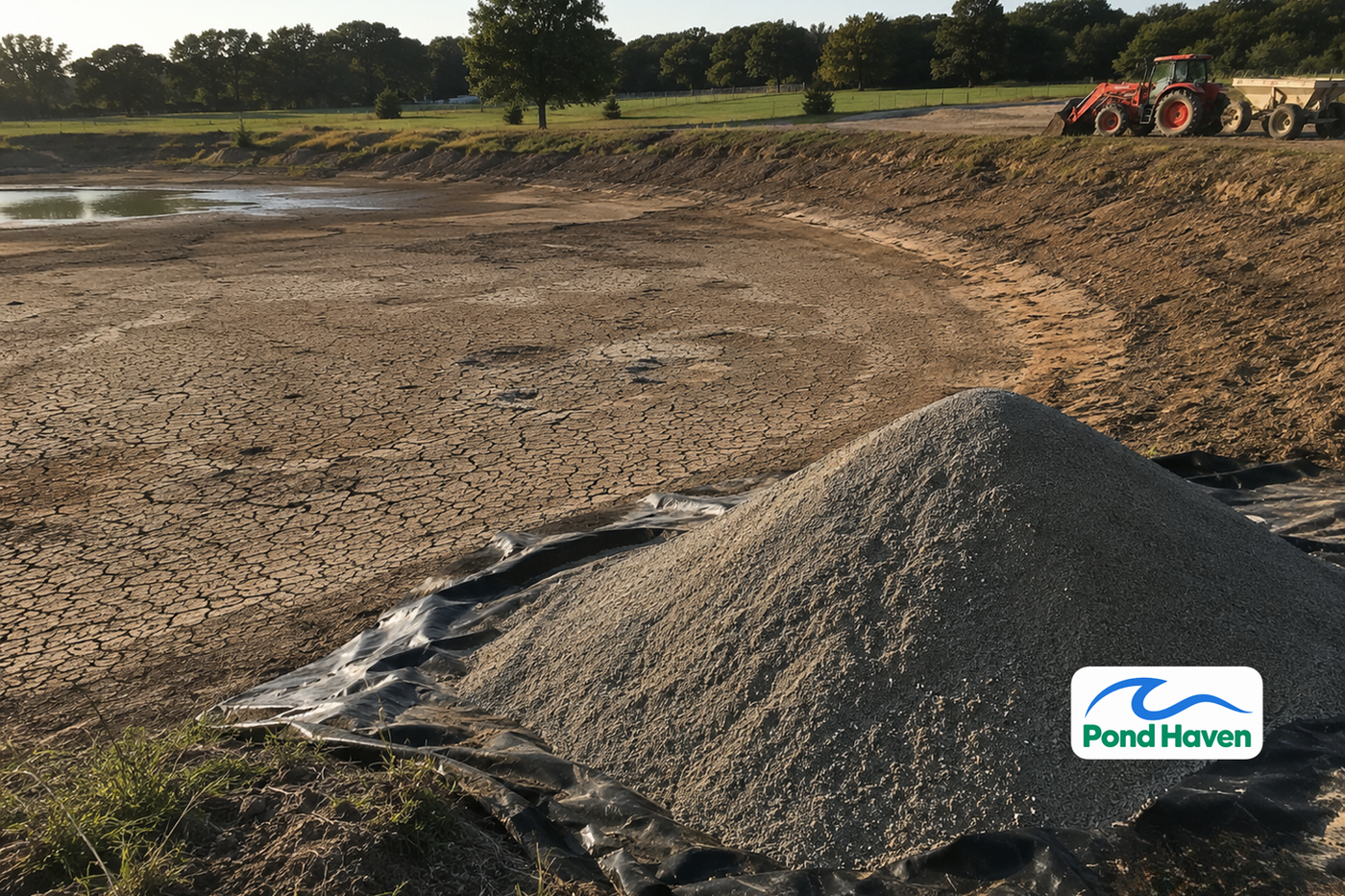

Sodium bentonite is the industry-standard sealant for leaking ponds. It expands 10 to 15 times its dry volume when hydrated, filling soil pores and cracks with a low-permeability gel that stops water loss. It is self-healing, fish-safe, and a properly applied seal lasts 20 years or more.
But the cost depends entirely on one thing: getting the quantity right. Under-apply and you waste money on a pond that still leaks. Over-apply and you waste money on material you did not need. A 1-acre pond can require anywhere from 65 to 140 tons of bentonite, so the difference between a correct and incorrect calculation is thousands of dollars.
This guide walks you through the exact calculation, soil-based application rates, depth adjustments, and application methods so you order the right amount the first time.
- Application rates range from 1 lb/sq ft for clay soils to 12+ lbs/sq ft for pure sand and gravel.
- Base rates assume a maximum water depth of 8 feet. Add 1 lb/sq ft for every additional 8 feet of depth.
- Add a 10-15% contingency buffer to your final total for irregular contours, rocky areas, and application waste.
- Use granular bentonite for wet application. Powdered bentonite floats and never reaches the pond bed.
- Verify your soil type with a Jar Test and your application rate with a 5-Gallon Bucket Test before ordering.
Why Soil Type is the #1 Factor in Your Bentonite Calculation
Soil porosity drives everything. Water moves through sand and gravel easily, so those soils need far more bentonite to create a seal. Clay soils are already dense and need only minimal enhancement.
Here is how bentonite works: sodium bentonite absorbs water and swells up to 15 times its dry volume. The expanding clay fills the pores between soil particles, creating a gel layer that water cannot penetrate. The more porous your soil, the more bentonite it takes to fill those voids.
Application Rate Table by Soil Type
| Soil Type | Application Rate (lbs/sq ft) | Notes |
|---|---|---|
| Clay | 1-2 | Best candidate; often needs minimal bentonite |
| Clay Loam | 2-3 | Moderate porosity |
| Loam | 3-4 | Mixed particle sizes |
| Sandy Loam | 4-5 | Higher porosity, more bentonite needed |
| Sand | 5-6 | High leakage risk |
| Gravel/Sand Mix | 6-8+ | May require multiple layers or a liner alternative |
These rates assume a water depth of 8 feet or less.
Why the range within each soil type? Compaction level, organic content, and the presence of rocks or roots all affect how much bentonite you need. Loose, uncompacted soil sits at the higher end of the range; dense, well-compacted soil at the lower end.

How to Calculate Your Pond's Bentonite Needs (Step-by-Step)
The formula is simple: Surface Area (sq ft) × Application Rate (lbs/sq ft) = Total Bentonite Required (lbs). The work is in getting each variable right.
Step 1: Measure Your Pond's Surface Area
Work in square feet for consistency. Use these formulas for common shapes:
- Rectangular ponds: Length × Width
- Circular ponds: 3.14 × radius²
- Oval ponds: Length × Width × 0.8
- Irregular shapes: Divide the pond into rectangles and triangles, calculate each area, then add them together
For a rough estimate on an irregular pond, multiply the average width by the length. This gets you close enough for planning purposes.
Step 2: Determine Your Soil Type
Dig test holes around the pond perimeter and bottom. Then do the feel test: squeeze a moist soil sample in your palm.
- Sand: Gritty, falls apart when squeezed
- Loam: Smooth, holds its shape briefly
- Clay: Sticky, holds its shape firmly
For a more precise reading, run the Jar Test described in the testing section below. It takes 24 hours but gives you a clear picture of your soil composition.
Step 3: Select Your Base Application Rate
Use the table above to pick your starting rate. Choose the higher end of the range if your soil is loose, uncompacted, or has high organic content. Choose the lower end if it is dense and well-compacted.
Step 4: Adjust for Water Depth (The 8-Foot Rule)
Base rates assume a water depth of 8 feet or less. Deeper water exerts more hydrostatic pressure, forcing water through soil pores more aggressively.
For every additional 8 feet of depth, add 1 lb/sq ft to your rate.
- 8 to 16 feet deep: add 1 lb/sq ft
- 17 to 24 feet deep: add 2 lbs/sq ft
Example: A 16-foot-deep pond on sandy loam. Base rate is 4-5 lbs/sq ft. Add 1 lb/sq ft for the depth adjustment. Final rate: 5-6 lbs/sq ft.
Step 5: Adjust for Slope
Slopes steeper than 3:1 (horizontal:vertical) are difficult to seal with the Blanket method because the saturated bentonite gel can slump downhill. Steeper slopes may require the Mixed-in method or a thicker application.
Add 10-15% to your total for slopes steeper than 2:1.
Step 6: Add a Contingency Buffer
Add 10-15% to your total to account for:
- Irregular bottom contours
- Rocky areas that consume extra material
- Application waste and spillage
- Measurement errors
For large projects, a more conservative 25-50% buffer is recommended to account for application inefficiencies on sloped banks.
Step 7: Final Calculation Example
1-acre pond (43,560 sq ft), sandy loam soil, 10 ft average depth:
- Base rate: 4.5 lbs/sq ft (midpoint of sandy loam range)
- Depth adjustment: 10 ft is under 16 ft, so no adjustment needed
- Contingency: 4.5 × 1.10 = 4.95 lbs/sq ft
- Total: 43,560 × 4.95 = 215,622 lbs = 107.8 tons
- At 22.5 tons per truckload: 5 truckloads
Run the 5-Gallon Bucket Test at your calculated rate before committing to a full truckload. A failed bucket test costs you a bag of bentonite; a failed pond seal costs you the whole project.
How Application Method Changes the Amount You Need
Your application method affects both the quantity of bentonite required and the form of material you should buy.
Blanket Method
Spread bentonite evenly over the dry pond bottom, then cover it with 6-12 inches of soil. This is the most common method for new ponds or fully drained ponds.
- Uses the standard rates from the table above
- Best for slopes up to 3:1
- Requires the pond to be completely dry
- Excavate 4-8 inches of soil first, place the bentonite, then replace the soil as a protective cap
Mixed-in Method
Till bentonite into the top 4-6 inches of soil, then compact it with 3-4 passes of a drum roller or pad-foot roller.
- Requires 20-30% more bentonite than the Blanket method
- Better for slopes up to 45 degrees because the clay is mechanically incorporated into the soil
- Creates a more uniform seal throughout the soil profile
- Recommended for ponds that cannot be completely dried
Sprinkle Method
Broadcast granular bentonite directly onto the water surface. It sinks and is drawn into porous areas by the flow of leaking water.
- Requires 2-3x the standard rate
- Least reliable method; only for minor seepage repairs
- Use granular bentonite, never powder
- Apply at 5 lbs/sq ft in concentrated leak zones identified with dye
Material Form Matters
| Form | Best Method | Notes |
|---|---|---|
| Powder | Mixed-in | Forms the most uniform, low-permeability layer |
| Granular | Sprinkle | Sinks through the water column before hydrating |
| Pelletized | Sprinkle (deep water) | Heavier, sinks faster |
Blanket Method Advantages
- Uses the least material (standard rates)
- Most reliable seal for new or drained ponds
- Self-healing properties work best when covered
Blanket Method Disadvantages
- Requires a completely dry pond
- Fails on slopes steeper than 3:1
- Needs excavation and soil replacement
Cost, Quality Checks, and Pro Tips
Cost Per Pound and Total Project Examples
Sodium bentonite typically costs $0.15 to $0.30 per pound ($300 to $600 per ton) before delivery. Delivery adds $100 to $300 per truckload depending on distance.
Example project costs:
- 0.25-acre pond (10,890 sq ft), loam soil, 6 ft deep: ~16.3 tons = $4,890 to $9,780
- 1-acre pond (43,560 sq ft), sandy loam, 10 ft deep: ~107.8 tons = $32,340 to $64,680
A full truckload holds 22.5 tons. At $0.20/lb, one truckload costs about $9,000 before delivery.
Always request quotes from multiple suppliers. Prices vary significantly by region, and bulk orders often qualify for better per-ton pricing.
How to Specify High-Quality Sodium Bentonite
Not all bentonite is the same. Specify these qualities when ordering:
- Sodium bentonite, not calcium bentonite. Calcium bentonite has lower swell capacity and requires chemical additives that degrade over time, leading to seal failure.
- Swell index of at least 22 mL. This is a common industry baseline. Premium products achieve 30 mL or more. The swell index measures how many milliliters 2 grams of dry bentonite swells to in water over 24 hours.
- A mix of particle sizes. A blend of fine and coarse particles seals better than uniform material because smaller particles fill the gaps between larger ones.
Request the manufacturer's spec sheet before ordering. The swell index should be listed.
Simple Field Tests Before You Buy
The Jar Test (Soil Type Verification)
- Fill a clear jar one-third full with your soil sample
- Add water to the top
- Shake vigorously, then let it settle for 24 hours
- Sand settles first (bottom layer), silt next, clay last (top layer)
- Measure the layer thicknesses to estimate your soil composition
The 5-Gallon Bucket Test (Bentonite Effectiveness)
- Drill 15 holes (1/4" to 3/8") in the bottom of a 5-gallon bucket
- Place 6-8 inches of your pond's soil in the bucket
- Mix in bentonite at your planned rate
- Add 3 cups of water and blend until moisture is uniform
- Tamp firmly and mark a fill line 2 inches from the top
- Monitor water loss for 48 hours
- If the bucket holds water, your rate is likely adequate. Test multiple rates to find the minimum effective amount

Common Pitfalls to Avoid
Even experienced pond owners make these mistakes. Skip them and you will save time, money, and frustration.
- Skipping the soil test. Guessing your soil type leads to guessing your rate. The Jar Test costs nothing and takes 24 hours.
- Using powder on a wet pond. Powdered bentonite floats and never reaches the bed. Always use granular for wet application.
- Ignoring depth adjustments. A 16-foot-deep pond needs 1 lb/sq ft more than the base rate. That adds up fast on a large surface area.
- Forgetting compaction. Bentonite must be compacted into the soil to form a continuous seal. Loose application leaves pathways for water.
- Ordering without a bucket test. A $50 test can save you thousands on wasted material.

Frequently Asked Questions
Can I use too much bentonite?
Yes. Excess bentonite can create a soft, unstable pond bottom and waste money. More importantly, over-application can cause the seal layer to shift or slump on slopes. Stick to the calculated rate plus a 10-15% contingency.
How long until bentonite works?
Bentonite begins swelling immediately on contact with water. Seepage typically slows noticeably within 10-14 days, and full seal effectiveness develops within 30-60 days as the clay hydrates and expands into soil pores. The pond may still lose water during this period.
What if my pond has water in it?
You have three options: drain the pond completely for the Blanket or Mixed-in methods, use the Sprinkle method with granular bentonite at 2-3x the standard rate, or consult a professional for a targeted seepage repair. Draining is almost always more cost-effective for a full seal.
Why is there a range of rates for my soil type?
Soil conditions vary even within the same classification. Compaction level, organic content, and the presence of rocks or roots all affect how much bentonite you need. Start with the midpoint of your range, then use the Bucket Test to verify before ordering your full quantity.
The Bottom Line
Accurate calculation saves money and prevents failed seals. The formula is simple: Area × Rate × Adjustments = Total.
Test your soil with the Jar Test. Verify your rate with the Bucket Test. Specify high-swell sodium bentonite with a swell index of at least 22 mL. Choose the application method that fits your pond's condition and slope.
A properly sealed pond lasts decades. A poorly sealed one costs you twice: once for the failed attempt, once for the redo. When in doubt, consult your local extension service or a pond professional before ordering. The cost of a consultation is a fraction of the cost of a wasted truckload of bentonite.