
How Deep Does a Pond Need to Be for a Fountain?
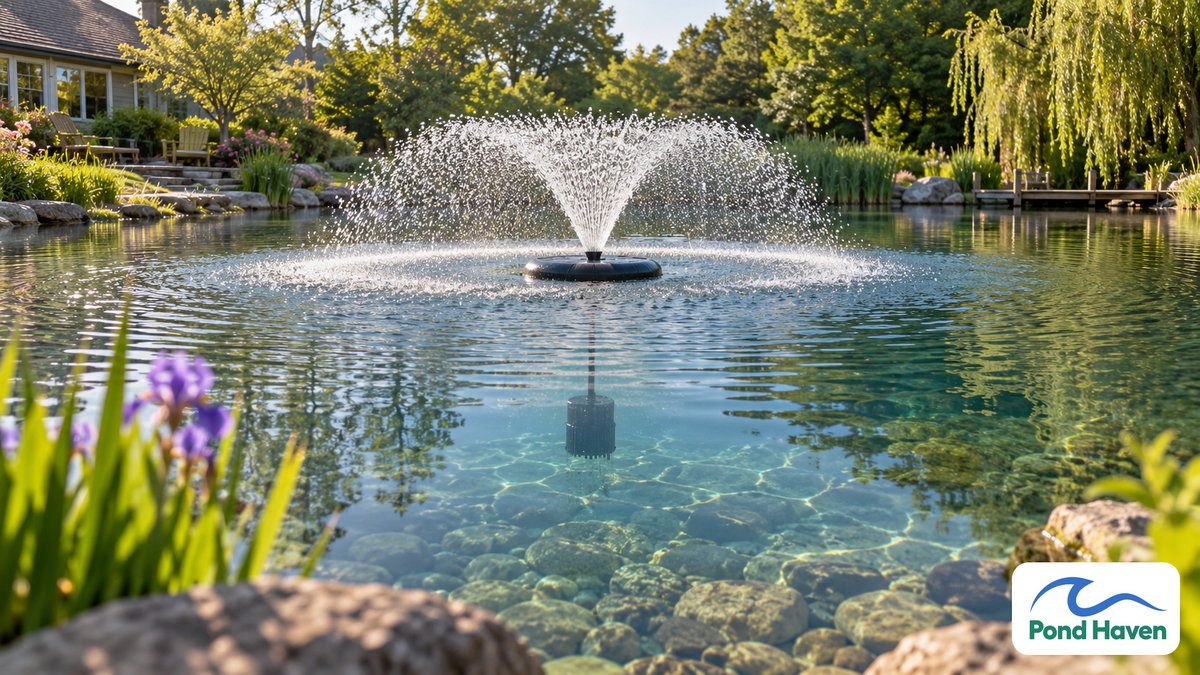

Your pond needs at least 24 to 36 inches (2 to 3 feet) of water for most floating fountains to operate safely. That is the physical minimum to keep the pump submerged and clear of bottom sediment. But if you want the fountain to actually aerate your pond, the water should be 6 feet deep or less. In deeper ponds, a fountain only circulates the top layer, and you need a subsurface aeration system instead.
- Most floating fountains need a minimum of 24 to 36 inches of water to operate without pulling bottom muck into the pump.
- A fountain only aerates the top 6 feet of the water column. Deeper ponds need a subsurface aerator for real water quality.
- In a shallow pond under 2 feet deep, use a mounting stand, a surface aerator, or a smaller low-draft fountain instead.
- Match spray height to pond surface area so the display looks proportional and does not lose excessive water to wind drift.
- For year-round installation in cold climates, place the unit where water stays above the freeze line, typically 4 to 6 feet down.
Quick-Answer Summary: Fountain Depth Requirements
The table below separates two concepts that often get confused: the minimum depth needed to run the equipment, and the maximum depth at which a fountain can still improve water quality.
| Pond Depth | Is a Fountain Suitable? | Primary Reason |
|---|---|---|
| Less than 2 ft | No. | Not enough water to float the unit or protect the pump intake from debris and sediment. |
| 2 ft to 6 ft | Yes, ideal. | A floating fountain operates safely and provides effective surface aeration for the full water column. |
| Over 6 ft | For decoration only. | The fountain cannot destratify or aerate the deeper water. A subsurface aerator is required for pond health. |
Why Pond Depth Matters: Aeration vs. Decoration
The real question is not just whether the pump gets wet. It is whether the fountain can do its job for your pond's ecosystem. That comes down to a process called thermal stratification.
In summer, deeper ponds separate into distinct layers:
- Epilimnion: The warm, oxygenated top layer.
- Hypolimnion: The cold, dense bottom layer where oxygen depletes and harmful gases like hydrogen sulfide can build up.
A fountain is a surface aerator. It draws water from just 12 to 24 inches below the surface and sprays it into the air, allowing gas exchange at the surface. Its mixing power is limited. Industry guidance from manufacturers like Kasco Marine and Otterbine consistently shows that the energy from a fountain cannot circulate water deeper than about 6 to 7 feet.
This is known as the "6-Foot Rule." If your pond is deeper than 6 feet, the fountain only aerates the top layer. The bottom water stays stagnant, low in oxygen, and potentially toxic to fish. A fountain in a deep pond is a decoration, not a water quality tool.

Minimum Depth for Safe Fountain Operation
Beyond aeration science, you need enough water to protect the equipment. The minimum depth requirement exists primarily for the pump's safety and performance.
- Floatation and intake: A floating fountain needs enough draft to fully submerge the pump intake, which typically sits 18 to 24 inches below the water surface.
- Debris clearance: You need an additional buffer of 6 to 12 inches below the intake to prevent it from sucking in bottom sediment, leaves, or muck. This matters most in windy conditions or when water levels fluctuate.
A minimum permanent water depth of 24 to 36 inches (2 to 3 feet) is the standard recommendation for safe, reliable fountain operation. Installing one in shallower water risks pump clogging, overheating, and premature failure.
Manufacturer Minimums Vary
Different manufacturers set different minimums. Check the spec sheet for your specific unit before you buy. The table below shows representative ranges from major brands, but always confirm against the exact model you are considering.
| Fountain Type | Typical Minimum Depth | Notes |
|---|---|---|
| Compact floating units (e.g., Anjon Monsoon) | 20 inches | Smaller draft, suited to water gardens and shallow ponds. |
| Fixed stand mounts (e.g., Otterbine Sunburst) | 22 inches | Stationary mount needs less depth than floating configurations. |
| Standard floating fountains (e.g., AquaMaster Series) | 24 inches | Common modern floating threshold for mid-size units. |
| Larger floating fountains | 30 to 36 inches | Bigger draft and heavier pump assemblies need more water. |
| High-output floating units (e.g., Airmax PondSeries) | 36 inches | Some warranties require this depth to remain valid. |
What to Do If Your Pond Is Too Deep for a Fountain
If your pond is 8, 12, or 15 feet deep, a fountain used alone will not maintain healthy water quality. The correct solution is a subsurface or diffused aeration system.
Here is how it works:
- An onshore compressor pumps air through a weighted hose to a diffuser plate placed at the pond's deepest point.
- The diffuser releases a column of fine bubbles, which creates a powerful upward current.
- This process, called airlift, pulls stagnant bottom water to the surface, where gases are exchanged.
- The entire water column circulates, destratifying the pond and oxygenating it from the bottom up.
For deep ponds, this is non-negotiable for preventing fish kills and controlling algae and weeds. You can still add a fountain for decorative purposes, but the subsurface aerator handles the vital task of water quality management.
A diffused aerator sized for a 1-acre pond will be undersized for a 3-acre lake. Use the pond's surface acreage and average depth to calculate total gallons, then select a compressor with enough output to turn the water over daily.
What to Do If Your Pond Is Too Shallow
A pond under 2 feet deep presents the opposite problem. You do not have enough water to float a standard fountain unit. You have three practical options:
- Use a mounting stand or platform. A fixed pedestal mount raises the pump off the pond floor so the intake clears the sediment. This is how fixed-stand fountains operate in as little as 22 inches of water.
- Choose a surface aerator instead. A surface aerator is designed for shallow water and provides the same oxygenation benefits as a fountain without the tall spray. These units work in water as shallow as 18 inches.
- Select a smaller, low-draft fountain. Compact units need only about 20 inches of water. Specialty models with side-intake pumps draw water from the middle of the water column rather than the debris-heavy floor.

Fountain vs. Aerator: Choosing the Right System
Match your equipment to your primary goal. This comparison clarifies the key differences:
| Feature | Floating Fountain | Subsurface (Diffused) Aerator |
|---|---|---|
| Primary Purpose | Decorative display and surface aeration. | Water quality management and full-pond circulation. |
| Effective Aeration Depth | 6 feet or less. | Unlimited. Effective in ponds 8 ft to 50+ ft deep. |
| Best For | Aesthetic appeal and surface gas exchange in shallow ponds. | Oxygenating the entire water column in deep ponds. |
| Winter Operation | Cannot operate if surface ice forms. Must be removed. | Can operate year-round under the ice to maintain an oxygenated refuge for fish. |
| Visual Impact | High; creates a visible spray pattern. | Low; only a small surface boil is visible at the diffuser location. |
Floating Fountain Advantages
- Creates a visible, attractive water display.
- Provides adequate surface aeration for ponds under 6 feet deep.
- Easy to install and remove seasonally.
Floating Fountain Disadvantages
- Cannot oxygenate water below about 6 feet.
- Must be removed before surface ice forms.
- Tall sprays lose water to wind drift in open areas.
Matching Spray Height to Pond Size
Depth is not the only factor. A fountain that looks dramatic in a small water garden looks undersized in a half-acre pond, and a tall geyser in a small pond looks overwhelming.
Use these general guidelines for spray height relative to pond surface area:
| Pond Surface Area | Recommended Spray Height | Notes |
|---|---|---|
| Under 500 sq ft | 3 to 5 feet | Keep the display modest so it does not dominate the space. |
| 500 to 2,000 sq ft | 5 to 8 feet | A mid-range unit provides good visual impact. |
| 2,000 sq ft to 1 acre | 8 to 12 feet | Larger spray patterns suit bigger water surfaces. |
| Over 1 acre | 12 feet or more | Use a 1 HP or larger unit per surface acre. |
Taller sprays are primarily decorative. They may actually reduce the evenness of water mixing. Lower, wider sprays are optimized for functional aeration. If your goal is water quality in a pond under 6 feet deep, choose a wide spray pattern over a tall geyser.
Freeze Line Depth for Year-Round Installation
If you live in a climate where ponds freeze, the freeze line determines whether you can leave equipment in the water year-round.
The frost line is the depth to which groundwater freezes in winter. In cold US climates, this is typically 4 to 6 feet deep. Water below the frost line stays liquid, protecting submerged equipment from ice damage.
For a fountain installed year-round:
- The pump must sit below the frost line to avoid ice damage.
- Floating fountains must be removed before the surface freezes. The spray creates dangerous ice formations on the unit and surrounding banks.
- A subsurface aerator can run all winter in shallow water, keeping an open hole for gas exchange. This is a critical difference if you keep fish through the winter.
If you want winter aeration without pulling your fountain, install a dedicated pond de-icer or run a subsurface aerator in water shallow enough to stay liquid.

Additional Sizing Factors Beyond Depth
While depth is the deciding factor between a fountain and an aerator, two other metrics determine the specific size (horsepower) of the unit you need:
- Pond surface area (acres or gallons). Larger surface areas require more power to create effective circulation. Fountain and aerator pumps are sized by horsepower relative to acreage. A common benchmark is 1 HP per 1 to 2 acres for fountains, and 1 HP per 1 to 3 acres for diffused aerators, depending on depth and shape.
- Fish load. A pond stocked heavily with koi or game fish has a higher biological oxygen demand. You may need to size up your aeration system to supply enough dissolved oxygen, ideally maintaining levels above 5 mg/L for fish health.
- Measure your pond's true depth at multiple points, not just the center.
- Confirm the manufacturer's minimum depth for your specific fountain model.
- Account for summer evaporation, which can drop water levels below the minimum by late August.
- Check the freeze line in your region before planning a year-round installation.
- Match spray height to pond surface area for a proportional display.
Frequently Asked Questions
Can I put a fountain in a 2-foot deep pond?
Yes, but it is at the absolute minimum limit. Ensure the water level stays consistently above 24 inches to protect the pump. A very shallow pond is also more prone to temperature swings and algae growth, where a fountain's surface aeration can be particularly beneficial.
My pond is 8 feet deep. What size fountain do I need?
For an 8-foot deep pond, do not select a fountain based on aeration needs, as it will be ineffective for the bottom half. Choose a fountain based solely on the spray pattern and aesthetics you want for the surface. You will need a separate subsurface aeration system to manage water quality.
How do I measure my pond's depth?
Use a weighted line or a long pole marked in feet. Take measurements at multiple points, especially the center and near the planned fountain location, to find the true maximum and minimum depths. Do not rely on estimates.
Will a fountain keep my pond from freezing?
No. Decorative fountains are not designed as de-icers. In freezing temperatures, the spray can create dangerous ice formations on the fountain itself and the surrounding banks. For winter oxygen exchange, you need a dedicated pond de-icer or a subsurface aerator running in shallow water.
What is the difference between a floating fountain and a surface aerator?
A floating fountain creates a tall decorative spray and provides surface aeration in ponds under 6 feet deep. A surface aerator creates a lower, wider spray or boil pattern designed specifically for oxygen transfer. Surface aerators typically operate in shallower water and are better suited for water quality goals over aesthetics.