
Heron Deterrent for Ponds
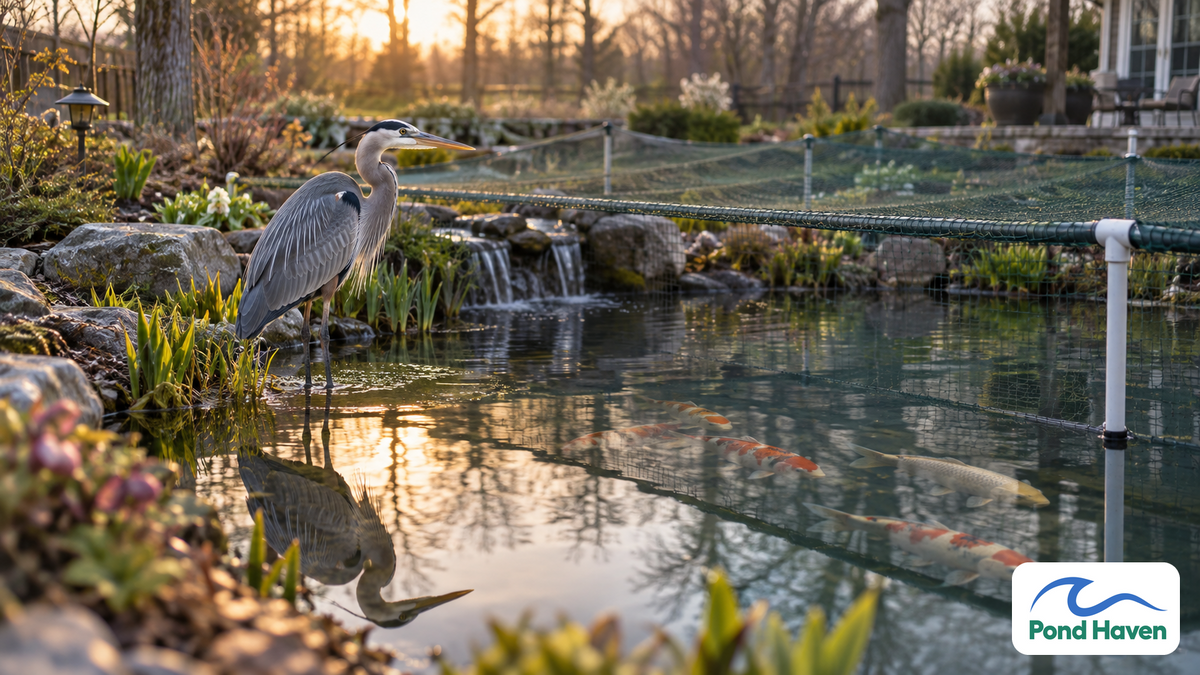

A great blue heron can clear a stocked pond of koi in a matter of days. These birds are patient, precise hunters, and once they learn your pond holds fish, they will return again and again.
Here is the part most articles bury: herons are protected under the federal Migratory Bird Treaty Act of 1918. Trapping, shooting, or poisoning them is illegal without a permit from the U.S. Fish and Wildlife Service, and those permits are only issued to supplement non-lethal methods. Your only legal, workable path is humane deterrence.
This guide ranks every common deterrent by how well it actually holds up over a season, gives you the installation numbers that matter, and tells you honestly which products are a waste of money.
- Physical exclusion (netting or fishing line grids) is the only method that reliably stops herons all season.
- Decoys and reflective tape fail once a heron learns they pose no threat, often within days.
- A pond at least 3 feet deep with steep edges and submerged fish shelters gives koi a fighting chance.
- Layered defenses that combine exclusion with motion-activated deterrents outperform any single method.
- Herons are federally protected. All deterrents must be non-lethal and humane.
Why Herons Target Your Pond: Understanding Predator Behavior
The great blue heron (Ardea herodias) is the predator most U.S. pond owners will deal with. It stands up to 38 inches tall with a wingspan approaching 70 inches, and it wades silently into shallow water to spear fish with a lightning-fast strike.
Your pond is an easy target for three reasons:
- Shallow shelves. Herons need water shallow enough to wade in, typically under 18 inches deep. Gradual slopes and planting shelves give them a perfect hunting platform.
- Clear, open water. Herons are visual hunters. If your fish have nowhere to hide and the water is clear enough to see them, the heron sees them too.
- No escape routes. Koi and goldfish in an open pond have nowhere to dive. A heron will work a pond methodically until it catches what it wants.
Herons feed most actively at dawn and dusk, though hungry birds, especially parents feeding young in spring, will hunt at any hour. They are also creatures of habit. Once a heron successfully catches fish at your pond, it will return to that reliable food source repeatedly.
The Deterrent Hierarchy: What Actually Works
Not all deterrents are equal. Here is the honest ranking, from the methods that hold up all season to the ones that fail within a week.
Tier 1: Physical Exclusion (The Gold Standard)
Physical barriers are the only deterrents with near-total effectiveness. They work because they do not rely on scaring the heron. They simply make the fish unreachable.
Pond netting is the most reliable option. A taut net suspended over the water surface physically prevents the heron from striking. When properly installed, it is the only method that works every single time.
Fishing line grids are a close second. Nearly invisible lines strung in a grid pattern across the pond disrupt the heron's approach. Herons need unobstructed airspace to spread their wings and strike, and the lines create a barrier they cannot read. Grids preserve the view of your pond better than netting.
Barrier systems like Heron Stop use tripwires or spike strips along the pond edge to block wading access. These work but only protect the perimeter, leaving fish vulnerable if a heron flies in and lands directly in the water.
Tier 2: Motion-Activated Deterrents
Motion-activated sprinklers like the Scarecrow or Havahart Spray Away detect movement up to 30 feet away and deliver a startling burst of water. Herons hate being sprayed, and the sudden, unpredictable nature of the response makes habituation slower than with static deterrents.
These devices work best as a supplement to physical exclusion, not a replacement. They have real limitations: they need a garden hose connection, they stop working when temperatures drop below freezing, and wind-triggered false activations can drain your patience and your water bill.
Tier 3: Visual and Scare Tactics
Decoys of herons, owls, and alligators exploit the heron's instincts. A fake heron at the pond edge suggests the territory is claimed. An alligator decoy suggests danger.
Here is the problem: herons are intelligent, and they habituate quickly. A decoy only works until the heron realizes it does not move, does not react, and poses no threat. That realization can come within days. The UC Davis Wildlife Damage Management guidelines on heron control recommend moving decoys to a new position every few days, and even then, a determined heron will eventually figure it out.
Reflective tape, shiny streamers, and eyespot balloons have the same fundamental weakness. They are static objects, and herons learn to ignore them.
Tier 4: Environmental Modifications
Making the pond itself less hospitable is a supporting strategy, not a standalone solution. Deep water, steep banks, and fish shelters reduce predation pressure, but a determined heron can still fish a 3-foot-deep pond from the edge.

Product Deep Dives: Specifications and Use Cases
Pond Netting Systems
Pond netting is the gold standard for a reason. Here are the numbers that matter:
- Mesh size: Use 1/2-inch to 1-inch mesh. This is small enough to block herons while allowing light and rain through. For larger ponds, 2-inch mesh will stop herons but may admit smaller birds.
- Height above water: Suspend the net 12 to 18 inches above the water surface. This is critical. A net lying on the water lets a heron spear fish through the mesh. A net suspended too high invites birds to land on it.
- Framing: Support the net with a frame of PVC pipe, rope, or stainless steel cable. For spans up to 25 feet, schedule 40 PVC works well. For larger ponds, use 3/32-inch 7x7 stainless steel cable with a 900-pound breaking strength, tensioned with turnbuckles.
- Tension: The net must be taut. Sagging netting can entangle fish and wildlife, creating a hazard and potential legal liability under the Migratory Bird Treaty Act.
Advantages
- Near-total effectiveness when properly installed
- Protects against herons, egrets, and other fish-eating birds
- Works 24/7 with no maintenance beyond inspection
- High-quality HDPE netting lasts 10+ years
Disadvantages
- Visible and can detract from the pond's appearance
- Requires a support frame and anchoring system
- Makes feeding and maintenance access more difficult
- Impractical for ponds larger than about 5 acres
Fishing Line Grids
Fishing line grids offer many of the benefits of netting with a much lighter visual footprint. The concept is simple: string monofilament or thin wire in a grid pattern across the pond.
- Line spacing: Space lines 8 to 12 inches apart. This is close enough to disrupt a heron's wing spread and strike angle.
- Height: Suspend lines 6 to 12 inches above the water surface. At this height, the lines are nearly invisible to humans but create an impassable barrier for a bird that needs clear airspace to strike.
- Line type: Use heavy monofilament (80-pound test or higher) or thin stainless steel wire. Dark-colored line is more visible to birds, which is what you want.
Grids work best on smaller ponds and water gardens where full netting would ruin the view. They require the same support structure as netting, but the visual result is dramatically cleaner.
Motion-Activated Sprinklers
The Scarecrow and similar devices are the most effective non-physical deterrents available.
- Coverage: Most units detect motion up to 30 feet away and spray a cone of water across a 70-degree arc.
- Placement: Position the sensor to cover the most likely heron approach paths, typically the shallow edges and gradual slopes where herons wade in.
- Power: Battery-powered units are portable but require regular battery changes. Wired units are more reliable but limit placement.
- Water supply: You need a garden hose connection with adequate pressure. The spray burst is brief but forceful.
These devices are genuinely effective at startling herons, and the unpredictability of the response slows habituation. But they are not a complete solution. They stop working when temperatures drop below freezing, and a heron that learns to approach from a blind spot will defeat them.
Heron Stop and Similar Barrier Systems
Heron Stop uses a series of tripwires or spike strips installed along the pond edge. When the heron tries to walk into the water, it encounters an unstable or uncomfortable surface and moves on.
These systems are cheaper and less visually intrusive than full netting. They work best on ponds with defined edges where you can install a complete perimeter barrier. The limitation is obvious: a heron can fly directly into the water, bypassing the edge defense entirely.
Installation and Strategy Guide: Building a Layered Defense
Step-by-Step Netting Installation
- Measure your pond accurately. Measure the length and width at the widest points, then add 2 to 3 feet on each side for anchoring. Order netting slightly larger than your measurements.
- Install anchor points. Drive posts or install eyebolts around the perimeter, spaced no more than 50 feet apart. For smaller ponds, screw eyes into decking or landscape timbers work well.
- Build the support frame. Run stainless steel cable or PVC pipe between anchor points, spanning the pond. Space support lines every 8 to 10 feet to prevent sagging.
- Attach the netting. Lay the net over the frame and secure it with net rings or zip ties. Pull it taut so it does not sag into the water.
- Create access points. Install a removable section or a simple frame door where you feed your fish and perform maintenance.
Preventing Habituation: The Key to Long-Term Success
Herons are learning animals. A deterrent that works today may stop working next week. The U.S. Fish and Wildlife Service is explicit on this point: a single deterrent method is rarely successful long-term because herons quickly habituate to static objects.
The solution is a layered defense that combines methods and changes them regularly:
- Rotate visual deterrents on a schedule. Move decoys every few days. Swap between a heron decoy, an alligator decoy, and reflective tape.
- Combine physical and motion-activated methods. Netting or a grid provides the baseline protection. A motion-activated sprinkler adds an unpredictable element that keeps herons off balance.
- Deploy early and aggressively. Start your deterrent program in early March, before herons establish feeding patterns. Hazing that begins after a heron has successfully fed at your pond is far less effective.
Maintenance and Monitoring
A deterrent system is only as good as its maintenance. Inspect nets and lines after every major storm. Check sprinkler batteries and connections monthly. Watch for signs your deterrent is failing, such as fish missing, heron tracks on the pond edge, or droppings on nearby structures.
Making Your Pond Less Attractive: Depth and Edge Design
Physical deterrents keep herons out. Environmental design makes your pond a less rewarding target in the first place. Both matter.
Deep Water Zones
Herons are wading birds. They need shallow water to stand in while they hunt. A pond with a minimum depth of 3 feet throughout the main body gives your fish a refuge the heron cannot reach.
If you are building a new pond or renovating an existing one, design for depth. A 3-foot minimum is the baseline. Deeper is better, especially in the center of the pond where fish can dive beyond the reach of a striking heron.
Steep Edges and Bank Design
Gradual slopes are heron highways. A pond with gently sloping sides gives a heron a stable platform to wade from, and it can work its way deeper as it hunts.
Steep, near-vertical edges deny the heron that platform. A heron standing on a steep bank cannot reach fish in the water below, and it cannot wade in without losing its footing. If your pond has a liner, bring it up steeply at the edges rather than letting it slope gradually into the water.
Fish Shelters and Escape Routes
Even with deep water and steep edges, your fish need somewhere to hide. Submerged shelters, tunnels, and faux log caves give koi and goldfish a refuge when a heron appears.
Place shelters in the deepest part of the pond, where the water is at least 3 feet deep. Position them so fish can reach them quickly from any part of the pond. A fish that can dive to cover in seconds has a much better chance of surviving a heron strike.
Combine a 3-foot minimum depth with steep edges and submerged shelters. Fish that can dive beyond wading depth and reach cover quickly will survive encounters that would kill fish in a shallow, open pond.
Aeration and Water Quality
Well-oxygenated water keeps fish active and healthy, and healthy fish are better able to evade predators. Aeration also keeps fish from congregating at the surface, where they are most vulnerable. A properly sized aerator or fountain circulates the water column and keeps your fish distributed throughout the pond rather than clustered in the shallows.

Comparison Table: Deterrent Options at a Glance
| Deterrent | Upfront Cost | Effort | Holds Over a Season | Best For |
|---|---|---|---|---|
| Pond netting | $$ | High | Excellent | Small to medium ponds where appearance is secondary |
| Fishing line grid | $$ | Medium | Excellent | Ponds where you want to preserve the view |
| Heron Stop / edge barriers | $ | Low | Good | Ponds with defined edges and no deep-water access |
| Motion-activated sprinkler | $ | Low | Moderate | Supplementing physical exclusion |
| Heron decoy | $ | Very low | Poor | Temporary deterrence before other methods |
| Reflective tape / streamers | $ | Very low | Poor | Short-term scaring during active feeding periods |
| Pond design (depth, edges, shelters) | Varies | High | Permanent | New construction or major renovation |
Community Wisdom: What Pond Owners Actually Report
The pond-keeping community has tested every deterrent on this list, and the consensus is remarkably consistent.
What Experienced Koi Keepers Swear By
On Reddit's koi and pond forums and the Pond Boss community, the most experienced keepers are unanimous: netting or a fishing line grid is the only thing that truly works. The stories of decoy failures are endless. The stories of herons defeating netting are rare, and when they happen, it is almost always because the net was installed too loose or too low.
Many long-time koi keepers build a permanent frame over their pond and leave the net in place year-round. They report that the net becomes invisible after a few weeks, and the peace of mind is worth the visual trade-off.
Common Mistakes and Ineffective Methods
The most common mistake is the "one and done" approach. A pond owner installs a decoy, watches it work for a week, and assumes the problem is solved. Then the heron figures it out, and the fish start disappearing again.
The second most common mistake is underestimating heron intelligence. These birds learn. They watch. A heron that has been sprayed by a sprinkler will approach from a different angle. A heron that has been scared by a decoy will test it from a distance before committing. Your deterrent strategy has to be at least as smart as the bird.
What to Avoid
- Illegal methods. Trapping, poisoning, and shooting herons are federal crimes under the Migratory Bird Treaty Act. The penalties are severe, and the permits for lethal control are almost never issued to residential pond owners.
- Products with no evidence base. Ultrasound devices have not been shown to deter herons. Rotating scare devices like the Flash-Harry have also shown little to no effect in field observations. Save your money.
- DIY solutions that endanger fish or wildlife. Loose, small-mesh netting can trap and kill birds, creating legal liability. Improperly installed electric fencing can harm pets and children. If a solution feels unsafe, it probably is.

Frequently Asked Questions
Will a heron decoy keep real herons away?
Temporarily, at best. A heron decoy exploits the territorial instinct, but herons habituate to static objects quickly, often within days. Move the decoy every few days to extend its effectiveness, but do not rely on it as your primary defense.
How high should pond netting be above the water?
Suspend netting 12 to 18 inches above the water surface. This prevents herons from spearing fish through the mesh while keeping the net low enough to discourage birds from landing on it. The net must be kept taut so it does not sag into the water.
Do motion-activated sprinklers work in winter?
No. Motion-activated sprinklers require a garden hose connection and stop working when temperatures drop below freezing. They are a warm-season deterrent. In winter, when koi are sluggish and more vulnerable, physical exclusion like netting is your only reliable protection.
What pond depth prevents herons from wading?
A minimum depth of 3 feet throughout the main pond body discourages wading. Herons prefer shallow water where they can stand and strike. Combine deep water with steep edges and submerged fish shelters to give your fish the best chance of escape.
How do I protect my pond when I'm away from home?
Physical exclusion is the only deterrent that works unattended. Install netting or a fishing line grid before you leave, and make sure it is taut and secure. Motion-activated sprinklers and decoys lose effectiveness quickly without someone to maintain and reposition them.
Your Action Plan for a Heron-Proof Pond
Herons are beautiful, intelligent, and persistent. They are also federally protected, which means your only legal option is humane deterrence. The good news is that humane deterrence works, if you use the right methods in the right combination.
Start with physical exclusion. Netting or a fishing line grid is the only method that reliably holds up all season, and it is the foundation of any serious heron defense. Add a motion-activated sprinkler for an unpredictable element that keeps herons off balance. Design your pond with deep water, steep edges, and submerged shelters so your fish have somewhere to go when a heron appears.
Skip the decoys and reflective tape as primary defenses. They fail once a heron learns the pond, and that learning happens fast.
A layered defense that combines physical exclusion, motion-activated deterrents, and smart pond design is the only strategy that wins over a full season. Deploy it early, maintain it regularly, and your fish will be safe.