
Green Pond Water
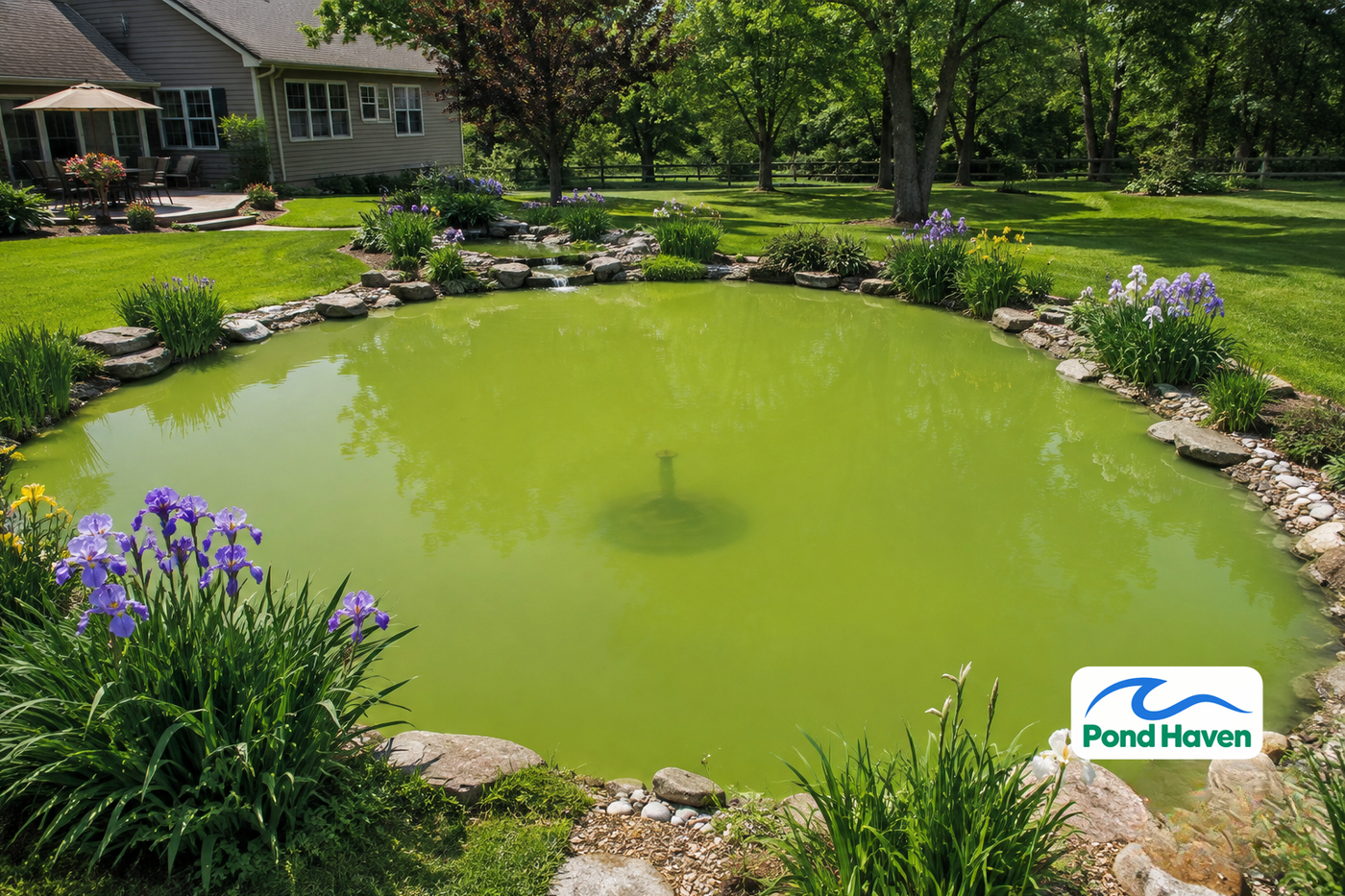

You walk outside on a warm June morning, and overnight your clear pond has turned into a murky bowl of pea soup. The fish are still swimming, but you can barely see them six inches below the surface.
Here's the truth: green water is not a pond failure. It's a symptom of a nutrient imbalance. Your pond has too much food for algae and not enough competition to eat it.
This guide explains exactly what causes green pond water, when it's dangerous, how to diagnose the severity, and the fastest ways to fix it. You'll get specific numbers, not vague advice.
- Green pond water is caused by planktonic algae blooms, microscopic single-celled plants suspended throughout the water column.
- Phosphorus is the primary trigger: levels above 0.03 ppm fuel blooms. Nitrate above 10 mg/L makes it worse.
- A Secchi disk test tells you severity fast: 18 inches of visibility is healthy, under 12 inches is problematic.
- UV clarifiers clear water in 3–10 days but treat symptoms only. Beneficial bacteria take 2–6 weeks but fix the root cause.
- Algaecides are a last resort. Dead algae decompose and can crash dissolved oxygen below 2 mg/L, killing fish within hours.
What Exactly Is Green Pond Water?
Green pond water is a uniform, murky green discoloration of the entire water column. It looks like someone poured pea soup into your pond. The green tint comes from millions of microscopic algae cells, each one packed with chlorophyll that reflects green light.
This is different from water that's merely green-tinted but clear. If you can see the bottom clearly but the water has a green cast, you're looking at dissolved organic compounds, not an algae bloom. True green water reduces visibility significantly.
Planktonic Algae vs. Filamentous Algae
These two algae types cause completely different problems. Knowing which one you have determines your treatment strategy.
| Feature | Planktonic Algae | Filamentous Algae |
|---|---|---|
| Appearance | Uniform green tint, murky water | Stringy mats, hair-like growth |
| Location | Suspended in water column | Attached to rocks, liner, plants |
| Common name | "Pea soup" | String algae, blanket weed |
| Cause | Excess nutrients + sunlight | Excess nutrients + shallow water |
| Treatment | UV clarifier, bacteria, nutrient control | Manual removal, barley straw, shading |
Planktonic algae turn the water green. Filamentous algae form visible mats that look like wet wool or cotton. They're different problems requiring different solutions.
Common Misidentifications
Before you treat, rule out these look-alikes:
- Clay turbidity: Brown-green murkiness from suspended sediment. It settles overnight if undisturbed. Algae blooms don't settle.
- Duckweed: Tiny individual floating plants, not a tint. You can see the individual leaves. Duckweed forms a surface mat, not a water-column discoloration.
- Pollen: A yellow-green film on the surface in spring. It collects at the edges and doesn't cloud the water column.
The Root Cause: Planktonic Algae Blooms
Planktonic algae are microscopic, single-celled photosynthetic organisms that stay suspended in the water column. A healthy pond hosts 50 or more species of phytoplankton, but only 4 to 5 dominate at any time.
The problem starts when those cells multiply explosively. Under ideal conditions, algae can double their population in hours. That's why blooms appear "overnight." One warm, sunny day after a rainstorm can trigger a visible bloom.
The Biology of Bloom-Forming Organisms
Common bloom-forming genera include Chlorella vulgaris, Scenedesmus, and Euglena. These are true algae, eukaryotic organisms with a nucleus. They reproduce by cell division, and each cell contains chlorophyll that absorbs sunlight and reflects green wavelengths.
When conditions are right, cell counts climb fast. A dense bloom can contain many millions of cells in just a single cup of water.
Cyanobacteria: The "Blue-Green Algae" That Aren't Algae
Cyanobacteria are often called blue-green algae, but they're actually bacteria. They contain plant pigments but are prokaryotic organisms, structurally closer to bacteria than to true algae.
Common nuisance genera include Microcystis, Anabaena, and Planktothrix. These matter because they behave differently from true algae:
- They can regulate their buoyancy with gas vacuoles, moving up and down the water column.
- Some fix atmospheric nitrogen, giving them an advantage when nitrogen is limited.
- Many produce toxins, including microcystins.
- They require a much higher UV dose to kill compared to common green algae.
If your green water has surface scum, paint-like streaks, or a musty odor, you likely have cyanobacteria, not true algae.
When Is a Bloom Dangerous?
A dense bloom can pose a risk. Visual cues that indicate a potentially dangerous bloom:
- Surface scum or foam
- Paint-like streaks on the water surface
- Musty or earthy odor
- Fish gasping at the surface

What Triggers an Algae Bloom? The Nutrient Connection
Algae need two primary nutrients to grow: nitrogen and phosphorus. In most freshwater ponds, phosphorus is the limiting factor. That means algae can't bloom until enough phosphorus is available. Control phosphorus, and you control the bloom.
Critical Thresholds
These are the numbers that matter:
- Phosphate: Below 0.03 ppm is stable. Above that, blooms become likely.
- Nitrate: Below 10 mg/L is the USEPA guideline for drinking water, and it's a practical target for pond nutrient control. Higher levels fuel rapid growth.
- Minimum triggers: As little as 0.4 mg/L nitrogen and 0.1 mg/L phosphorus can start a bloom in calm water.
Home test kits measure both phosphate and nitrate. Test monthly during the growing season, and weekly if you're fighting a bloom.
Sources of Nutrient Loading
Where do these nutrients come from? In backyard ponds, the biggest source is fish waste and overfeeding. Every pellet of uneaten food decomposes into ammonia, then nitrite, then nitrate. That's fertilizer for algae.
Other sources:
- Runoff from fertilized lawns and gardens
- Decaying leaves and grass clippings
- Duck and goose waste
- Pet waste washed in by rain
- Leaky septic systems (for acreage ponds)
Internal Loading: Why Muck Matters
Here's what most guides miss: even if you stop all external nutrient input, your pond can keep feeding itself. The sediment at the bottom, the muck layer, stores phosphorus. When that muck gets disturbed, it releases phosphorus back into the water column.
This is why treating the water without addressing the muck is temporary. You're removing the symptom while the source keeps producing.
Beneficial bacteria that digest organic sludge address the internal phosphorus source. Without them, any clarity you gain from UV or water changes will be short-lived.
Environmental Catalysts: Light, Temperature, and Seasonality
Nutrients alone don't cause blooms. You need the right environmental conditions too.
Why Warm Weather Fuels Blooms
Cyanobacteria thrive between 25°C and 35°C (77°F to 95°F). That's mid-summer pond water in most of the US. Metabolic rates increase with temperature, so algae reproduce faster in warm water.
Phosphorus release from sediment is also temperature-dependent. Sediment releases significantly more phosphorus in warm water than in cold water. Warm water doesn't just speed up algae; it feeds them more.
Sunlight and Photosynthesis
Algae need light to photosynthesize. Six or more hours of direct sunlight per day accelerates growth dramatically. This is why blooms often appear after a stretch of clear, sunny days.
Shading helps, but don't shade the whole pond. Aquatic plants that cover 40–60% of the surface provide shade while competing for nutrients.
Seasonal Patterns
- Spring blooms: Winter die-off releases nutrients. Spring runoff washes fertilizer into the pond. Cool-tolerant algae take off first.
- Summer blooms: Sustained warm temperatures keep algae reproducing at maximum rate.
- Fall die-off: When the bloom dies, decomposition releases nutrients that fuel next year's growth.
Storm Events and Nutrient Pulses
Heavy rain washes nutrients into the pond in a pulse. Runoff carries fertilizer, manure, and soil. That's why blooms often appear within days of a storm. The rain delivers a nutrient load, then the sun triggers the bloom.
Why New Ponds Turn Green: New Pond Syndrome
If your pond is less than 6 weeks old and turned green, this is normal. It's called new pond syndrome, and it's a predictable phase of the nitrogen cycle.
The Nitrogen Cycle Explained
Your pond's biological filter is a chain of beneficial bacteria:
- Nitrosomonas bacteria convert toxic ammonia into nitrite.
- Nitrobacter bacteria convert nitrite into nitrate.
- Plants and algae absorb nitrate, or denitrifying bacteria convert it to nitrogen gas.
The problem: these bacteria take time to colonize. A new pond has no established bacterial population. Until they grow, ammonia builds up, and that excess nutrient feeds algae.
The 4–6 Week Maturation Timeline
- Weeks 1–2: Ammonia spikes as fish waste and decaying matter accumulate.
- Weeks 2–4: Nitrite spikes as Nitrosomonas colonize.
- Weeks 4–6: Nitrate stabilizes as Nitrobacter establish.
Green water is common during this entire period. The algae are absorbing the excess nutrients your immature filter can't process yet.
Stocking and Feeding Guidelines for New Ponds
You can reduce the severity of new pond syndrome:
- Start with only 1/3 to 1/4 of your pond's maximum fish capacity.
- Feed starter fish one pellet per fish per day during cycling.
- Test water weekly for ammonia, nitrite, and pH.
- Add a starter bacteria product to accelerate colonization.
Is Green Water Dangerous? Oxygen and Health Risks
Green water itself rarely kills fish. The oxygen crash that follows a bloom die-off can.
The Oxygen Paradox
During the day, algae photosynthesize and produce oxygen. A dense bloom can actually supersaturate the water with oxygen. But at night, algae respire and consume oxygen. So do the bacteria that decompose dead algae.
The result: dissolved oxygen swings wildly. High during the day, dangerously low at dawn.
Fish Kill Thresholds
- Healthy range: 5–8 mg/L dissolved oxygen
- Danger zone: Below 4 mg/L stresses fish
- Lethal: Below 2 mg/L kills most fish
Signs of oxygen stress: fish gasping at the surface, gathering at the waterfall or pump outflow, listless behavior.
Toxin-Producing Cyanobacteria
Some cyanobacteria produce microcystins and anatoxins. These are liver and nerve toxins that can harm fish, pets, and humans. The WHO advises avoiding contact with visible surface scums.
If you have a cyanobacteria bloom with surface scum, keep pets and children away. Test for toxins if you're concerned.
When to Be Concerned vs. When to Wait It Out
- Green but clear, no surface film: Usually harmless, often temporary. Monitor and address nutrients.
- Surface scum, musty odor, fish distress: Act immediately. This is a potential toxin producer and oxygen risk.
- New pond, first 6 weeks: Normal. Let the nitrogen cycle establish.

How to Diagnose Your Pond's Green Water
Before you buy any treatment, know how bad the problem is. The Secchi disk test takes 2 minutes and tells you a lot.
The Secchi Disk Test
A Secchi disk is a black-and-white disk you lower into the water until it disappears. You can use a white dinner plate tied to a string.
- Healthy: Visible at 18 inches (45 cm) or deeper
- Problematic: Disappears before 12 inches (30 cm)
- Danger zone: Less than 8 inches (20 cm) means the bloom is dense enough to cause nighttime oxygen crashes
Test weekly during bloom season and track the trend. If visibility is dropping, act before it becomes critical.
Water Testing
Test these parameters monthly, and weekly during a bloom:
| Parameter | Target | Action Level |
|---|---|---|
| Phosphate | Below 0.03 ppm | Above 0.03 ppm: add phosphate binder |
| Nitrate | Below 10 mg/L | Above 10 mg/L: reduce feeding, add plants |
| Dissolved oxygen | 5–8 mg/L | Below 4 mg/L: run aeration continuously |
| pH | 6.5–8.5 | Below 6.5 or above 8.5: investigate cause |
Visual Indicators of Cyanobacteria vs. True Algae
| Cue | True Algae | Cyanobacteria |
|---|---|---|
| Water color | Uniform green | Green, blue-green, or reddish |
| Surface | Clear | Scum, paint-like streaks |
| Odor | None or mild | Musty, earthy |
| Fish behavior | Normal | Gasping, lethargic |
How to Fix Green Pond Water (Solutions Ranked by Speed)
Here's the honest ranking of treatments, from fastest symptom control to long-term fixes.
UV Clarifiers (3–10 Days): Fastest Symptom Control
UV clarifiers expose water to UV-C light at 253.7 nm, which damages algae DNA and prevents reproduction. The cells clump and settle, and the water clears.
- Sizing: Match wattage to pond volume. A 9W unit handles up to 1,000 gallons, 18W for 2,000 gallons, 36W for 5,000 gallons.
- Flow rate matters: Slower flow means more UV exposure and better kill. Follow the manufacturer's flow rate, not maximum pump output.
- Timeline: Visible improvement in 3–10 days.
The catch: UV treats symptoms, not the cause. Without nutrient management, the bloom returns.
Beneficial Bacteria Treatments (2–6 Weeks): Long-Term Balance
Beneficial bacteria compete with algae for nutrients. They digest organic waste, muck, and uneaten food, starving the algae.
- Timeline: 2–6 weeks for visible results
- Best for: Prevention and maintenance, not emergency fixes
- Application: Liquid or powder, dosed weekly
This is the root-cause treatment. It addresses the nutrient load that feeds algae.
Phosphate Binders and Chemical Treatments
Phosphate binders like lanthanum-modified bentonite lock up free phosphate into forms algae can't use.
- Timeline: Days to weeks, depending on product
- Best for: Ponds with confirmed high phosphate levels
- Caution: Follow label rates exactly. Overdosing can harm beneficial bacteria.
Barley Straw and Natural Remedies
Decomposing barley straw releases compounds that inhibit algae growth.
- Timeline: 4–6 weeks to become effective
- Best for: Prevention, not treatment of existing blooms
- Placement: Floating bales or loose straw in mesh bags
Add barley straw in early spring before blooms start. It won't clear an existing bloom.
Water Changes: Immediate but Temporary
Replacing 10–20% of the pond water dilutes nutrients and algae cells.
- Effect: Lasts days to a week
- Caution: Don't change more than 20% at once. Large changes disrupt the nitrogen cycle.
- Best combined with: Other treatments
Why Algaecides Are a Last Resort
Algaecides kill algae fast. That's the problem. When millions of algae cells die at once, bacteria decompose them, and that decomposition consumes massive amounts of oxygen.
An oxygen crash can kill fish within hours. Algaecides also disrupt the biological balance that keeps your pond stable.
If you must use one:
- Treat half the pond at a time, wait 48 hours, then treat the other half.
- Run aeration continuously during and after treatment.
- Remove dead algae promptly.
Advantages
- Fast visible results in 1–3 days
- Effective on both true algae and cyanobacteria
Disadvantages
- Oxygen crash risk can kill fish
- Disrupts biological balance
- Treats symptoms only; bloom returns without nutrient control
How to Prevent Green Water Long-Term
Prevention is about building a pond ecosystem that doesn't produce blooms in the first place.
Proper Pond Design
If you're building a new pond, or renovating an existing one:
- Minimum depth: 3 feet to reduce warming and light penetration. Go 6–7 feet if fish overwinter.
- Slope: 3:1 ratio (1 foot drop per 3 feet from shore) to minimize shallow areas where light reaches the bottom.
- Buffer strips: 10–20 feet of native plants around the pond edge to filter runoff.
Aquatic Plants as Biological Filters
Plants compete with algae for the same nutrients. Cover 40–60% of the surface for best results.
- Floating plants: Water hyacinth, water lettuce. Shade the water and take up nutrients.
- Submerged plants: Anacharis, hornwort. Oxygenate and compete for nutrients.
- Marginal plants: Pickerelweed, cattails. Filter runoff before it enters the pond.
Mechanical Filtration and Skimmers
Skimmers catch leaves and debris before they sink and decompose into nutrients. This is the most effective long-term prevention strategy.
- Clean skimmer baskets weekly during fall leaf drop.
- Rinse pre-filters monthly.
- Drain waterfall boxes and rinse bio-media 2–3 times per year.
Feeding Discipline and Stocking Rates
Overfeeding is the #1 cause of nutrient buildup in backyard ponds.
- Stocking guideline: 1 inch of fish per 10 gallons of water
- Feeding: Only what fish consume in 2–3 minutes, once daily
- Temperature rule: Skip feeding below 50°F (10°C)
Aeration and Oxygenation
Bottom diffused aeration circulates the water column, preventing stratification and nutrient buildup at the bottom. It also supports the beneficial bacteria that compete with algae.
Match aerator output to pond volume and depth. Aeration is especially important in summer when warm water holds less oxygen.
Regular Maintenance Schedules
- Weekly: Check water clarity, remove debris, inspect equipment
- Monthly: Test water chemistry (phosphate, nitrate, pH), clean filters
- Spring: Add beneficial bacteria, add barley straw, clean out winter debris
- Fall: Remove dead plants, net out leaves, reduce feeding as temperatures drop

Frequently Asked Questions
Will green water kill my fish?
Rarely, directly. The danger is the oxygen crash when a dense bloom dies and decomposes. Dissolved oxygen below 2 mg/L is lethal to most fish. If your fish are gasping at the surface, run aeration continuously and consider a partial water change.
How long does green water last?
In a new pond, expect 4–6 weeks while the nitrogen cycle establishes. In an established pond, a bloom can last weeks to months if nutrient levels stay high. UV clarifiers clear water in 3–10 days, but without nutrient control, the bloom returns.
Can I swim in a green pond?
If the green is from true algae, swimming is generally safe, though visibility is poor. If you see surface scum, paint-like streaks, or smell a musty odor, you may have cyanobacteria. The WHO advises avoiding contact with visible cyanobacteria scums due to toxin risk.
Does barley straw really work?
Yes, but only as a preventative. Decomposing barley straw releases compounds that inhibit algae growth. It takes 4–6 weeks to become effective, so add it in early spring before blooms start. It won't clear an existing bloom.
How often should I change pond water?
Replace 10–20% weekly during bloom season to dilute nutrients. Don't change more than 20% at once, as large changes disrupt the nitrogen cycle. Water changes are a temporary fix; combine them with nutrient control for lasting results.
The Bottom Line: Diagnose First, Then Treat
Green pond water is a nutrient problem, not a pond failure. The three-step action plan:
- Diagnose: Run the Secchi disk test. Test phosphate and nitrate. Identify whether you have true algae or cyanobacteria.
- Treat: Use a UV clarifier for fast clarity (3–10 days) while starting beneficial bacteria for root-cause control (2–6 weeks). Add a phosphate binder if tests confirm high phosphate.
- Prevent: Reduce feeding, add aquatic plants, install a skimmer, and run aeration. Address the muck layer with beneficial bacteria before it becomes next year's bloom.
The ponds that stay clear year after year aren't lucky. They're managed. Control the nutrients, and the algae have nothing to eat.