
Should a Pond Pump Be On All the Time?
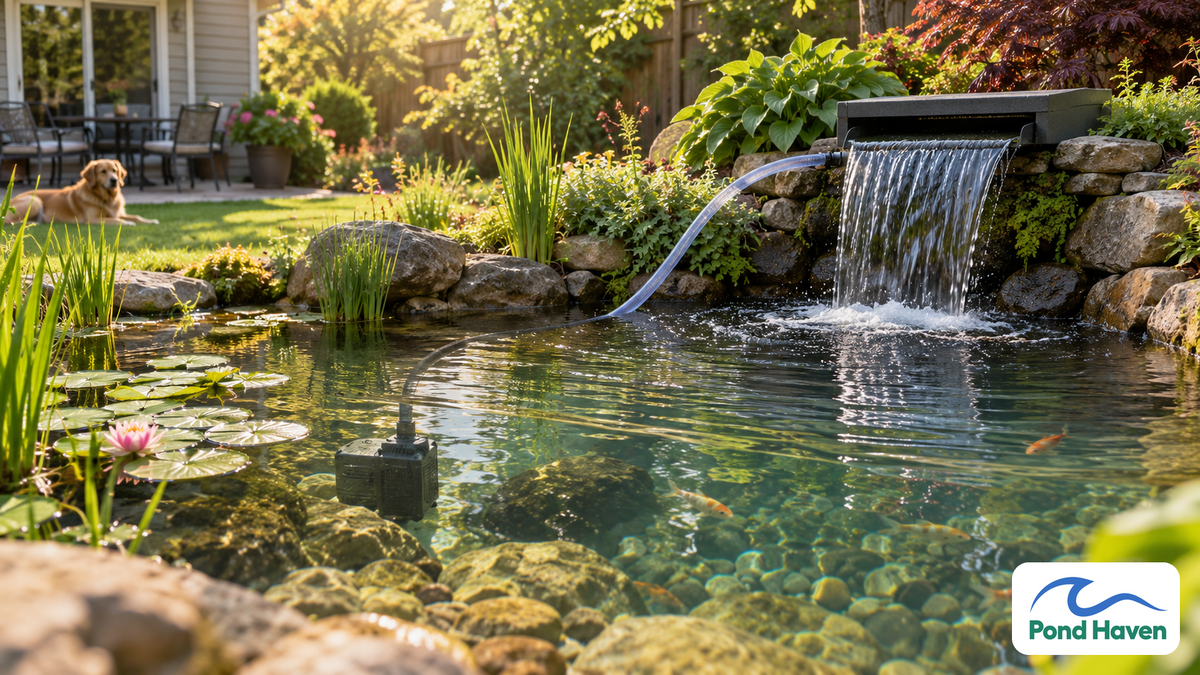

The monthly electric bill arrives. You glance at the pond pump humming in the backyard and wonder: does it really need to run every single hour of every single day?
It's a fair question. Pond pumps draw power, make noise, and seem like the kind of appliance you could switch off at night or while you're at work. But a pond pump isn't a light fixture. It's the heart of a closed aquatic ecosystem, and turning it off has consequences that go far beyond a still water surface.
Here's the direct answer, the science behind it, and the real cost math so you can decide with your eyes open.
- In any pond with fish or a biological filter, the pump must run 24/7, 365 days a year.
- Turning the pump off starves your filter bacteria of oxygen; they begin dying within hours, and ammonia spikes when you restart.
- A typical 100-watt pump costs about $12 per month to run continuously at average US electricity rates.
- Frequent on/off cycling wears pumps out faster than continuous operation. Pond pumps are designed for 24/7 duty.
- Fish-free ornamental ponds, decorative fountains on timers, and winter shutdown in icing climates are the main exceptions.
The Short Answer
Yes. If your pond has fish or relies on a biological filter, the pump must run 24/7.
No qualifiers, no "most of the time." Continuous circulation is not a preference. It is the operating requirement for a healthy pond.
The reasons break down into three pillars:
- Oxygen for fish. Moving water drives gas exchange, keeping dissolved oxygen above the levels fish need to survive.
- Survival of filter bacteria. The beneficial bacteria that process fish waste are aerobic. They die without a constant supply of oxygenated water.
- Prevention of stagnation. Still water warms, stratifies, breeds mosquitoes, and grows algae.
The main exception is a fish-free ornamental pond, where there is no biological load demanding oxygen. We'll cover that and other exceptions below.
The Science of Why: Pond Health 101
Oxygen for Fish: Why Moving Water Matters
Fish breathe dissolved oxygen, not the oxygen in the air. That oxygen enters the water through the surface, where the air meets the water. The process is called gas exchange: oxygen dissolves into the water while carbon dioxide escapes into the air.
Here's the catch. Gas exchange only happens efficiently when the water surface is moving. A perfectly still pond surface exchanges gas at a tiny fraction of the rate of a choppy, circulating one. Your pump creates that surface turbulence, whether through a waterfall, a fountain, or simply pushing water back into the pond.
The numbers matter. Fish need dissolved oxygen above 6 mg/L to thrive. Levels below 3 mg/L cause physiological stress. Below 1 mg/L, fish become lethargic, hang at the surface gasping, and die. These thresholds are well documented in aquaculture research and extension service publications, including guidance from the USDA and university fisheries programs.
Koi and goldfish (Carassius auratus) are hardy fish, but they are not immune to these thresholds. They need the same oxygen levels as any other fish. A pump that stops moving water stops replenishing that oxygen.
The Nitrogen Cycle: Why Your Filter Bacteria Need Constant Flow
Your pond filter is not a sieve. It is a living colony of bacteria, and those bacteria do the real work of keeping your water safe.
Here's how the system works. Fish waste and uneaten food break down into ammonia (NH₃), which is highly toxic. A class of bacteria called Nitrosomonas converts that ammonia into nitrite (NO₂⁻), which is also toxic. A second class, Nitrobacter, converts nitrite into nitrate (NO₃⁻), which is far less harmful and is absorbed by plants or removed through water changes.
This two-step process is the nitrogen cycle, and every stage depends on bacteria that are strict aerobes. They require oxygen to live, reproduce, and process waste.
When you turn the pump off, water stops flowing through the filter media. The oxygen in that media is consumed within hours by the bacteria themselves, by fish respiration, and by decaying organic matter. Research on nitrifying bacteria in biofiltration systems shows that dissolved oxygen depletion in stagnant filter media causes nitrification to slow dramatically within hours and cease entirely as oxygen approaches zero. In warm water, significant die-off of your nitrifying bacteria begins within 4 to 6 hours of flow cessation.
Here's the part most guides skip. When you restart the pump, the dead bacteria can't process the waste that accumulated while they were dying. Ammonia and nitrite spike to toxic levels. You don't just lose filtration overnight. You create a poison problem that takes weeks to fix while a new bacterial colony re-establishes itself.

The Risks of Turning Your Pump Off
Immediate Danger: Oxygen Depletion
Without circulation, oxygen doesn't just stay where it is. It depletes.
In a still pond, the water column stratifies. Warm, oxygen-rich water stays at the surface while deeper water becomes stagnant and anoxic. Fish that normally swim throughout the pond get squeezed into the top layer.
The most dangerous moment is early morning. Oxygen levels in a pond naturally drop overnight because photosynthesis stops when the sun goes down, but fish and bacteria keep respiring. In a pond without circulation, that dawn oxygen crash can be fatal. Fish gather at the surface gasping, and in a severe case, you can wake up to a pond full of dead fish.
Filtration Collapse and Ammonia Spikes
We covered the biology above, but the practical consequence deserves emphasis. Ammonia is toxic to fish at remarkably low concentrations. Levels above 0.02 mg/L stress fish. Above 0.1 mg/L, ammonia becomes lethal. These figures align with published water quality guidelines for ornamental fish culture.
When your filter bacteria die from lack of oxygen, ammonia builds up unchecked. Restarting the pump circulates that accumulated waste through the entire pond at once. The result is a toxic spike that stresses or kills fish and takes weeks to resolve.
Stagnation, Algae, and Mosquitoes
Still water is a breeding ground for problems.
- Algae. Stagnant water warms faster in the sun, and warm, nutrient-rich water grows algae. Excess nitrogen and phosphorus from decaying waste fuel the bloom.
- Mosquitoes. Mosquitoes lay eggs in still water. A pond without circulation becomes a breeding site within days.
- Hydrogen sulfide. Debris settles to the bottom and decays without oxygen, producing hydrogen sulfide. That's the rotten egg smell you sometimes notice near stagnant ponds.
None of these problems exist in a circulating pond. All of them appear quickly in a still one.
Pump Longevity: Is 24/7 Harder on the Equipment?
No. In fact, the opposite is true.
Pond pumps are engineered for continuous duty. Quality submersible pumps use the water flowing past the motor housing to cool the motor. That design assumes the pump runs all the time. A pump that runs 24/7 and is cleaned seasonally will typically outlast one that is cycled on and off daily.
The real wear culprit is frequent starting and stopping. Every start draws higher amperage than steady running, which stresses the electrical components. Each restart also stresses the seals and impeller as they transition from a dead stop to full speed.
Think of it like a light bulb. A bulb that runs continuously lasts a long time. A bulb that gets flicked on and off constantly burns out faster. The same principle applies to pumps.
A continuously running pump still needs seasonal care. Clean the intake and impeller in spring and fall, and check the seals annually. Maintenance extends life far more than cycling the pump off.
The Real Cost of Running a Pump 24/7
Let's address the elephant in the room with actual math.
Example Cost Calculation
The formula is simple: (watts ÷ 1,000) × hours per day × days per month × cost per kWh.
Take a typical backyard pond pump. A 1,200 GPH pump rated at 100 watts is common for a 1,000 to 1,500 gallon pond.
- (100 ÷ 1,000) × 24 hours × 30 days = 72 kWh per month
- At the US average of $0.17 per kWh: 72 × $0.17 = $12.24 per month
That's about $147 per year. The $0.17 per kWh figure reflects the US Energy Information Administration's average residential electricity rate. Here's how different pump sizes compare:
| Pump Wattage | Monthly kWh | Monthly Cost at $0.17/kWh |
|---|---|---|
| 50 W (small feature) | 36 kWh | $6.12 |
| 100 W (typical backyard pond) | 72 kWh | $12.24 |
| 200 W (large pond/waterfall) | 144 kWh | $24.48 |
| 350 W (heavy waterfall) | 252 kWh | $42.84 |
Your actual rate may differ. Check your electric bill for the cost per kWh and plug in your pump's wattage, which is printed on the pump label or in the manual.
Cost vs. Consequence
Now compare that $12 per month against the alternatives:
- Replacing dead koi: $20 to $200+ per fish, depending on grade and size
- Emergency water treatments and bacteria supplements: $30 to $60 per treatment cycle
- Rebuilding a crashed filter system: $50 to $150 in new media and bacteria, plus weeks of waiting for the colony to re-establish
A $12 monthly electric bill is the cheapest part of pond ownership. It is cheap insurance compared to the cost of replacing fish or fixing a crashed ecosystem.

Seasonal Rules and Exceptions
Summer: Non-Negotiable 24/7 Operation
Summer is when the pump matters most. Warm water holds less dissolved oxygen than cold water. Fish metabolism rises with temperature, increasing their oxygen demand. And algae blooms consume massive amounts of oxygen at night when photosynthesis stops.
The combination of high demand and low supply makes summer the most dangerous season for oxygen depletion. Never shut a pump down in summer, even for a few hours. A morning oxygen crash can kill fish before you notice anything wrong.
Winter: What Changes
Below 40°F (4°C), fish metabolism slows dramatically. Dormant fish need far less oxygen than active ones. But they still need some, and they need a way for toxic gases to escape.
The critical winter danger is ice. A completely frozen pond seals the surface and blocks gas exchange entirely. Carbon dioxide, methane, and hydrogen sulfide build up under the ice while oxygen depletes. This is called winterkill, and it kills fish in ponds that freeze solid.
You have options. You can keep the main pump running to prevent full freeze-over, or you can switch to an aerator or de-icer to maintain an open hole. A 300 to 500 watt de-icer keeps a hole open in a 10 to 15 foot diameter pond. Aerators work well in deeper ponds where you want to keep the water column mixed.
When You Can Turn It Off
There are a few defensible exceptions to the 24/7 rule:
- Brief maintenance. Stops under 30 minutes for filter cleaning or pump inspection are generally safe. The water doesn't lose enough oxygen in that window to matter.
- Fish-free ornamental ponds. No fish means no biological oxygen demand. A pond without fish can run on a timer or even be shut down seasonally.
- Separate decorative fountains. A small fountain that exists purely for aesthetics, plumbed separately from the main filtration loop, can run on a timer.
- Winter shutdown in icing climates. In regions where ponds freeze solid and fish are moved to indoor tanks or go fully dormant, a deliberate winter shutdown of the main pump is standard practice. You must provide alternative aeration or move the fish.
- Pond treatments. Some water treatments specify pump shutdown during application. Follow the product label instructions.
Practical Solutions and Compromises
Air Pumps: The Lower-Cost 24/7 Alternative
If electricity cost is your primary worry, an air pump is the smartest compromise. Air pumps with air stones provide continuous aeration at a fraction of the wattage of a water pump.
A small air pump for a backyard pond draws only 5 to 10 watts, costing roughly $0.60 to $1.20 per month. That's a rounding error on most electric bills.
Air pumps are best used as:
- Backup aeration during main pump maintenance or power outages
- Primary aeration in winter when the main pump is off but the pond still needs gas exchange
One caveat: air pumps aerate but do not circulate water through a filter. They supplement a filtration pump. They don't replace it. For a stocked pond, you still need the main pump running for filtration. The air pump is insurance, not a substitute.
Browse our pond aerators to see continuous-duty air pump options.
Timers: Only for Fish-Free Ponds
Timers make sense in exactly one scenario: ornamental ponds without fish, where the pump runs purely for water movement aesthetics.
Never put a timer on a pond with fish or a biological filter. The overnight shutdown that saves you $6 a month will cost you fish and filter bacteria.
If noise is your concern, address the source rather than shutting the pump down. Vibration pads under the pump, proper placement away from the house, and a pump that's correctly sized for the pond all reduce noise without compromising water quality.
Right-Sizing Your Pump
Many pond owners run oversized pumps, wasting electricity and creating excessive water flow. The fix isn't cycling the pump off. It's buying the right pump.
The sizing rule: the pump should circulate the total pond volume at least once per hour. A 1,500 gallon pond needs a pump rated around 1,500 GPH at the actual head height (the vertical distance the pump must push water).
A correctly sized pump saves money every month without compromising water quality. An oversized pump wastes electricity continuously. An undersized pump fails to maintain water quality. Getting it right matters.
Browse our pond pumps to find a properly sized, energy-efficient model.
Scenario Reference Table
| Scenario | Recommended Run Schedule |
|---|---|
| Stocked pond with fish and biological filter | 24/7, 365 days a year |
| Fish-free ornamental pond | Timer acceptable; run for aesthetics |
| Separate decorative fountain (no fish) | Timer acceptable |
| Winter in icing climate, fish in pond | Keep pump running OR switch to aerator/de-icer |
| Winter in icing climate, fish moved indoors | Full shutdown acceptable; drain or protect pond |
| Maintenance (filter cleaning, pump inspection) | Off for under 30 minutes, then restart |
| Power outage | Restore as soon as possible; use battery backup aerator |

Frequently Asked Questions
What happens if I turn my pond pump off for one night?
In a stocked pond, oxygen levels drop overnight, especially in warm weather. Most fish survive a single night, but repeated shutdowns stress them and begin killing filter bacteria. Each restart risks an ammonia spike as dead bacteria fail to process waste.
How long can a pond pump be off before fish die?
It depends on water temperature, fish load, and pond depth. In summer, oxygen can drop to dangerous levels within 6 to 12 hours. In winter, fish can survive days without flow if an ice hole exists for gas exchange. The safe window is measured in hours, not days, for stocked ponds.
Do pond pumps use a lot of electricity?
A typical 100-watt pump costs about $12 per month at average US electricity rates. Larger pumps with waterfalls cost more. Energy-efficient models and correct sizing reduce the bill. An air pump backup draws only 5 to 10 watts, costing under $1.50 per month.
Should I run my pond pump in winter?
Only if it prevents the pond from freezing solid. Otherwise, switch to an aerator or de-icer to maintain gas exchange without circulating cold water to the pond bottom. A completely frozen pond kills fish through winterkill as toxic gases build up under the ice.
Will turning the pump off at night save money?
Yes, but the savings are small and the risk is large. A 100-watt pump running 12 hours instead of 24 saves about $6 per month. That $6 is not worth an ammonia spike, dead filter bacteria, or a morning oxygen crash that kills fish.
Conclusion and Final Recommendation
The rule is simple: if you have fish or a biological filter, the pump runs 24/7, 365 days a year. No exceptions.
The three pillars are oxygen for fish, survival of filter bacteria, and prevention of stagnation. Every one of those depends on continuous water movement. A pond is a closed ecosystem. Unlike a stream, it doesn't receive fresh, oxygenated water from upstream. Your pump is the only thing keeping the water moving and the ecosystem alive.
If electricity cost is your worry, don't cycle the pump off. Invest in a properly sized, energy-efficient pump, or add a low-wattage air pump as backup. The $10 to $15 per month is the cheapest part of pond ownership compared to replacing fish or fixing a crashed ecosystem.
A healthy pond is a moving pond. Let it run.